
Los Angeles Dodgers 2026 Post-Mortem: The Cost of Chasing History
The Dodgers' season came to a shocking halt in the NLCS. What's to make of their sweep, and what's their best path back to the World Series?
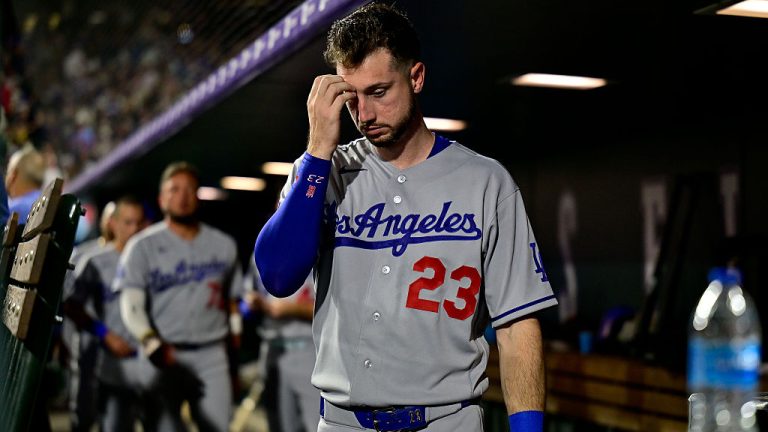
Watching the champs go down is always a bit jarring. Watching this iteration of the Los Angeles Dodgers get swept out of the postseason on their home field? That was something nobody had on their bingo card. The Dodgers, the team supposedly ruining baseball by buying all the championships, were unceremoniously disposed of by the Milwaukee Brewers. A team spending roughly $270 million less on its roster swept the two-time defending champions. And the most remarkable part? Milwaukee didn’t even play its best baseball.
Presumptive Cy Young winner Jacob Misiorowski failed to make it through five innings in Game 1. Game 2 starter Logan Henderson committed multiple throwing errors. In Game 3, it wasn’t Jackson Chourio, Brice Turang, William Contreras, or Christian Yelich delivering the decisive blows. It was Jake Bauers and Garrett Mitchell going back-to-back as two left-handed hitters against two-time Cy Young winner Blake Snell.
Even in Game 4, when Milwaukee was forced to piece together a bullpen game, the Dodgers appeared poised to extend the series. Los Angeles jumped out to a 4-0 lead behind a three-run homer from Shohei Ohtani, but Milwaukee clawed its way back to tie the game by the fifth inning. From there, JoJo Romero and Aaron Ashby slammed the door, combining for five innings of three-hit, six-strikeout baseball without issuing a walk. Mitchell delivered the go-ahead home run in the eighth, and David Hamilton provided insurance in the ninth to complete the sweep.
Narratively, this was David slaying Goliath. But make no mistake: Milwaukee was the better team and thoroughly dominated this series. This is a Brewers team that has won more regular-season games than anyone in baseball in consecutive seasons, with an impressive collection of stars playing at the peak of their abilities. They didn’t need everything to go right to beat Los Angeles. They were simply good enough to overcome their own mistakes and still win convincingly.
For the Dodgers, falling short of a third consecutive championship is undoubtedly disappointing. But there is no shame in losing to this Milwaukee team, and one postseason series is hardly an indictment of the 2026 Dodgers. The cruelty of October is that even the most talented teams are only a handful of bad games away from elimination.
What this defeat does demand, however, is a long, sobering look in the mirror for an organization that spent the better part of three years with its foot pressed firmly against the accelerator, chasing a place in baseball history.
The Cost of Chasing History
In an era when teams have increasingly made decisions motivated as much by financial considerations as by on-field performance, there is something commendable about the Dodgers pushing all their chips in year after year. They have never been shy about using their considerable resources to pursue championships, and that ambition has been rewarded with two consecutive World Series titles. But chasing history has a cost. And the Dodgers team that looked capable of steamrolling the rest of baseball in 2024 is not the same one entering 2027.
In 2024, a hitter-only Shohei Ohtani produced a season unlike anything baseball had ever seen, becoming the first player to join the 50-50 club. The Dodgers survived an elimination scare against San Diego in the NLDS, dispatched the Mets in six games in the NLCS, and then handled the Yankees in a World Series that featured several close games but ultimately demonstrated the gap in quality between the two rosters. Los Angeles was loaded with talent, and for much of that October, it felt inevitable that the Dodgers would finish the job.
In 2025, the addition of Blake Snell to the rotation, along with Ohtani’s return to the mound, made an already formidable roster even more intimidating. Los Angeles marched through the National League, but Toronto pushed the defending champions to the absolute brink. The Blue Jays were one strike away from winning the World Series before Miguel Rojas delivered one of the most improbable home runs in baseball history. An otherworldly performance from Yoshinobu Yamamoto, who somehow found another 2 2/3 scoreless innings on zero days’ rest in Game 7, ultimately got the Dodgers across the finish line. But the roster that once felt invincible was suddenly showing signs of mortality. For all the talent assembled in Los Angeles, the difference between immortality and an offseason spent wondering what went wrong had been razor-thin.
The Dodgers entered 2026 determined to stave off any regression, signing the most coveted free-agent bat on the market in Kyle Tucker at an average annual value of roughly $60 million. To put it kindly, he did not live up to expectations. Ohtani remained a premium offensive player, but his production dipped from otherworldly to merely very good, and a lingering knee injury ultimately shut him down as a pitcher. Will Smith missed a significant portion of the season, while Freddie Freeman and Mookie Betts, despite remaining productive players, are clearly at a different stage of their careers. The expectation can no longer be that those two will carry a lineup for 162 games. Andy Pages enjoyed a terrific campaign, helping offset Tucker’s underwhelming production, but the Dodgers were increasingly reliant on contributions from players who hadn’t been central to their championship formula two years earlier.
Even with Yoshinobu Yamamoto and Blake Snell, two pitchers most teams would comfortably call their ace, the Dodgers went out and acquired Tarik Skubal at the trade deadline. In exchange for a few months of one of the best pitchers on the planet, Los Angeles surrendered two Top 100 prospects according to our rankings at Just Baseball: Zyhir Hope (No. 30) and River Ryan (No. 51), along with Brady Smith. Acquiring even one prospect of that caliber for a rental would constitute an exceptional return. Getting two is almost unheard of.
But how many people wearing Dodger blue really care about swapping prospects for a chance to make history? Isn’t that the entire point? To push the chips into the middle of the table and give this extraordinary collection of players every opportunity to cement its legacy? The Dodgers were attempting to become the first team since the 1998-2000 Yankees to win three consecutive World Series titles. Opportunities like that don’t come around often, and no one can or should fault Andrew Friedman for taking an extraordinary swing at an extraordinary achievement.
The free-agent decisions, however, are a different matter. Trading prospects for Skubal was an aggressive but defensible decision with a clear objective. Committing enormous sums of money to players who fail to live up to expectations can carry consequences that extend far beyond one October. For years, bad contracts were little more than a line item for the Dodgers, a cost of doing business for an organization with seemingly limitless financial flexibility. But with baseball approaching an uncertain economic future, some of those decisions could become considerably more expensive than Los Angeles ever anticipated.
The Bill Comes Due
Whatever baseball’s financial landscape looks like in 2027, the Dodgers are entering uncharted territory. The current collective bargaining agreement expires in December, and while it remains unclear whether a new agreement will force teams like Los Angeles to shed payroll, it’s difficult to envision the Dodgers continuing to shop at the top of the free-agent market with the same reckless abandon. The organization has leveraged contract deferrals more aggressively than anyone in baseball, while also benefiting from one of the most favorable local television revenue arrangements in the sport.
Both of those advantages could come under scrutiny as MLB and the MLBPA negotiate the next economic framework. The first payments from the Dodgers’ current collection of deferred contracts begin in 2028, when Freddie Freeman receives $4 million. Financially, the Dodgers are already committed to the roster they’ve constructed, and the possibility of operating under an entirely different set of economic rules makes those commitments all the more consequential.
The impending free-agent class is relatively light on premium talent at the very top, outside of Tarik Skubal, whose potential departure presents the Dodgers with their first major offseason decision. Having surrendered an extraordinary package of prospects to acquire him, Los Angeles must now determine whether retaining him is financially viable. But even if Skubal departs, the Dodgers still possess one of the best rotations in baseball. Yoshinobu Yamamoto and Blake Snell remain frontline starters, Tyler Glasnow is still an immensely talented arm, and the organization has internal reinforcements to be excited about. Christian Zazueta, our No. 41 prospect at Just Baseball, is one of several young pitchers who could contribute in the coming years.
Despite the sting of falling short of the three-peat, there is little reason to believe the Dodgers won’t once again be among the National League’s best teams and legitimate World Series contenders in 2027. The pitching should be excellent. The larger concern is a lineup featuring an awful lot of familiar names that might not pack quite the same punch they once did.
A healthy campaign from Will Smith would do wonders for this team, both stabilizing the catching situation and providing a much-needed presence in the middle of the order. Freddie Freeman and Mookie Betts aren’t the same players they were when the Dodgers first hoisted the trophy in 2024, but they’re future Hall of Famers who remain more than worthy of everyday lineup spots. Max Muncy continues to produce at a well-above-average clip, and Andy Pages has established himself as a critical piece of the next iteration of this offense.
The most concerning part of the lineup is the lack of production from the corner outfield positions, particularly given the amount of money Los Angeles has committed to them.
Kyle Tucker was serviceable during the NLCS, but for large stretches of the regular season, he looked like a shell of his former self. This was his age-29 season, a point in a player’s career when the expectation should be that he’s at or near his peak. Instead, Tucker produced the worst full season of his career. His offensive production cratered, he struggled defensively, and some of the underlying batted-ball and bat-speed indicators suggest his struggles weren’t simply a product of bad luck.
Baseball is a fickle game, and there’s every possibility that Tucker rebounds in 2027. A season worth less than one win above replacement is unlikely to be his new normal. But the days of Tucker threatening a 30-30 season while pushing five or more wins above replacement might be behind him. That’s a troubling possibility for a player the Dodgers just committed $240 million to, particularly with opt-outs following the 2027 and 2028 seasons. If Tucker returns to form, he can explore the market again. If he doesn’t, Los Angeles remains on the hook for an enormous financial commitment. For a franchise that could soon have significantly less financial wiggle room, that distinction matters.
Teoscar Hernández also endured a pedestrian season by his standards, and his days as an everyday fixture in the Dodgers outfield may be numbered. The most obvious candidate to replace him is Josue De Paula, who flashed brilliance in his brief introduction to the majors. De Paula is one of the most exciting young hitters in baseball and offers Los Angeles something it desperately needs: premium upside at a fraction of the cost of its established stars.
Dalton Rushing provides another avenue for injecting youth into the roster. For all the mercurial moments and growing pains early in his career, Rushing offers a level of offensive depth that few teams enjoy. He can spell Smith behind the plate, provide a viable bat at designated hitter, and potentially offer additional positional flexibility when needed. His ability to contribute in multiple roles becomes particularly valuable for a roster that has been hampered by injuries and increasingly dependent on aging stars.
Ohtani certainly wasn’t at his best during the 2026 postseason, but a lineup that costs this much money should not be reliant on one player to carry the offense, even if that player happens to be the greatest baseball player most of us have ever seen.
Beyond De Paula and Rushing, the Dodgers have another wave of talent approaching the majors. Outfielders Eduardo Quintero and Mike Sirota, ranked No. 14 and No. 19, respectively, on our Top 100 at Just Baseball, have established themselves among the best prospects in the sport. Both enjoyed impressive campaigns in the upper minors and could factor into the Dodgers’ outfield plans over the next several seasons.
For most of the last decade, being a highly regarded Dodgers prospect has often meant waiting to find out which organization would eventually give you a chance to crack a big-league lineup. Los Angeles could afford to treat prospect capital as currency, exchanging tomorrow’s potential for today’s established stars without worrying too much about the long-term consequences.
That calculus may have to change.
In a new financial landscape, the Dodgers might find that retaining and developing cost-controlled talent is a more prudent avenue than perpetually sacrificing it for established veterans. This doesn’t mean abandoning their commitment to winning. It means recognizing that the formula that made them the envy of baseball might need to evolve.
Let’s be clear: the Dodgers are going to be just fine. This is still a roster loaded with extraordinary talent, backed by an organization that has demonstrated an unmatched ability to identify, acquire, and develop players. They are going to be excellent again in 2027, and it would surprise absolutely no one if they found themselves playing deep into October.
But for the first time in nearly a decade, the Dodgers are entering an offseason with major questions about their roster that don’t have an immediate solution. The aging core, the massive financial commitments, the uncertainty surrounding baseball’s next collective bargaining agreement, and the growing importance of their young talent all point toward a franchise approaching an inflection point.
For years, the Dodgers’ answer to almost every problem was to go out and acquire another superstar. They built one of the greatest collections of talent baseball has ever seen, won consecutive championships, and came within four victories of returning to the World Series for a third straight season.
The question now is whether the Dodgers can sustain their dominance in a world where simply writing another check may no longer be the answer.
Become a Member of Just Baseball
Subscribe and upgrade to go ad-free!
* Save 25% by subscribing annually.

Written by