
Biggest Whiffs at the MLB Trade Deadline
It's clear that some organizations fared much better than others at the 2026 trade deadline, but these teams are likely regretting their trades, or lack thereof.
A few weeks have gone by since the MLB trade deadline shook up the rosters of most teams and helped them decide whether to be buyers or sellers as the postseason approaches. Every year, we see some teams go big and make blockbuster deals to shake up their rosters, but we also often see teams fare out poorly.
While some teams fared very well at the deadline and bolstered their rosters with bona fide major-league talent, others traded away star players to add notable young prospects. However, not all teams emerged from this year’s deadline much better than they were when they entered it.
This isn’t to say that the teams listed in this article were intentionally not helping their team succeed post-deadline, but rather to say that their efforts simply didn’t work out as well as they had hoped. A combination of not selling off expiring contracts, acquiring players underperforming, and not addressing key needs led these teams to have a less-than-ideal deadline haul.
There’s still plenty of time left in the season, but for now it appears as though these organizations undersold themselves on baseball’s best opportunity for teams to improve their rosters.
The Reds Should’ve Sold Harder
The Reds had a confusing deadline, as they entered with a 53-58 record and some of the best trade candidates in catcher Tyler Stephenson and outfielder JJ Bleday. Stephenson entered the deadline with a .752 OPS and some of the best catching defense in baseball. With teams like the Rays, Yankees, and Red Sox clambering for catching options, the Reds stayed put and didn’t move Stephenson which is especially confusing when the Yankees ended up without adding a starting catcher.
Bleday had 19 home runs, 46 RBI, and a .805 OPS in a career-year but the Reds ended up holding onto him as well instead of cashing in on his value. He has two more arbitration-eligible years after the 2026 season but the Reds don’t seem to be on the verge of turning themselves into a playoff team in the immediate future, especially now that their ace Hunter Greene underwent his second Tommy John surgery.
While Cincinnati did sell off veterans Nathaniel Lowe and Caleb Ferguson, both of whom were signed to one-year deals prior to the season, but they simply should’ve done much more than they ended up settling for. Finding a trade partner for Stephenson and moving on from Bleday in the midst of what is essentially a lost season should’ve taken more priority.
The Angels Should’ve Dealt Reid Detmers
The Angels had an interesting deadline where they sold off many pitchers from their bullpen and rotation as well as core parts of their lineup in Jo Adell and Logan O’Hoppe. Their ace José Soriano was a surprising trade candidate as he still had two more years of team control left before hitting free agency, yet the Angels still sought fit to send him to the Toronto Blue Jays, a seller at this year’s deadline.
The more confusing aspect of the Soriano trade was the Angels’ simultaneous refusal to trade Reid Detmers. Detmers has been one of the best breakout pitchers in baseball this year and entered the deadline with a 4.03 ERA, 3.33 FIP, and 145 strikeouts across 125 innings in which he only allowed 99 hits. He was one of the most coveted pitchers at the deadline and the Angels could’ve got a sizeable trade package for him.
While the Angels have historically refused to trade off aging star players, this year they traded Soriano for a very strong return from the Blue Jays yet didn’t do the same with Detmers. Getting Arjun Nimmala from the Blue Jays and Moisés Ballesteros from the Cubs are solid additions for the Angels and they’re building a very nice pool of young players.
They did a good job selling off their solid relievers and veteran hitters but they didn’t quite hit a home run this deadline by continuing to hold onto Detmers. They don’t seem to be competitive in the immediate future and they should’ve committed more to a full rebuild.
The Mariners Easily Could’ve Traded Another Starter
The Seattle Mariners had a bit of a confusing deadline, selling off starting pitcher Luis Castillo but bringing in outfielders Taylor Ward and Nolan Jones as well as reliever Seranthony Dominguez alongside an outstanding young hitter in Boston Smith.
The Mariners are multiple games out of a Wild Card spot and Ward is a free agent after the season, and it seems as though Seattle couldn’t decide whether they were a buyer or seller at the deadline. The names Seattle added are certainly very appealing and they improved their offense by adding Ward, but one can’t help but wonder why they didn’t move on from another starter.
Seattle has incredible pitching depth in their minor-league system as well as an excess of options at the MLB level. This makes it somewhat baffling that they only chose to move on from Castillo and not Emerson Hancock or even George Kirby, as Hancock was widely regarded as being on his way out of Seattle. With the presences of uber-prospects Ryan Sloan and Kade Anderson in the minors, the Mariners easily could’ve cashed in on Kirby or Hancock and had an in-house replacement already available.
Similarly to the Angels holding onto Detmers, Seattle stood pat with this duo, and is now 3-8 in their first 11 games post-deadline.
This indecision might lead them further out of the playoff picture than they wanted to be. Both Hancock and Kirby are talented young pitchers, but the Mariners really could’ve used more of a boost to their .685 team OPS.
The Rockies Had So Many More Premier Trade Chips
The Rockies had a bit of an up-and-down deadline, selling off several parts of their MLB roster while keeping some others that could’ve netted them some very nice return packages. Starting with the players they traded, they moved on from Antonio Senzatela in the midst of his first good season in half a decade, Brenton Doyle as he’s been very ineffective at the plate, and a couple of solid relievers for player packages in return.
The issues with the Rockies’ deadline don’t stem from who they traded but rather from who they didn’t trade. Hunter Goodman was poised to be easily the best catcher on the trade block this year as he’s challenging the game’s best hitters for the home run title. Goodman entered the deadline with 33 home runs, 65 RBI, and a 125 wRC+, and it’s more than certain that teams would’ve paid a high price to add him to their lineups.
Other players like Jake McCarthy and Mickey Moniak weren’t traded during their career-best seasons this year, but Moniak signed a two-year, $16.25 million extension with the Rockies post-deadline and McCarthy still has multiple years of team control remaining. Perhaps this group is going to be the the Rockies’ core over the coming seasons and they’re not ready to move on just yet?
Colorado hasn’t made the playoffs since 2018 and they need all the talent they can get their hands on, so maybe this will end up working out for them. However, it’s hard not to see it at the moment as a missed opportunity to earn themselves some of the game’s top prospects.
The Red Sox Swapping Early for Mead Was a Massive Whiff
The Boston Red Sox were very active at the deadline this year, acquiring catcher Adley Rutschman, reliever Erik Miller, and breakout infielder Curtis Mead, just to name a few. The Red Sox didn’t necessarily have a bad deadline per se, but one of these moves in particular has not worked out nearly as well as they would’ve liked.
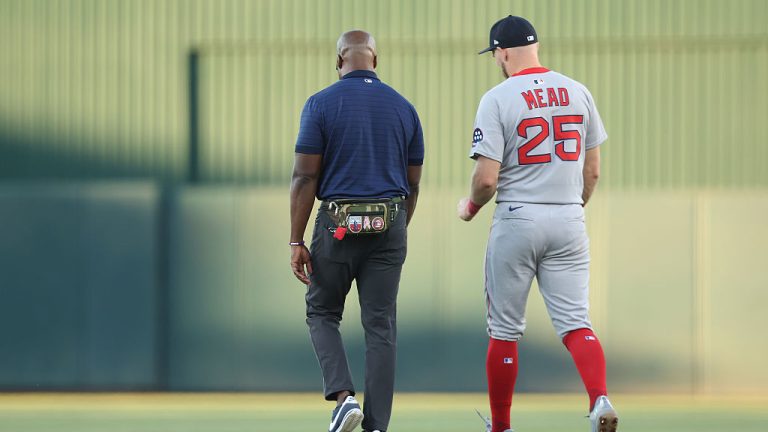
Shortly prior to the August 3rd deadline, the Red Sox swapped young controllable starter Connelly Early with infielder Mead from the Washington Nationals and it had the potential to be a win-win trade. With Washington building towards future seasons and the Red Sox needing a boost to their lineup, Mead’s 134 wRC+ seemed like a perfect solution.
However, Mead was hit by a pitch in his hand during his Red Sox debut and has been out on the IL with a fracture in his left wrist. Obviously this isn’t anything that Boston could’ve controlled or foreseen, but it’s still unfortunately looming over the rest of their trade deadline moves.
Boston certainly made themselves better at the deadline as they look to push for the playoffs, but there’s a good amount of buyer’s remorse since Mead’s not healthy at the moment.
How Did the Diamondbacks Come Away Without a Starter?
The Arizona Diamondbacks had one of the most disappointing deadline performances in the league because they didn’t address their key need for starting pitching help and, in fact, they hardly did anything at all despite being in trade deadline purgatory. The lone move on Arizona’s ledger from this year’s deadline was acquiring outfielder Lars Nootbaar from the Cardinals in exchange for two Double-A-calibre pitchers.
Nootbaar had three home runs, 16 RBI, and a .234/.333/.354 slashline prior to being traded, and he has one more year of arbitration eligibility remaining. After being a hitter at or above the league average for his entire career leading up to 2026, this has been a very down year for him, but hopefully he’ll provide another spark from the left-handed batter’s box for the Diamondbacks. That being said, Arizona still missed out on improving the part of their team that needed the most work: their rotation.
A cumulative 4.29 ERA from their starters heading into the deadline ranked 15th in MLB and their 4.72 FIP ranked 27th. The Diamondbacks chose not to improve this area through the trade market but rather through calling up prospects like Mitch Bratt and Kohl Drake to fill in the gaps. As of August 16th, the Diamondbacks are tied for a wild-card spot, and they’ll need every bit of help they can get from their current squad to stay there.
Become a Member of Just Baseball
Subscribe and upgrade to go ad-free!
* Save 25% by subscribing annually.

Written by
Ethan has been writing for Just Baseball since 2024 and is fascinated by how sabermetric statistics can assist our understanding of outcomes and probability in baseball.…