
Nationals Notebook: Game Recap, Williams and Irvin Returning
In a pivotal contest for the team's playoff hopes, the Nationals lost to the Blue Jays on Wednesday afternoon.
WASHINGTON, D.C. — The Washington Nationals entered Wednesday afternoon’s rubber match with the Toronto Blue Jays just one game back of the final National League wild card spot. In a pivotal contest for the team’s playoff hopes, the Nationals lost, 5-2.
Outfielder Jacob Young got the scoring started for Washington, lacing an RBI double in the fourth inning. The Blue Jays scratched across runs in the sixth and seventh innings, but the big blow for the Nationals came in the eighth.
Against reliever Paxton Schultz, Toronto collected four hits – two of which went for extra bases – to give their bullpen some run support. The big blow was a 73.8-mph double by Kazuma Okamoto that a diving Young barely couldn’t get to, which gave the Blue Jays a 4-1 lead.
“You feel like he [Young] gets that ball nine out of ten times,” Nationals manager Blake Butera said postgame. “Just a perfectly placed ball…it felt like we were just out of reach on a couple of big plays.”
Okamoto would come around to score on a George Springer RBI single, which gave Toronto a four-run lead. The Nationals didn’t go down quietly, despite the deficit at hand.
In the bottom half of the inning, Washington’s first three batters reached base, pushing across a run against reliever Tyler Rogers. To attempt to secure the win, Toronto turned to their closer, Louis Varland, for a six-out save. Varland shut down the rally and stranded the bases loaded in the eighth, then closed it out in the ninth.
Though the Nationals were only able to score two runs in the game, their manager felt good about his lineup’s showing against some of the Blue Jays’ best arms.
“We had some opportunities, but [Blue Jays starter Trey] Yesavage is really good. I was actually really impressed with our at-bats off Rogers there and even Varland a little bit, too,” Butera recalled.
Washington (55-54) can’t dwell on this loss for long, as they travel to Atlanta for a four-game set this weekend against their division rival, the Braves (63-45). A series win in Atlanta would do wonders for the Nationals’ dwindling playoff chances.
Recapping Zack Littell’s Start
Zack Littell (7-8) hasn’t been a particularly effective starter for the Nationals this season, but he’s covered some important innings. He’d posted just a 5.17 ERA and 15.2% strikeout rate entering Wednesday’s game, but had also allowed more than one run in just one of four starts this month.
In Wednesday’s game, Littell threw 4.2 scoreless innings. The veteran struck out two batters, walked three, and allowed four hits. It wasn’t a remarkable showing, but like many recent outings, it kept the Nats competitive.
“I thought Littell threw the ball great; he did everything we asked him to,” Butera said.
Littell has tinkered with his arsenal of late to figure out what works best, and his manager was encouraged by what he saw Wednesday.
“I thought landing the split more often and throwing it more often is really good for him,” Butera explained. “When he’s able to land that pitch for strikes and even just show hitters that he’ll throw it pretty often, it keeps them off-balanced, and they have to respect that pitch, and that allows the fastball to play up.”
None of Littell’s offerings currently rate as above-average per Stuff+, but the splitter is his best-rated pitch, at 90. At its peak, Littell’s splitter earned a 118 Stuff+ in both 2021 and 2023.
“I think what we saw here today, when he has success, it’s going to work for him,” Butera said. “If we notice that teams are starting to make adjustments and maybe sitting on that pitch more, we’ll adjust off of that. But it’s a game of adjustments throughout this long season.”
Littell aims to continue putting up zeros in his next start, projected for Monday in Philadelphia.
Williams, Irvin Returning From Injured List
The Nationals will regain some arms from injury this week, as Trevor Williams and Jake Irvin are ready to return to major league mounds.
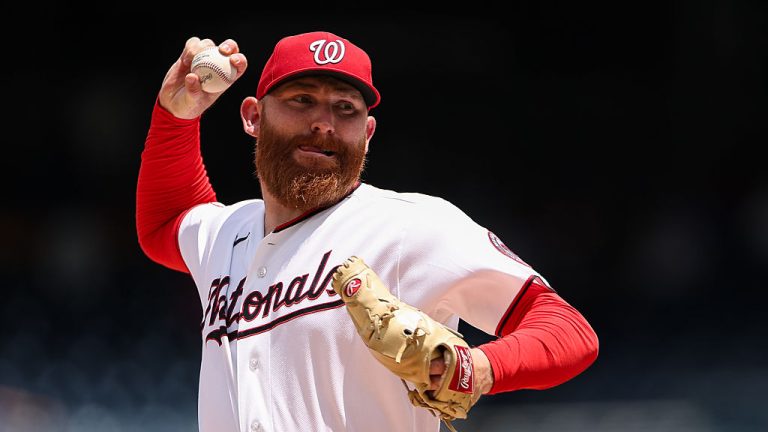
Williams, 34, made his season debut on Wednesday after recovering from an internal brace procedure that took place in July of 2025. Despite his fastball topping out at just 90.8 mph, the veteran right-hander threw a scoreless inning and a third out of the bullpen.
“He kept us in the game,” Butera explained. “Obviously, it had been a long road for him just to get back to this point. So one, just to get on the mound and do it healthy is one thing, but two, to have the success that he had today was huge.”
Williams is likely to function as a reliever for now, though he could be a candidate to start at some point.
“Hopefully it gives him some confidence that he’s back and he’s as good as he was before,” Butera said.
Irvin, 29, made 33 starts for Washington in both 2024 and 2025, but has been sidelined since late May due to a shoulder strain. The right-hander completed three rehab starts and will rejoin the team in Atlanta to start Thursday’s series opener.
“We know what we’re getting, which is a pretty good starting pitcher,” Butera remarked. “It allows us to bolster the rotation of course, but also the domino effect of strengthening the bullpen more because we’re getting a really good pitcher.”
The only thing Butera warned of was not to expect Irvin to return to a full starter’s workload immediately.
“I think he went 63, 65 [pitches] his last time out, so we’re not going to push him and immediately go 100,” Butera said. “We’ll be responsible with his pitch count, while also paying attention to how he looks, how he feels, and making our decision based off that.”
Though he’s struggled to an ERA of 5.23 this season, Irvin’s 25.4% strikeout rate is well above the major league average. If he could cut down on his 9.6% walk rate, Irvin is a candidate to improve down the stretch.
Become a Member of Just Baseball
Subscribe and upgrade to go ad-free!
* Save 25% by subscribing annually.

Written by
Daniel Rotter follows the game of baseball with passion. He was the youngest participant in the inaugural year of The Great Fantasy Baseball Invitational, at 17…