
St. Louis Cardinals 2026 MLB Draft Analysis: Day 1
The St. Louis Cardinals came into the draft well prepared to make a splash. How did they do on Day 1?
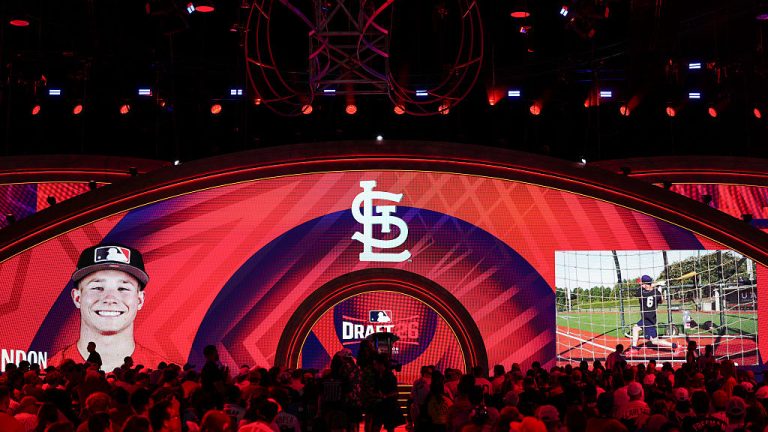
The St. Louis Cardinals entered the 2026 MLB Draft armed with an astounding 23 total draft picks, providing themselves with a golden opportunity to continue adding to their ever-improving farm system.
No organization owned more selections, and St. Louis used its seven Day 1 picks on a variety of high-upside prep hitters, polished college hitters, and high-rising fastball pitchers. The organization shifted its emphasis toward the latter on Day 2, using 10 of its final 16 selections on college arms.
By the end of the weekend, their draft class contained a compelling mix of high-upside prep bats, advanced college hitters, and college pitchers whose fastball traits will serve as a solid foundation of a more complete arsenal. Let’s take a look at each selection and see what makes them special.
13. Trevor Condon, OF | Etowah High School
Zach Mortimer and his staff kicked things off with one of the loudest upside selections available at pick 13, selecting high school outfielder Trevor Condon.
Condon’s appeal begins with premium athleticism. His 96th-percentile sprint speed on the 2025 summer high school circuit gives him a legitimate chance to patrol center field as a big leaguer, while his 81st-percentile bat speed creates room for considerably more offensive impact.
His swing decisions and contact results were above average against high-end prep competition but are far from elite. He ranked in the 63rd percentile in zone contact and the 66th percentile in chase rate on the summer circuit. Condon’s approach will be his biggest kryptonite as a professional, but I’m betting on his eventual power to buoy his offensive output should he slump.
The largest swing factor (pun intended) surrounding Condon’s future development is how consistently he can turn his bat speed into damage.
His 14th-percentile air-pull rate shows a glaring weakness to do damage toward a shorter field, and for a guy who presently doesn’t hit for a ton of power, this is a ruby-red flag, especially if he doesn’t grow into the kind of power the Cardinals are banking on.
Trevor has the speed to be a pest on the bases, the range to handle an up-the-middle defensive position, and enough bat speed and rotational athleticism to become more than a defense-first center fielder. Even if the bat doesn’t develop as hoped, his athleticism and defense provide a higher floor.
This is the type of pick a system with six top-100 selections can afford to make. St. Louis could target a high-variance prep bat because it had so many picks behind him. If Condon’s hit tool progresses and the raw power begins translating in games, Condon has a chance to become one of the defining players of the class 10 years from now.
32. Tegan Kuhns, RHP | University of Tennessee
After selecting two Tennessee power arms with their first three selections last year, the Cardinals found themselves back at the Knoxville well, this time selecting draft-eligible sophomore Tegan Kuhns.
Any conversation about the Gettysburg native starts with his elite fastball. He’ll sit 94-95 mph, has touched 99, and generates approximately 19 inches of induced vertical break from a 5.5-foot vertical release point. That combination gives the pitch an extremely flat approach angle and allows it to play better than a traditional mid-90s heater.
Kuhns also commands the pitch exceptionally well. Overall, it’s an offering that already projects as a legitimate weapon at the next level.
The rest of the arsenal leaves plenty to be desired. Kuhns throws a high-70s curveball with -10 inches of induced vertical break, an 83–84 mph slider with a bullet or gyro shape, and an 83–84 mph changeup that creates approximately 11 inches of vertical separation from the fastball.
His breakers are not thrown hard enough and remain works in progress. The bender is about three mph away from being a legitimate power curve, and the gyro is about two ticks away from being an MLB-caliber bullet slider.
The appeal here is that Kuhns weighs just 190 pounds despite carrying a 6-foot-3 frame, so with added weight will inevitably come velocity that will trickle down to the curveball and slider.
His changeup is arguably his best secondary from a pure stuff perspective, generating plenty of vertical, horizontal, and velocity offset from the fastball, but it’s by far the pitch he least throws for strikes.
That contrast defines the pick. Kuhns has a strong foundation with his fastball, but his long-term role squarely depends on how much velocity he can squeeze out of the breakers, and if he can refine his offspeed command.
The encouraging part is that he already demonstrates outstanding fastball command. It’s arguably the most MLB-ready offering of any arm in the draft, as demonstrated by an overall 4.7% walk rate. This solves 55-60% of the problem, so he can focus his efforts on improving the shape and execution of breaking balls and the changeup.
Like Liam Doyle and Tanner Franklin before him, I wouldn’t be at all surprised to see the Cardinals challenge Kuhns by heavily curtailing his four-seam fastball usage in 2027. He threw the pitch 57% of the time at Knoxville this past spring, and I could see them axing this into the high-40s, intentionally exaggerating the secondary usage.
Tegan is best viewed as a highly appealing, half-baked piece of clay. His fastball gives him immediate bat-missing potential, and if one or two of his secondaries emerge as reliable weapons, he has a chance to remain a starter. If they do not, the fastball and breaking balls could still give him a role as a high-leverage reliever.
50. Rocco Maniscalco, SS | Oxford High School
As if having a record 23 picks (since 2021) wasn’t enough, the Cardinals decided to once again etch their names into the record books by selecting Rocco Maniscalco, who is the youngest MLB Draft selection ever at just 17.2 years old.
The Oxford native is one of the highest-upside players in the entire class, and his age creates important context for our evaluation. Maniscalco is already regarded as one of the better defensive prep shortstops in the class despite being younger than his peers. A great athlete, he’ll have every opportunity to remain up the middle.
Maniscalco possesses plenty of projectable raw power and enough rotational acceleration. We saw that at the Draft Combine, where he uncorked a 109 mph maximum exit velocity, a figure that stands out for such a young player and suggests he’ll eventually settle in at above-average MLB raw juice at peak physical maturity,
His 2025 summer circuit results show why patience will be required. Rocco ranked in the 38th percentile in zone-contact rate, the 48th percentile in chase rate, and the 42nd percentile in air-pull rate. None of those marks jump off the page, but they also reflect a player who was/is still early in his physical and offensive development.
Still, some scouts question whether he’ll ever make enough contact to unlock the newfound power.
That being said, Maniscalco does not need to become an elite hitter to accrue WAR. If he sticks at short and develops even an average offensive profile, his glove can carry much of the overall package. The upside becomes considerably greater if the bat-to-ball skills improve and the 109 mph maximum exit velocity develops into consistent game power.
St. Louis is going all in on a young shortstop with defensive certainty and physical projection. His timeline may be lengthy, but few players in the class offer as much growth potential.
68. Andrew Williamson, OF | University of Central Florida
St. Louis went tools-heavy with the first hitter selections, but flipped the switch with an old-school masher at 68 in Andrew Williamson.
The UCF outfielder was one of the most productive hitters in this group with a 168 wRC+ in his junior campaign in Orlando, and his underlying power data supports the results. Williamson recorded an eye-watering 109 mph EV90 and a 119 mph maximum exit velocity, both of which are well above the Division I average.
He consistently produces quality contact and has top-end raw power that will seamlessly translate to the professional ranks. Andrew also had a 60% line-drive-plus-pull rate, so a good portion of that hard contact was efficiently directed in the air toward a shorter right field.
The bat-to-ball rates hovered at a respectable 85.8%, which gives him a solid balance between bat-to-ball ability and impact.
Williamson’s primary weakness is his swing decisions. He fished at 23.9% of pitches outside the zone, well below the Division I average. He’s not doing so at a detrimental clip like, say, Peyton Bonds, but it is the clearest area of improvement at the dish.
Even with a longer lever, he’s still not making enough contact out of the zone (54.5%) to justify him nipping at pitches in the shadow zone and beyond.
Defensively, the profile is less exciting. Even though he was UCF’s anchor in the outfield, his range and jump in center are fringy at best. A lack of athleticism doesn’t help much either, and it only increases the odds he slides over to a corner at some point. He may get some run in center field in his early minor league days, but he won’t be the best outfield glove on his team if/when he gets to the high minors, let alone the big leagues.
The Cardinals are getting a guy with a solid blend of power and contact. If his swing decisions tighten up, he has a chance to become one of the better offensive players in this draft class.
72. Dawson Montesa, RHP | West Virginia University
Earlier this month, I wrote an article discussing how the Cardinals’ 2025 pitching draft strategy could tell us what they may do this go-around. A common theme was high-octane, flat-vert heaters that can be thrown for strikes. Tegan Kuhns fit that mold earlier, and so does Dawson Montesa.
The former Division II standout at Adelphi University made quite the leap, being a force in a rotation that made its first appearance at Omaha in program history.
Montesa’s fastball is his signature pitch, sitting 94-95 mph, touching 98, and producing about 17 inches of induced vertical break from a 5.6-foot release point. It has a relatively flat approach and gives him a solid primary pitch. He throws it in the zone an effective 54% of the time, so command here isn’t an issue.
The secondary pitches are where the profile becomes less intriguing. Montesa throws a high-70s curveball with significant depth, an 84-85 mph slider with more of a sweepier shape, and an 87-88 mph changeup that creates about 12 inches of vertical separation from the fastball. From a movement standpoint, the arsenal has real variety, and with added weight (he’s only 155 pounds), his breakers will only improve with more velocity.
Montesa’s main problem is that he does not throw the curveball, slider, or changeup for strikes often enough. Hitters can start eliminating pitches when they know those offerings are unlikely to land in the zone. That places too much pressure on the fastball and makes the entire repertoire easier to sit on.
All told, there is a starter’s bag here. He has four distinct pitches and enough velocity to make the package work. But that only matters if he can consistently place them where hitters have to respect them.
If the command improves, Montesa could take a significant step forward. If it does not, the Cardinals may eventually need to simplify the mix and focus on building a fastball/slider-oriented bullpen option.
86. Caden Ferraro, OF/DH | Texas Tech University
Plain and simple: This dude absolutely rakes.
Caden Ferraro might be the best pure hitter in the draft class. The Texas Tech product posted a 143 wRC+ while showing no obvious weakness at the plate. His 92.3% zone-contact rate is elite, especially when paired with an 110 mph EV90 and 115 mph maximum exit velocity.
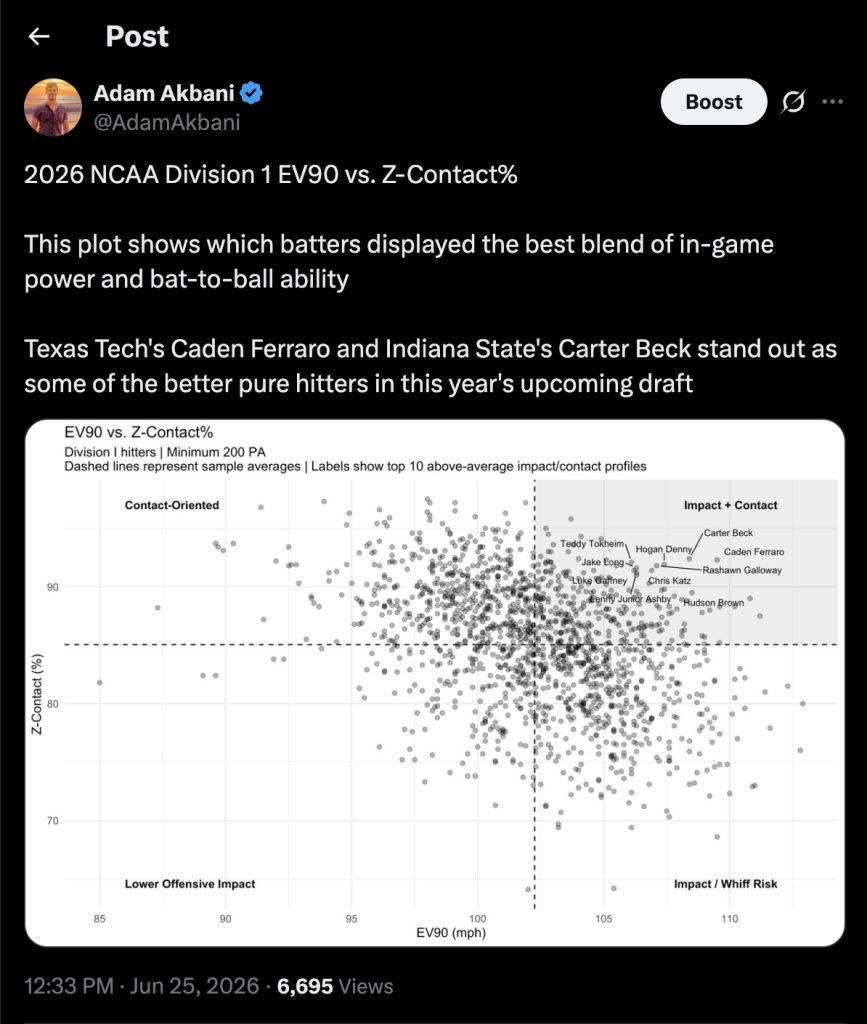
His swing decisions were just as impressive. Ferraro chased only 20% of pitches outside the zone, which gives him a clean offensive profile. He recognizes pitches, attacks strikes, and makes loud contact pull-side in the air when he connects. There is not much more a team can ask for from a college hitter as far as peripheral data goes.
His 53.7% line-drive-plus-pull rate was also solid. He is not completely selling out to yank the ball in the air, and that may be part of what allows the bat-to-ball skills to remain strong.
The obvious limitation is defense. Ferraro is not a standout athlete and is essentially positionless as a result. He’ll get run at at the corner spots in his early days as a professional, but it’s unlikely he adds much value with the glove in MLB. He may eventually end up at first base or designated hitter, which puts a lot of pressure on the bat to excel.
That is usually a difficult profile because there is very little margin for error. A hitter at the bottom of the defensive spectrum cannot survive with an average offensive game. It’s a large part of why such a prolific hitter slid this far down in the draft. Ferraro, however, is one of the few exceptions to this rule; he has that sort of offensive foundation.
Ferraro represents one of the safer picks made by the Cardinals. He’s my pick to make the big leagues before anyone in this draft since he’s such an advanced hitter. Even with the defensive/athletic limitations, it wouldn’t be surprising to see him turn into a star.
114. Dee Kennedy, SS | Kansas State University
Dee Kennedy is someone I’ve been high on for months. He does not have the same contact quality or power as some of the other names selected above him, but he may have some of the best swing decisions and glovework in the class.
The Kansas State shortstop posted a 154 wRC+ and chased only 16.5% of pitches outside the zone, making for one of the best sets of eyes in Division I. Kennedy does not help pitchers by giving them many free strikes, helping him work into better counts and force opposing arms to throw him something to hit in the zone.
His batted-ball direction was also a major strength. Kennedy posted a 63.4% line-drive-plus-pull rate, showing that he made the most of the contact he did produce. He may not hit the ball as hard as some of the other players in the class, but he optimizes toward a shorter field.
The concerns are easy to identify. His 79.8% overall zone-contact rate is fringy at best, and he struggled against premium velocity, with just an 81.1% zone-contact percentage against pitches 94+ mph.
Dee’s 106 mph EV90 with a 109 mph maximum exit velocity also points to only modest power. That being said, even without top-end exit velocities, he’s such a prolific rotational athlete that he still gets to what he does have in the tank quite often.
All things considered, there’s a non-insignificant number of universes where Kennedy becomes a 20/20 guy as a big leaguer.
The defense helps stabilize everything. Kennedy is a high-level athlete and defender who should remain up the middle. That gives him a much better floor than the offensive metrics alone would suggest.
He does not need to become a big power hitter. If he can raise the zone-contact rate while continuing to make excellent swing decisions, the offensive profile becomes more fascinating.
Reactions
Day 1 Grade: B+/A-
Trevor Condon is not the Cardinals’ typical mold of draft pick. When he inevitably signs, he’ll be just the fourth prep player the team will both draft and sign in the past six cycles. They’ve been incredibly risk-averse, but now that the farm system is in a much better place, they can afford to reach for the stars.
Given the quality of names that flew off the board before him, I wouldn’t be shocked if he wasn’t their first realistic choice at 13. After taking a closer look at him, I do like the profile, and it’s a high-floor, high-upside pick with a viable path for more power even if he isn’t getting to it presently.
Tegan Kuhns and Dawson Montesa represent a relic of the 2025 draft strategy, selecting high-velocity, flat-approach fastballs with solid command. Kuhns was an outstanding pick at 32, but I was left scratching my head after Montesa. He fits what I thought the Cardinals like, and while I like him as a concept, I was shocked to see him selected that high, especially when better arms with a similar profile went right after him.
Rocco Maniscalco was someone I wanted, simply because of how physically projectible he is at such a young age, all while being an odds-on favorite to stick at shortstop. He and Dee Kennedy are both standout defenders, though the latter is an athletic marvel who will also be a thief on the basepaths. This was outstanding value at 114 given how high his floor is.
Andrew Williamson has a well-rounded offensive profile, and while he’s not the most projectible athlete, he may hit enough to where it doesn’t matter long-term. That being said, I’m shocked they didn’t continue the trend of taking athletic up-the-middle guys with a better chance than not to stick there. Still, there’s an outlier trait with the AirPull%, and considering his pop, it makes sense how the team landed on the UCF product.
Ferraro is a great exception because he mashes taters, and while Williamson is solid, he probably wouldn’t have been my pick at 68. Any time you have the chance to secure arguably the draft’s best pure hitter, you pounce on it.
Day 1 was a resounding success in my eyes. Montesa was the only one I was truly confused about, and even then, we don’t know what each player’s signing bonus will look like, and it’s entirely possible that he was the Redbirds’ highest-ranked pitcher on their board at the time who fit how much they were willing to spend at that spot.
Cardinals fans knew they were in for a treat on draft day, and the front office did not disappoint.
Become a Member of Just Baseball
Subscribe and upgrade to go ad-free!
* Save 25% by subscribing annually.

Written by
Adam Akbani is a writer and analyst from St. Louis, MO. He attended Washington University in St. Louis, double majoring in Economics & Strategy and Political…