
What the Cardinals’ 2025 Draft Strategy Could Tell Us About Their 2026 Plans
The Cardinals have made sweeping changes to their pitching draft strategy over the past few cycles. What can their recent preferences tell us about their plans for the 2026 MLB Draft?
For much of the last decade, the St. Louis Cardinals’ pitching preferences in the draft were centered around selecting arms with enough command and solid secondaries to project as starters.
Settling on the Michael McGreevys and Pete Hansens of the world meant fielding a minor-league system with arms who will rapidly ascend the ladder by limiting walks and hard contact with pinpoint accuracy. They’re more likely to become a starter in some capacity, but can they be the true ace of the staff?
The 2024 season brought fresh faces into the front office, and with a new leadership group in tow, the franchise has made sweeping changes to their prospect acquisition and development strategy. Instead of minimizing risk as much as possible for their incoming pitchers, the front office has been more open to selecting projects with outlier pitch shapes, especially with their fastballs.
The Cardinals’ approach in last year’s draft was the perfect example of this. The selections of guys like Tanner Franklin, Kaden Echeman, and Alex Breckheimer, amongst others, signaled a new era of power arms entering the Cardinals’ development pipeline.
But why this change in strategy, and what does it tell us about how they may attack the 2026 draft?
Fastballs Are King
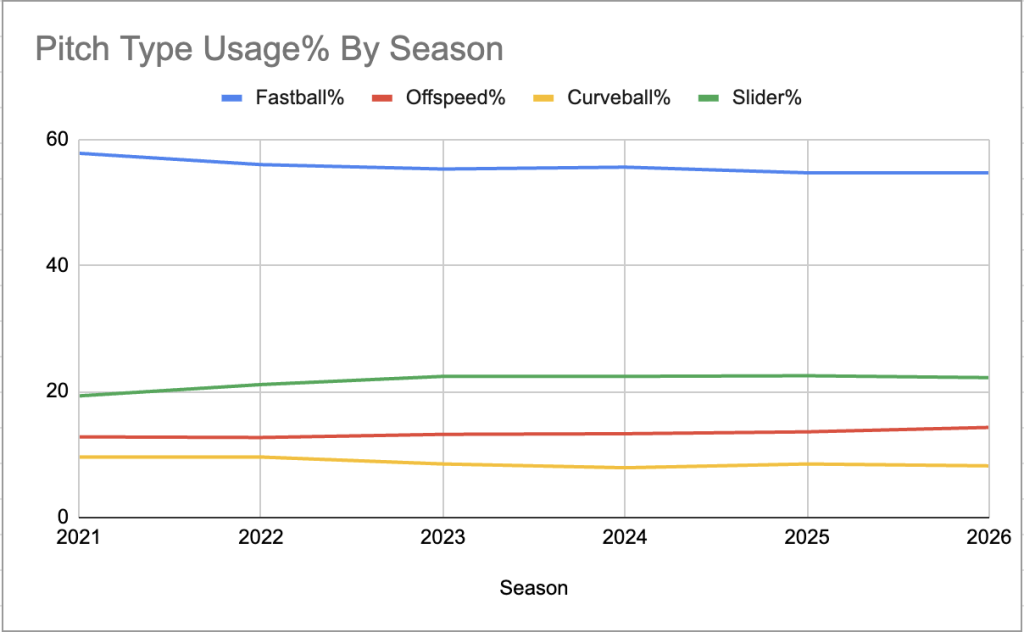
Modern pitching development is much more focused on traits that are difficult to teach, but it all boils down to the basics: fastballs are still, by and large, the most important offering in a pitcher’s arsenal.
Even if the rest of your arsenal is littered with above-average secondaries, your pitch mix must contain a heater with a standout shape. If not, you’re not optimizing more than half of your pitch usage.
There’s no one-size-fits-all fastball shape; it typically encompasses one or more factors, including velocity, release height, extension, and vertical approach angle.
The latter is especially important. A flatter vertical approach angle can help a fastball generate more whiffs, especially when located at the top of the strike zone and paired with higher velocity, elite vertical carry from a low arm slot, and/or long extension.
Teams that prioritize this fastball shape prefer pitchers who already rely heavily on it before joining the organization, allowing them to focus on refining their secondary offerings.
Those traits can allow a fastball to play better than its velocity alone would suggest. A flat 92 mph fastball thrown frequently in the upper third of the strike zone can miss more bats than a harder fastball that enters the zone on a steeper plane and isn’t located as effectively.
Conversely, a steeper approach angle means a fastball’s effectiveness must be driven more by elite velocity than by its shape. However, it also makes it easier for a pitcher to throw his secondary pitches. A steeper approach angle better aligns the ball’s trajectory with the downward tilt of a hitter’s swing.
This steeper angle reduces the amount of time the bat and ball share the same plane, making it easier for secondary pitches to deceive hitters and generate swings and misses.
Like mentioned earlier, there is no right or wrong fastball preference. It ultimately comes down to what a team’s player development staff feels most comfortable working with. Some teams prefer to have 55-60% of a pitcher’s arsenal already accounted for, while others would rather have the 40-45% of secondary offerings nailed down and bet on premium velocity and command to overcome the limitations of a steeper-approach fastball.
2025 Strategy: VAA, Velocity, and Results
The Cardinals’ 2025 strategy can be boiled down to a few simple fastball characteristics and outcomes:
- 91.0 mph average velocity or higher
- 67th percentile or better four-seam fastball VAA in the upper third of zone
- 82nd percentile or better in-zone whiff rate
- 72nd percentile or better swinging strike rate
These make it fairly clear that St. Louis prefers the former strategy discussed earlier: flatter approach guys who can readily locate their heaters at the top of the zone and miss bats.
Within these parameters, there were 52 draft-eligible pitchers aged 20, 21, or 22 for the 2025 MLB Draft. Of the 12 pitchers the Cardinals selected, nine fit this profile. It’s also likely that a significant number of arms they did not select ranked highly on their draft board as well.
This list could plausibly be narrowed to only 20- and 21-year-old pitchers, as the only 22-year-old selected by the Cardinals was Kaden Echeman. However, I decided to include them for completeness.
Below is a table highlighting those arms, along with which ones the Cardinals selected.
| Pitcher | Selected by Cardinals? |
| Gage Wood | |
| Tyler Van Dyke | ✅ |
| Joe Ariola | |
| Will McCausland | |
| Lucas Kelly | |
| Kaden Echeman | ✅ |
| Kaiden Wilson | |
| Brady Afthim | |
| Tanner Franklin | ✅ |
| Kade Anderson | |
| James Tallon | |
| Jake Clemente | |
| Nick Potter | |
| Chase Renner | |
| Andrew Sentlinger | |
| Liam Doyle | ✅ |
| Alex Breckheimer | ✅ |
| Danny Thompson | |
| Michael Lombardi | |
| Cade Crossland | ✅ |
| Patrick Forbes | |
| Luke Dotson | |
| J.D. Thompson | |
| Carter Rasmussen | |
| Zane Coppersmith | |
| Jamie Arnold | |
| Sawyer Hawks | |
| Jordan Fisher | |
| Riley Quick | |
| Carson Laws | |
| Matthew Potok | |
| Reed Garris | |
| AJ Russell | |
| Ben Jacobs | |
| Ethan Young | ✅ |
| Kyson Witherspoon | |
| Andrew Johnson | |
| Brian Curley | |
| Bryson Dudley | |
| Malachi Witherspoon | |
| Caden Hunter | |
| Brady Jones | |
| Alton Davis II | |
| Liam Best | ✅ |
| Peyton Prescott | |
| Dominic Fritton | |
| Marcus Phillips | |
| Dylan Mathiesen | |
| Logan Forsythe | |
| Eric Lin | |
| Anthony Watts | ✅ |
| Jack Martinez |
The three arms the Cardinals selected who did not fit this filter — Payton Graham, Dylan Driessen, and Jake Shelagowski — either failed to meet the minimum pitch threshold or did not pitch in Division I. The latter applied to Shelagowski, who is a pitch-model darling selected in the 13th round out of Saginaw Valley State University.
Graham was a standout at Gonzaga but suffered a UCL injury after his first start of 2025. Driessen was a reliever at South Dakota State who relied on a more diverse pitch mix. Both, however, met the velocity and VAA in the upper third of the zone requirements, albeit at a lower pitch threshold.
A fun note on Jack Martinez, the last name listed in the table above: Martinez was acquired in the Nolan Arenado trade this past winter and also fits this fastball mold. The fact that the Cardinals adhered to this model months after the draft and following a regime change makes me believe there is a non-insignificant likelihood that they return to this well in 2026.
Additionally, aside from Liam Doyle, Cade Crossland, and Ethan Young, no pitcher selected threw more than 56 innings last year. While this is not reflected in the filter, it’s worth noting that, after selecting Crossland and Young, the club exclusively selected projectable, bigger-bodied arms who could eventually grow into a starter.
Who Fits the Criteria in 2026?
Now that we’ve examined last year’s crop of talent, let’s take a look at the same players who fit these same parameters this past spring.
| Pitcher |
| JT Raab |
| Nolan Higgins |
| Johnny Nuanez |
| Trip Brown |
| Garrett Lambert |
| Micah Worley |
| Tegan Kuhns |
| Logan Reddemann |
| Bo Rhudy |
| Michael Gibson |
| Cal Randall |
| Duncan Marsten |
| Nathan Helman |
| Jaden Alba |
| Ryan Marohn |
| Dawson Montesa |
| Justin Feld |
| Eric Nachtsheim |
| Luke McNeillie |
| Patrick Davidson |
| LJ Mercurius |
| Sam Carlisle |
| Justin Shadek |
| Connor Kelley |
| Josh McDevitt |
| Niklas Pavia |
| Justin Byrd |
| Ariston Veasey |
| Ruger Riojas |
| Aidan Keenan |
| Drew Horn |
| Drew Titsworth |
| Ryan Piech |
| Braxton Shaffer |
| Deven Sheerin |
| Evan Dempsey |
| Tyler Kapa |
| Michael Harpster |
| Josh Gunther |
| Collin McKinney |
| Dallis Moran |
| Alex Overbay |
| JP Robertson |
| Declan Dahl |
| Chase Horst |
| Ethan Kleinschmit |
| Max Miller |
| Alex Philpott |
| Ethan McElvain |
| Carson Turnquist |
| Cade Rusch |
| Hudson Barrett |
| Colin Linder |
| Jake Kennedy |
| JR Fordham |
| Tyler Pitzer |
| Cal Scolari |
| Hudson Calhoun |
| Sahil Patel |
| Schuyler Sandford |
| Maddox Webb |
| Andrew Edrington |
| Mavrick Rizy |
One caveat to this list is that it doesn’t account for those with eligibility remaining who chose to return to school.
Who Are the Standouts From This List?
When assessing all of the options that fit this criteria, a few names stand out as potential candidates for the Cardinals to target.
Dawson Montesa
The Mountaineers, looking for a rotation piece in the transfer portal last year, picked up the Division II standout from Adelphi University. He wasn’t nearly as dominant in Morgantown, but Montesa more than held his own against much tougher competition than he faced previously.

Montesa’s signature offering is, of course, his fastball, which sits 94-95 mph and has reached 98 mph. It features a -3.8 VAA in the upper third of the zone and is thrown for strikes 64.2% of the time. It’s an outstanding foundation.
His main breaker is his curveball, which sits in the high-70s. It’s not thrown hard enough right now to be a viable power curve at the MLB level, but he does throw it for strikes 61.4% of the time. This is by far his best-commanded secondary offering.
Dawson will also dabble with a sweeping slider, and while it’s metrically better than the curveball (sitting 84-85 mph and generating seven inches of glove-side movement), he really struggles to throw it for strikes.
He’ll also mix in a high-80s splitter, killing spin to around 1,600 RPMs and generating 12 inches of drop off of the heater. It’s not thrown for strikes, but it’s a very solid offering from a pure stuff standpoint.
Montesa is understandably very raw, but there’s plenty of intrigue surrounding his starter buildup and outstanding fastball shape. He has the looks of an early-middle round selection.
Bo Rhudy
From high school, to two campaigns at Kennesaw State, to a remarkable year at Tennessee out of the bullpen — Cardinals fans, does this sound familiar? This is the exact path Tanner Franklin took en route to the organization last summer, and he is now a top-15 prospect in the system.
The pathway is where the comparisons end, however. Both Franklin and Rhudy feature quality fastballs, but Franklin’s stands out with elite velocity and an outstanding movement profile. Rhudy sits 91-92 mph, though he has touched 96 mph and displays elite backspin, reaching up to 2,800 RPM.

Rhudy’s fastball still features an outlier approach angle at -4.24 VAA and misses bats at an eye-watering 21.6% rate, ranking in the 99.6th percentile among Division I pitchers.
Rhudy’s sweeper is his best secondary offering, sitting 79-80 mph and generating 13 inches of glove-side movement. He throws it for strikes 59.8% of the time.
His main offspeed offering is a traditional changeup, sitting 82-83 mph and generating a cool eight inches of vertical separation from the fastball. He’ll need to feature it more frequently, as he primarily relied on the heater and slider, but it’s a solid offering from a metrics standpoint.
Rhudy is among my favorite bullpen-to-rotation bets, given his outstanding strike-throwing ability, feel for spin, and arsenal diversity. He currently projects as an early- to middle-round selection.
Drew Titsworth
A long reliever who made seven starts at Clemson in 2025, Titsworth was slated to join the Tigers’ rotation full-time this spring. It didn’t quite work out that way, as he was limited to just 35.1 innings in 2026, but the foundation of a starter is there given his 6-foot-3 frame and outlier fastball.
His heater sits 93-94 mph and has topped out at 97 mph. Drew generates 13 inches of IVB from a 4.7-foot release height, resulting in a flat -3.95 VAA overall.
The heater is supplemented by a low-to-mid-80s gyro slider. He pounds the zone with it, but it currently lacks the velocity to be a viable power slider at the major-league level.

Scouts can dream on the outlier fastball, but Titsworth is a project in every sense. He projects as a middle-round arm.
Takeaways
It’s easy to understand why the Cardinals chose this mold for their pitchers in last year’s draft: arms with better fastball shapes can account for more than 50% of a pitcher’s arsenal usage, allowing their development staff to focus on refining their offspeed and breaking pitches.
The club has especially excelled at the former. Tekoah Roby, Gordon Graceffo, and Hancel Rincon have each adopted a kick-changeup to supplement their supination-heavy approach.
Obviously, it’s not guaranteed that the Cardinals will follow the same blueprint in 2026. However, after years of leaning toward safer strike-throwers, the team will likely continue taking chances on louder arms with premium fastballs.
Become a Member of Just Baseball
Subscribe and upgrade to go ad-free!
* Save 25% by subscribing annually.

Written by
Adam Akbani is a writer and analyst from St. Louis, MO. He attended Washington University in St. Louis, double majoring in Economics & Strategy and Political…