
How Much Should the Tigers Worry About Framber Valdez?
The Tigers signed Valdez to be a reliable, top-of-the-rotation starter. That hasn't been the pitcher they've seen so far.
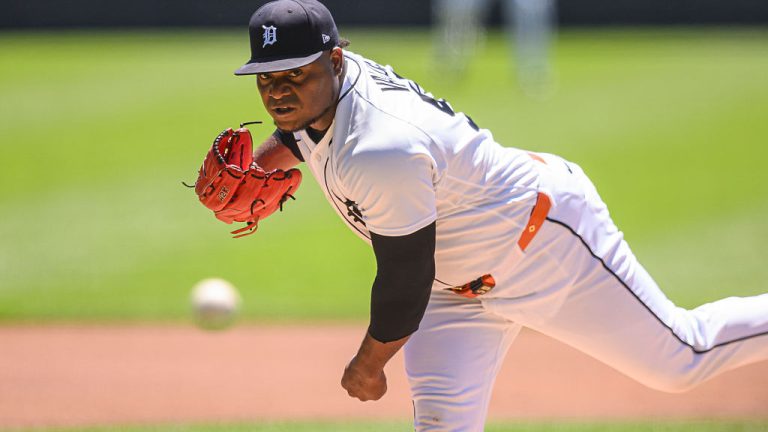
When the Detroit Tigers signed Framber Valdez, it was a statement.
Losing the Tarik Skubal arbitration case could have been a reason for the team to go with cheaper options, but instead, the Tigers made Valdez one of the highest-paid left-handed pitchers, inking him to a three-year, $115 million contract.
Back-to-back seasons in which the Tigers essentially ran out of starting pitchers pushed the emphasis on the need over the offseason. Bringing in Valdez, especially on a shorter-term deal, made all of the sense in the world. A stable and proven veteran with a clean injury history and a pedigree of winning was exactly what the Tigers needed to elevate their rotation and team.
However, Valdez has not pitched to the level of his contract. While he has not been bad, he has also not been the type of pitcher the Tigers thought they were getting this offseason. At $36 million a season, you need to be an ace. A pitcher who gives his team a real shot at winning every time he takes the mound. That has not been the case with Valdez.
Decline or Speed Bump?
Through 19 starts and 107.2 innings, Valdez sits with a 4.10 ERA, a 4.09 FIP, and 7.27 K/9 – all career-worst numbers since he became a full-time starter in 2020.
Another area where Valdez typically brings value is as an elite groundball arm with an ability to eat innings. He’s currently tracking to pitch 175 innings, which would be his lowest since 2021. His 52.3% groundball rate, although still very good, is the lowest of his career.
To emphasize, these are not bad numbers, but they hardly match what the Tigers signed up for.
Considering Valdez did not become a true starter until he was 26 years old and logged fewer than 200 innings in his first three seasons combined, I wouldn’t think a decline due to age, at 32, would be likely. Usually pitchers like Valdez who are not burning up radar guns and have a proven clean bill of health can pitch well into their mid-to-late 30s.
Many of the advanced metrics on Valdez’s 2026 season align with prior years when he posted better numbers. Let’s take a look.
| Season | Avg. Exit Vel. | Avg. Launch Angle (degrees) | Barrel % | GB % |
| 2023 | 91.5 mph | 4.2 | 7.9% | 54.2% |
| 2024 | 90.2 mph | 0.4 | 5.3% | 60.6% |
| 2025 | 90.8 mph | 2.7 | 6.7% | 58.6% |
| 2026 | 89.6 mph | 7.1 | 6.5% | 52.3% |
Hard contact does not hurt a pitcher like Valdez nearly as much as others because so much of it is on the ground. However, from time to time, you’ll have games where those groundballs don’t find defenders and the snowball can be several runs.
We saw that happen early in the year when Valdez allowed 10 hits and eight runs against the Twins. Another outing, this one against the Red Sox, saw him give up nine hits and 10 runs (seven earned) with three home runs. It was an uncharacteristic outing allowing the long ball for Valdez.
Of his 19 starts, seven have included four or more earned runs. He had 10 such starts out of 31 last season and only four in 2024 and eight in 2023. So, he’s pacing for roughly 11 starts of four or more earned runs, which is not all that far off from last year, but a continued trend away from 2023 and 2024.
Part of the problem has been Valdez getting less swing-and-miss. Although he was never much of a strikeout artist, a dip from over 8.5 K/9 the past four seasons to 7.27 K/9 is rather significant. His overall whiff rate has dropped by about 5%. The whiff rate on his sinker has only dropped 1.5%, but on his curveball it’s down 12%, and on his changeup about 5%.
Obviously, any drop in swing-and-miss will most likely result in fewer strikeouts, but it also changes how Valdez can attack hitters. He’s always been a pitcher with plus command that lives in the zone. More of those pitches are now being put in play. The zone contact rate against Valdez, 92%, is 5% higher than the standard throughout his career.
Not getting a swing and miss with a two-strike count impacts the at-bat, but so does not getting a whiff on 0-1. Maybe that ball is put in play. Maybe his curveball is not as effective as a tool to get ahead or put batters away.
Last season, his curveball was used as his put-away pitch 30% of the time, and that has dropped to 18.5% this season. Perhaps that’s a change in organizational pitching differences, but we can’t rule out the step back in movement profile not being a factor as well.
All of this to say I do think Valdez is closer to the pitcher the Tigers signed than we might think. The blow-up starts have burned an image into our minds, but Valdez also has 11 quality starts, nine of which were six or more innings and one or fewer runs.
Has he been exactly what the Tigers thought? Results-wise, no. Can he get back to being what they thought? I think so. And for the Tigers, that matters a ton when you look ahead.
Valdez’s Success Is Crucial for the Tigers
I don’t need to remind you that Skubal’s time in Detroit is running out. Even if the Tigers do not trade him at the upcoming deadline, he is likely signing elsewhere in free agency. I view the Valdez signing as a bridge to life after Skubal, helping to transition the team while still having a high-end veteran in the rotation.
Oh yeah, let’s not forget that Casey Mize is also on an expiring deal and pitching as well as he ever has. Troy Melton and Keider Montero stepping up and proving they are not only legit big leaguers, but good ones, makes the future rotation look less shaky. However, there are still plenty of unknowns.
Former top prospect Jackson Jobe is working his way back from injury. He still has his 100 mph fastball, but the swing-and-miss numbers have not been what we all expected. Not just in a small sample in 2025, but in the minors in 2024.
Reese Olson was trending towards being one of the more reliable arms in the Tigers rotation, but after his 2024 was cut short due to injury followed by another injury in 2025 holding him out to this date, we truly do not know what we can expect moving forward.
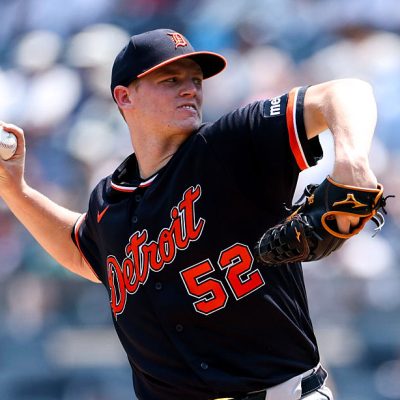
Even if Olson and Jobe come back healthy and prove they are big league caliber arms the rotation still needs an ace. Someone they can give the ball to in a playoff game. A pitcher with experience who can anchor what will likely be the traditional growing pains we see from young pitchers. That needs to be Framber Valdez.

Final Thoughts
Consistency in starting pitchers can be difficult to find. That’s part of the reason Framber Valdez was given the contract he was given. When I first decided to write this article, I was prepared to think everything was worse than it actually was. Many times the truth lies between opposite extremes, and I think that is the case for Valdez.
He’s not been the pitcher the Tigers need him to be, but he’s not far off from it. Getting back to that level might just take time. Settling in with a new team has been proven to take time with many free agent signees over the years. Am I worried about Framber Valdez? Not yet.
Become a Member of Just Baseball
Subscribe and upgrade to go ad-free!
* Save 25% by subscribing annually.

Written by