
How Can the Marlins Best Handle the Trade Deadline?
The trade deadline is quickly approaching, and Miami is in an interesting spot. Will Peter Bendix make some serious additions to his team?

The first half of the 2026 season for the Miami Marlins has been quite the ride.
Following the five games in March, when the Marlins went 4-1, they proceeded to crawl through April and May with sub-.500 records and looked like prime candidates to be sellers at the deadline. Now, after a 20-6 performance in June – and currently sitting 6-5 in July – they have flipped the script and could be one of the surprise buyers this summer.
Here we are at the All-Star break, and the Marlins are sitting at 52-45.
That record not only puts them four games back from the division-leading Atlanta Braves, but they are also the third National League Wild Card team, just 2.5 games behind the number one spot.
The Fish are fightin’.
Depending on which site you check, the Marlins’ percentage chance to make the postseason ranks anywhere between 30-55%. Needless to say, the rest of July is going to play a huge part in whether Peter Bendix and the Marlins front office decide to buy or sell at the deadline. Either way, the team is in a good position to continue to be the scrappy team no one wants to see down the stretch.
So the question then becomes, which way are they going?
Buying Times
If you take one look at this roster, you’re probably wondering just how they’ve been able to be as successful as they have.
On offense, they’re getting insane contributions from All-Star shortstop Otto Lopez. Xavier Edwards is proving to be one of the better second basemen in the league. Joe Mack was called up for his debut and has been a staple on both sides of the ball. More clutch performers day in and day out have catapulted them into this position.
If they were to buy, I think their needs are pretty clear.
Even though they have been able to manage it to this point, they need a stable starting pitcher whom they would be able to slot into the rotation behind their top three of Sandy Alcantara, Eury Pérez, and Max Meyer.
This is also coming on the heels of the news that the Marlins are going to skip Meyer’s next start because of the career-high workload he’s had just halfway through this season. If they are going to continue to try to find a way to manage his innings, the addition of another starter is going to be important if they truly believe in their team and their chances to make noise in the playoffs.
Staying on the same page of the roster, a true, back-end, high-leverage reliever is a must. Especially since Pete Fairbanks simply has not met the expectations of this team.
On offense, the Marlins are going to need to attack the position that has alluded them for quite some time. Third base has been a gaping hole that needs to be fixed if they are to be a true playoff team come the end of the season. A right-handed bat in the lineup is also something they need. They may be able to “kill two birds with one stone,” but adding two separate hitters fitting those criteria would do wonders for this lineup.
Starting Pitching Options
Seth Lugo & Michael Wacha – Royals
This is not coming out at the best time, considering the Royals recently said it’s more than likely that both Seth Lugo and Michael Wacha will be on their roster following the 2026 MLB trade deadline.
However, we have seen just how quickly teams are willing to change their minds, and acquiring one of the Royals would be a perfect fit for the Marlins.
The 2026 season hasn’t been kind to Lugo, as evidenced by his 4.56 ERA in 18 starts this season. The $30-plus million he is owed through the 2027 season might also deter the Marlins from making a move for the 36-year-old because of the position their roster is currently in, but the benefit would come in the cost of acquisition.
Wacha, on the other hand, continues to be one of the more consistent pitchers in baseball. On the season, he has a 3.77 ERA in 119.1 innings for Kansas City. He is also signed through 2028, but at a far more affordable cost of a little over $20 million.
Either of these two pitchers would fit in nicely behind Sandy, Eury, and Meyer.
Casey Mize – Tigers
It wasn’t too long ago that I wrote an article talking about just how good Casey Mize has been this year and the fact that he is, finally, beginning to look like the pitcher that was drafted first overall.
Mize is having a career year for a largely disappointing Tigers team. While Tarik Skubal is garnering all of the trade talk as we approach the deadline, Mize and his 2.79 ERA over 77.1 innings should be generating far more trade buzz.
Mize is also in his last year of control with the Tigers, owed a little over $2 million through the end of the year. If there is a pitcher on the market who fits this Marlins roster construction best, Mize is likely the one.
He would also be a candidate to be extended by the team at year’s end.
Sonny Gray – Red Sox
This Red Sox season has been one to forget. The latest roster move placing left-handed starter Ranger Suárez on the 15-day IL should trigger full sell-mode for Craig Breslow.
Sonny Gray was a notable acquisition this offseason by Boston, but with how their season has gone and considering his age, Gray should be on his way out and onto his seventh major league team. Despite the Red Sox’s struggles, Gray has been great for them. A 2.54 ERA in 17 starts is nothing to scoff at.
Sonny Gray would be a great addition to a young Marlins team that not only is in need of a consistent starter in their rotation, but also one who could add even more experience to this locker room. Unfortunately for them, Gray is going to be a hot commodity this deadline, so there might be plenty of competition for the veteran starter.
Robbie Ray – Giants
At this point, it should be considered a foregone conclusion that the San Francisco Giants are going to move on from Robbie Ray at this year’s deadline.
While Ray may not be putting up the same flashy strikeout numbers he put up through the early portion of his career and his first season in San Francisco back in 2024, the overall numbers have been fairly consistent with his career numbers.
In 106.2 innings this season, Robbie Ray has pitched to a 3.38 ERA and struck out 7.6 hitters per nine innings. The FIP is a bit inflated at 4.70, but he is pitching to what would be a career-low 38.5% hard-hit rate.
While Ray would be a rental for the Marlins, the biggest holdup with trading for him would be the price tag that comes with him.
Depending on whether the Giants would be willing to eat some of that deal (he’s making $25 million this season) is going to determine just what type of return they are going to get, and the inflated salary number is likely going to push teams away if San Francisco is not willing to at least pay some of it down.
If Buster Posey and the Giants’ ownership are willing to do so, then slotting Robbie Ray into a Marlins rotation, which does not currently have a southpaw, would give the Fish an added boost towards clinching a spot in the playoffs.
Back End of the Bullpen
Aroldis Chapman – Red Sox
Given what I said about the Red Sox season, finding another one of their players on this list should come to the surprise of no one. This also would not be the first time that Aroldis Chapman’s name has been tied to the Marlins, even if the last time was quite a while ago.
The Red Sox closer entered year two with the team after arguably the best season of his career, coming in his age-37 season. Though the strikeout numbers haven’t been the same for the now-38-year-old, his 2026 numbers are still holding strong and have amounted to 19 saves so far this year.
As I mentioned previously, the Marlins made it clear that they wanted Fairbanks to be their closer this season after handing him a one-year, $13 million contract this offseason. Unfortunately for them, it just hasn’t panned out.
Chapman is going to be the hottest bullpen name on the market this trade deadline, and the Marlins should pick up the phone and get in the conversation to acquire him from Boston.
Kyle Finnegan – Tigers
The Tigers made the move at the last trade deadline to acquire Kyle Finnegan from the Nationals to boost their roster in their run to make the postseason in 2025. After acquiring him as an expiring contract, they then signed him to a new two-year, $19 million deal, with a mutual option for 2028.
Finnegan has been nails for the Tigers this season. Even though he isn’t their closer, serving as the set-up man for Kenley Jansen, Finnegan has been one of the better relief pitchers in baseball.
Given his experience as a successful back-end-of-the-bullpen option for teams, with 113 career saves in six seasons to prove that statement, Finnegan’s affordable deal would make him an interesting option for the Marlins’ bullpen.
Luke Weaver – Mets
Mets reliever Luke Weaver would probably be my favorite trade option for Miami at this year’s deadline.
As the Mets made a flurry of moves to try to recreate Edwin Díaz in the aggregate, Weaver became one of the relievers brought in to help secure the back end of their bullpen. There hasn’t been a more disappointing team in baseball than the New York Mets, and a total reset should be at the forefront of their minds.
Weaver signed a two-year deal with the Mets this offseason, and with him coming off a “down” 3.62 ERA in his final season with the Yankees, they were able to bring him in on an affordable contract that would amount to $22 million over the two seasons. Though it was backloaded, the $12.5 million owed to Weaver next season should not be a deterrent for any team looking for a reliable back-end option.
With all of the ugliness that has been the Mets’ 2026 season, Weaver’s performance has been anything but.
Offensive Upgrades
Isaac Paredes – Astros
It seems that year after year, Isaac Paredes is at the forefront of trade rumors, no matter what team he is on. Despite Paredes entering just his seventh major league season, another trade would put him on the sixth team of his career.
What makes him such an attractive piece for teams is that he is still under his initial team control, which runs through the end of next season. There’s also the added benefit that he would provide defensive versatility, which any team would love to acquire in addition to what he brings on the offensive side of the game.
It has been well-documented that Paredes’s offensive profile is far more valuable depending on which ballpark he calls home. It makes far more of an impact on his power profile, which was proven by the uptick in production between when he called Tampa and now Houston his home.
Per Baseball Savant’s expected home runs by park stat, Marlins Park would be one of the least beneficial parks for his power profile:
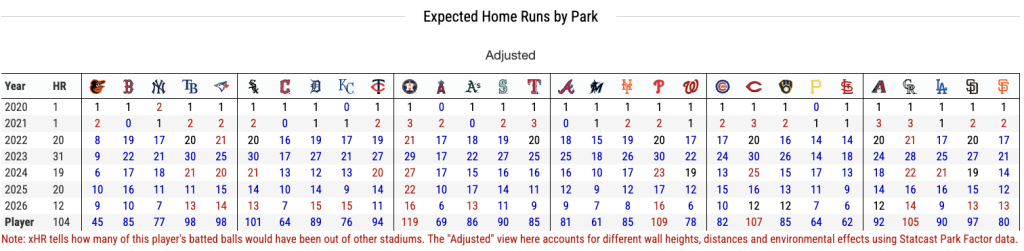
Even if the power wouldn’t necessarily come with the addition of Paredes to this Marlins lineup, it’s hard to ignore everything else he could provide them with.
The Marlins haven’t had a notoriously “powerful” lineup since Giancarlo Stanton was traded away. Even then, outside of Stanton, there wasn’t much power to speak of. Adding Paredes and his darn near-90% zone contact rate fits the mold of what the Marlins seem to look for in a hitter.
Bo Bichette – Mets
This is not a pretty contract to be willing to take a gamble on if Bichette were to decide to opt into the two years and $84 million remaining on his deal, but given the fact that he has proven to be able to hold his own at third base, he becomes an intriguing option for the Marlins if they are willing to really buy into this roster.
Also, I should note that Bichette would also be able to opt out after 2027 as well, if he decided to.
On the whole, the season hasn’t looked great for Bichette on the offensive side, but I would like to believe that it has a large part to do with his team’s overall struggles. A .255/.300/.376 slash line with 10 home runs, an 89 wRC+, and a .121 ISO doesn’t scream “strong trade candidate,” but his recent play is more like that of the player who warranted the big deal he signed this past offseason.
Since June 1, Bo is hitting .315 with a .490 slug, 128 wRC+, five home runs, and a .356 wOBA. He also isn’t someone who solely relies too heavily on power to be a productive hitter. His ability to spray the ball to all fields makes the large gaps in loanDepot Park incredibly advantageous to his hitting profile.
There have been rumors that Bichette is leaning toward declining the remaining money on his deal, but that could be in large part due to the Mets more than anything else. If New York is willing to pay down some of the money should Bo opt in, as they did with Max Scherzer and Justin Verlander, the Marlins should be picking up the phone and dialing the number to their division rivals.
Sellers?
Look, even as an optimistic Marlins fan, as someone who has watched this game for as long as I have, I know just how quickly a season can turn around. If the Marlins are to sell, they have a handful of trade chips that have consistently been mentioned on the rumor mill over the years.
Sandy Alcantara would, obviously, be at the forefront of the list of names.
His $21 million club option for next year should be a no-brainer given how he has been able to bounce back after a rough stretch and continues to eat innings despite any struggles. As much as it would pain Marlins fans to see Sandy go, it’s a move that would feel justifiable given the team’s roster construction.
The Marlins could also choose to simply eat the money spent on closer Pete Fairbanks and try to find whatever return is possible for the reliever. At the end of the day, a reliever with an extensive history of being reliable at the end of games is going to bring in some sort of return.
Along with Fairbanks, the Marlins have a plethora of other relievers who could find their way onto new teams at the deadline.
Anthony Bender, Calvin Faucher, Michael Peterson, and Lake Bachar have all been nails for the team and are also under team control at least through next season. All of them would fetch the Marlins a decent return, even for a relief pitcher.
What Will the Marlins Do?
Fandom aside, I do think this is the deadline at which Peter Bendix decides to truly invest in this team.
Since he became the lead decision-maker in the Marlins front office, he has been able to supplement this roster through a ton of under-the-radar moves, which have panned out beautifully. It’s the reason why they currently sit seven games above .500 going into the second half.
Despite what ESPN’s Buster Olney said at the beginning of the month, there’s a chance the Marlins’ level of aggression increases if the success continues. In fact, there have been conflicting reports regarding what Miami’s front office’s approach will be. Some outlets have been quoted as saying they may be willing to deal off the big league roster in order to fill other holes.
Where that comes from is a question in itself, but just the fact that there are added details for a plan to buy should have Marlins fans excited and convinced that this brass is willing to invest in this team.
There is plenty of potential on this roster to justify further investment in their future via the trade market without them being labeled as the sellers in the deal. If they do decide to buy, Bendix and the rest of the development staff have done a great job rebuilding the farm system, giving them plenty of options to use as trade pieces at the 2026 MLB trade deadline.
Become a Member of Just Baseball
Subscribe and upgrade to go ad-free!
* Save 25% by subscribing annually.

Written by
Cristian has been at Just Baseball since 2021, when he first started writing about prospects. He spent eight years working in Major League Baseball with the…