
Cade Smith Deserves More Praise
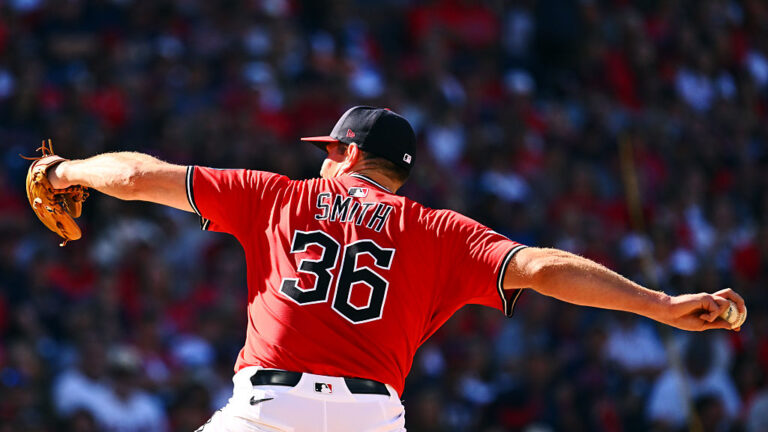
Cleveland Guardians closer Cade Smith earned his first All-Star selection, but he's been one of baseball's most dominant relievers since making his MLB debut in 2024.
The Cleveland Guardians have developed one of baseball’s best reputations for identifying and developing high-end power relievers.
So when perennial All-Star closer Emmanuel Clase was placed on leave midway through the 2025 season, the expectation outside the organization was that replacing one of baseball’s premier closers would be nearly impossible.
As it turns out, the answer was already in the bullpen. That answer was Cade Smith.
The 6-foot-5 Canadian right-hander has quietly developed into one of the game’s most dependable ninth-inning arms, and his first career American League All-Star selection is simply the latest recognition of what has been building since his debut in 2024.
Smith leads all of Major League Baseball with 26 saves while posting a 2.90 ERA, 1.14 WHIP, and 57 strikeouts across 38 appearances. He’ll represent Cleveland in Philadelphia alongside rookie teammates Parker Messick and Travis Bazzana.
For a pitcher leading the majors in saves, he’s received remarkably little national attention.
Stats were taken prior to play on July 7.
Ready When the Opportunity Arrived
As a rookie in 2024, Smith emerged as one of baseball’s best setup men, appearing in 74 games while posting a 1.91 ERA, a 0.90 WHIP, and 103 strikeouts in 75.1 innings. His 28 holds illustrated exactly how much trust Cleveland already had in him.
He followed that with another outstanding campaign in 2025, throwing 73.2 innings with a 2.93 ERA, a 1.00 WHIP, 104 strikeouts, 16 saves, and 19 holds.
When Clase was removed from the closer’s role following his suspension and eventual leave, Smith inherited one of the highest-pressure jobs in baseball. After blowing his first two save chances, he settled in quickly, converting 13 of his final 16 opportunities over August and September while pitching to an ERA in the mid-2.00s.
He carried that momentum into October, tossing 3.1 scoreless innings with four strikeouts during Cleveland’s Wild Card Series against Detroit.
So, this season hasn’t been a breakout nearly as much as it has been a continuation.


The Guardians Keep Winning Close Games
Part of Smith’s value stems from how often Cleveland asks him to finish games.
The Guardians have played 31 one-run games this season, the most in baseball entering play on July 7, and own a 16-15 record in those contests. That’s a lot of ninth innings carrying very little margin for error.
The Underlying Profile Has Changed
His 2.90 ERA remains excellent, but several expected metrics suggest he’s been slightly less dominant beneath the surface.
Smith’s expected ERA sits at 3.44, still comfortably above average, but not quite at the elite level his traditional numbers suggest. His overall Pitching Run Value, per Baseball Savant, ranks around league average, driven largely by a fastball that has surprisingly taken a step backward despite gaining velocity.
That’s one of the more fascinating parts of his season.
Smith’s four-seam fastball averages 96.8 mph, harder than it did a year ago, yet opponents are hitting .289 against it after batting just .170 last season. Its expected slugging percentage has also jumped considerably, suggesting hitters have become much more comfortable squaring it up.
Fortunately for Cleveland, Smith has another weapon. His splitter has become one of the most effective pitches in baseball.
Opponents are hitting just .135 against it this season after batting .250 against the pitch in 2025. His sweeper has taken a similar leap, limiting hitters to a .143 average after they hit .300 against it last year.
That development has changed the way Smith attacks hitters. Rather than relying primarily on overpowering them with his fastball, he’s increasingly using his secondary pitches to generate chase swings and empty swings.
The results speak for themselves.
Smith’s chase rate ranks in the 75th percentile. His whiff rate sits in the 95th percentile. His strikeout rate ranks in the 98th percentile across Major League Baseball, while his walk rate places him in the 86th percentile.
Strikeouts eliminate the possibility of defensive mistakes. Limiting walks prevents innings from snowballing. Together, those two traits allow Smith to survive even when hitters make loud contact in the air.
Living With the Trade-Off
Speaking of, there is one statistic in Smith’s profile that jumps off the page. Actually, two.
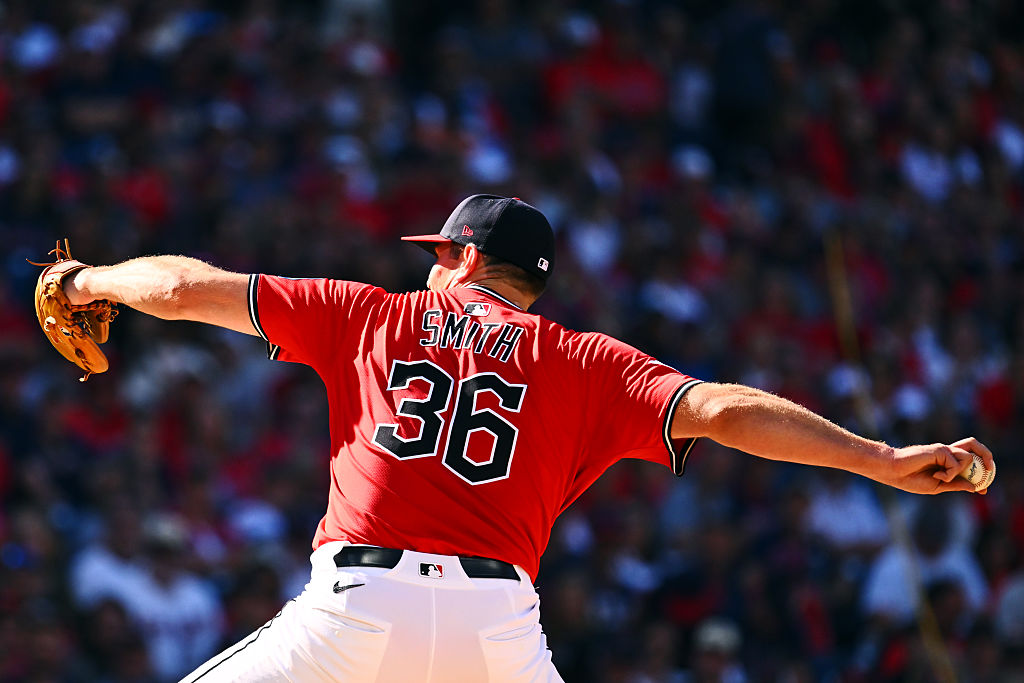
His average exit velocity allowed ranks in just the first percentile. His hard-hit rate ranks in the eighth percentile, while his barrel rate has fallen from the 97th percentile a season ago to the 16th percentile this year.
Ordinarily, that’s a dangerous recipe for a late-inning reliever. However, most of the damage has been concentrated into only a handful of outings.
The upstart division rival White Sox have been Smith’s biggest headache. They’ve scored four runs against him across just 4.1 innings while handing him one of his three blown saves.
The back-to-back defending champion Dodgers accounted for another rough series, scoring three runs in two innings.
Outside of those two opponents, Smith hasn’t allowed a run this season against Baltimore, Boston, Cincinnati, Detroit, Kansas City, Los Angeles (Angels), Milwaukee, Oakland, Philadelphia, St. Louis, Tampa Bay or Toronto.
That illustrates the important distinction that Smith isn’t consistently getting hit hard. Rather, when things have gone wrong, they’ve tended to happen in clusters. That’s far easier to live with than a steady stream of mediocre outings.
Smith has now produced three consecutive seasons with an ERA below 3.00 while striking out more than a batter per inning, first as one of baseball’s premier setup men and now as MLB’s saves leader.
For a pitcher who inherited one of the toughest jobs in baseball, that’s an impressive résumé.
His first All-Star selection is well deserved. It probably won’t be his last.
Become a Member of Just Baseball
Subscribe and upgrade to go ad-free!
* Save 25% by subscribing annually.

Written by