
Michael McGreevy Looks Like a Building Block in the Cardinals’ Rotation
The St. Louis Cardinals have been in search of a young arm to solidify their next rotation - and they may have it in Michael McGreevy.
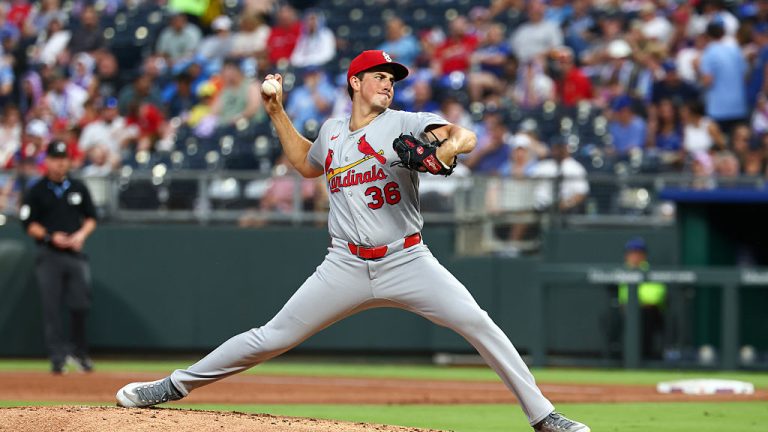
Through his first 15 starts, Michael McGreevy has been solid for the St. Louis Cardinals. He sports a 3.35 ERA, ranking him 15th in the National League.
The problem: nearly all the predictive data suggests it shouldn’t be happening.
In 83.1 innings, McGreevy has a 120 ERA+ and consistently gives the Cardinals a chance to win. His 5.5 innings per start ranks among the best in the Cardinal rotation, only trailing Dustin May.
Under the hood, however, McGreevy’s profile presents a much different framework. The right-hander owns a 5.70 expected earned run average and an expected batting average of .294.
McGreevy’s FIP currently sits at 4.42, lining up almost directly with his ZiPS profile ahead of the season. Most projections had him hovering around a 4.00 ERA and two WAR.
In addition to his poor expected numbers, McGreevy lacks velocity, struggles to induce chase, and rarely strikes anyone out.
If the predictive data seems so dreary, how has McGreevy warded off regression?
All stats updated prior to games on Wednesday, June 24th
The Art of Old School Pitching
Referencing St. Louis Post-Dispatch’s Lynn Worthy column, Missouri Hall of Fame writer Bernie Miklasz discussed McGreevy’s “veteran presence.”
“He’s the guy who is calling all the new pitchers who have joined the organization,” said Miklasz. “And he’s the one telling them, ‘here’s who you call; here’s how you find a place.’”
Those actions directly mirror the way McGreevy pitches. Despite being just 25 years old, he attacks hitters with the poise and efficacy of a seasoned starter.
The way McGreevy finds success is simple: he limits self-inflicted wounds (walks, HBPs, etc.), and he is above average at keeping hitters on the ground. Lots of pitchers in MLB have similar skill sets, but most can’t sustain success over five-plus innings. So how does he make it work?
Simply put, McGreevy’s seven-pitch repertoire allows him to attack hitters based on count and weakness. He has a pitch-mix that includes a four-seam fastball, cutter, sweeper, curveball, changeup, sinker, and slider. Although most of them register about league-average movement, McGreevy’s ability to execute sets his stuff apart.
Additionally, McGreevy ranks in the 85th percentile in walk rate, allowing him to consistently work ahead, despite not having elite stuff. His first-pitch strike percentage of 58.6% further demonstrates his willingness to challenge hitters early in the count.
There aren’t many starters in baseball who still adhere to pitchability over stuff. The average fastball velocity in 2002 was 89 mph, and jumped all the way up to 94 mph in 2025. Pitchers who survive on weak contact rather than overpowering stuff have become increasingly hard to come by.


Who Can Cardinals Fans Compare McGreevy To?
With such a confusing new talent among them, Cardinals’ fans are likely looking around baseball for player comps to help refine their expectations for McGreevy’s future.
Well, there’s one pitcher in baseball who’s doing it similarly to McGreevy, and that’s Seth Lugo.
In 2024, Lugo notched 200+ innings, had an ERA of 3.00 on the dot, and 5 bWAR–and he did it all with a formula that mirrors the young Cardinals’ starter.
This season, Lugo and McGreevy both have expected ERAs over 5.00, and rank in the bottom 11th percentile or worse in average fastball velocity, expected batting average, and whiff percentage. Despite this, both have been effective for their respective Missouri teams.
Lugo keeps hitters off balance with an extensive pitch mix–in a similar manner to McGreevy.
The difference? Breaking balls. Long known for the ridiculous RPMs he registers on his famous curveball. Through 2025, Lugo had never ranked below the 98th percentile in curveball spin in his career.
McGreevy doesn’t have a pitch that equals Lugo’s curveball, but his innate ability to locate and work ahead mirrors the Royals’ veteran hurler.
If you had told Cardinals’ fans after McGreevy’s electrifying debut that he’d turn into Lugo, many would’ve likely been pleased. The real concern isn’t current stature; it’s future performance.
Is Regression Coming for McGreevy?
The biggest question on every Cardinals fan’s mind is about McGreevy’s future. How will his numbers hold up throughout a 162-game season?
Although the analytics seem to indicate that he’ll come back down to Earth, projection models can struggle to predict the success of contact-oriented, location specialists.
Similar to how hitters produce better results than expected via the pulled flyball, pitchers can beat projection models with elite command and sequencing. Keeping hitters off balance, diluting the quality of contact, and baseball IQ remain pillars in modern pitching, even if the numbers now command the spotlight.
Although even McGreevy has a few numbers that go his way. What the young right-hander lacks in Stuff+, he makes up for with his Location+. His repertoire ranks above average across the board, with an overall measurement of 111, according to FanGraphs.
As the season progresses, McGreevy could regress. He’s got minimal room for mistakes. When he leaves a pitch over the middle, it’s going to get hit. When he walks batters, he often won’t have a strikeout to make up for it.
Regardless of his continuity, McGreevy’s numbers serve as a reminder that commanding the zone, sequencing pitches, and keeping hitters off balance have a place in modern baseball–but is that place in the St. Louis rotation for the foreseeable future?
The Cardinals Need Certainty Above Anything Else
Fortunately, the Cardinals don’t need McGreevy to become an ace. They need stability.
St. Louis’ starting rotation doesn’t have a single arm that’s registered a two-WAR season, via Baseball Reference. With that kind of lackluster production, and McGreevy currently on pace to rectify recent trends, the Cardinals may have found a reliable option.
That’s ultimately what makes him a building block rather than just a surprise story.
Even if his ERA regressed to his peripheral numbers, McGreevy would still be a foundational piece. Starters who remain on the field for 180+ innings and pitch to anything around a 4.00 ERA are more valuable than ever with the modernity of pitching injuries.
St. Louis has been one of MLB’s most surprising teams in 2026, and without McGreevy, they wouldn’t be nearly as steady. Strikes, groundballs, and a deep pitch mix have kept him productive in the first half.
If McGreevy maintains his elite walk rates, dynamic pitch-mix, and veteran aptitude, he’ll be a fixture in the Cardinals’ rotation for years.
Become a Member of Just Baseball
Subscribe and upgrade to go ad-free!
* Save 25% by subscribing annually.

Written by
AJ Stone is a sportswriter and journalist currently attending the University of Missouri School of Journalism. His work has appeared on Redbird Rants, Heavy.com, Arcadia News,…