
Are Better Days Ahead for Aaron Nola?
There's no denying Nola's resume, but there's no ignoring his recent struggles either. Can he turn things around?
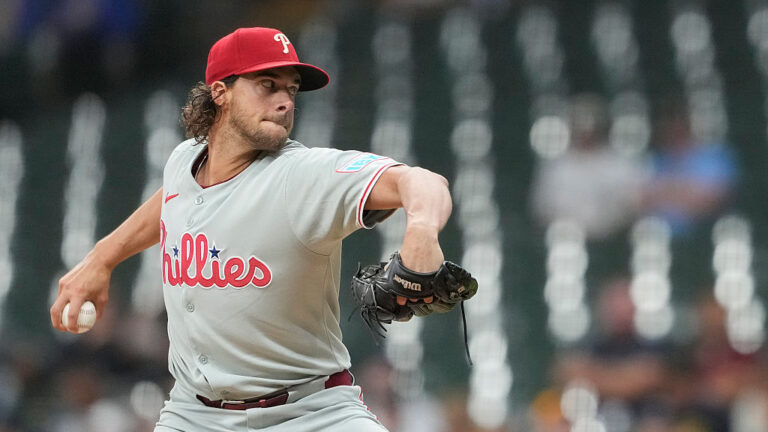
Aaron Nola is one of the greatest pitchers in Philadelphia Phillies history, but two years of declining performance have left many wondering whether the franchise icon can still be a productive starter.
The former first-round pick now finds himself at the top of many of the franchise’s pitching categories. Nola is second in strikeouts by a Phillie and ranks in the top five in games started in red pinstripes.
He has quietly become a franchise icon. For a decade, he was one of baseball’s most dependable starters, rarely missing a turn while providing quality innings at the front of Philadelphia’s rotation.
All that has changed since the start of the 2025 season, when Nola’s production and reliability fell off a cliff. Nola sported an ERA of 6.01 in 2025 and failed to start 20 games for the first time since 2015 (excluding the shortened 2020 season, in which Nola didn’t miss a start).
Phillies fans have not been happy with Nola’s production, and with four seasons remaining on his contract after 2026 at roughly $25 million a year, many have begun to view the deal as a burden on the club’s future payroll flexibility.
Nola’s Attempt at Redemption
Many within the Phillies organization, and Nola himself, believed that 2025 was just a down year. Both the club and Nola thought 2026 would bring a fresh start and a recharged Aaron Nola. Yet, the surface numbers lead many to believe he will never return to form.
Nola has made 13 starts this season, logging 66 innings with a 5.86 ERA, fanning 68 hitters. Not exactly the bounceback the Phillies were hoping for.
The truth is, Nola hasn’t been very dominant since 2022, when he finished fourth in Cy Young voting. Since the start of the 2023 season, Nola has a 4.57 ERA. He put together a solid 2024 season after signing his new contract with the Phillies, but overall, the deal hasn’t gone according to plan for Philadelphia.
The Phillies and Nola came to an agreement on a seven-year deal following the 2023 season, a campaign in which Nola had a 4.46 ERA. The Phillies were confident after a dominant postseason that Cy Young-caliber Aaron Nola was still in there.
The club was not expecting him to return to his 2018 form, when he put together a monster season, logging 5.5 fWAR. With the money he’s being paid, they just need him to be a solid number four starter behind the premier arms of Cristopher Sánchez and Zack Wheeler, as well as Jesús Luzardo, who has shown flashes of joining that ace conversation.
What the Advanced Numbers Say
While two seasons with an ERA hovering around 6.00 have not been pretty, the advanced metrics suggest Aaron Nola may have been on the wrong side of some bad luck so far in 2026.
That’s not to say Nola is still an elite pitcher, but the underlying numbers suggest he’s more productive than the surface-level stats indicate.
The LSU product currently has a 4.32 xERA, according to Statcast. That’s not great by any stretch, but it definitely changes the perspective on the ugly 5.86 ERA Nola currently possesses.
Nola also has just a 4.21 FIP and a 3.71 xFIP. Those metrics suggest he has pitched significantly better than his ERA indicates, pointing toward poor luck and sequencing issues rather than being completely ineffective.
The right-hander has always had favorable advanced numbers that tell a better story than just ERA. For the past two seasons of struggles, Nola has a 3.71 SIERA in each season. Taken together, all these metrics provide a reason for confidence that Nola may be able to turn the corner.
Why Has Nola Fallen Off?
The 33-year-old’s regression can largely be attributed to the ineffectiveness of his fastball. While Nola has never been a big velocity guy, when he’s at his best, his fastballs are at least serviceable.
According to Baseball Savant, Nola is currently in the bottom first percentile for fastball run value. Combined, his four-seam, sinker-, and cutter have a -19 run value. In other words, he has been one of the worst fastball pitchers in baseball at this juncture.
Opposing batters are hitting .407 against Nola’s four-seam fastball and slugging .864 against the pitch. Despite this, Nola’s knuckle curve is still one of the most effective pitches in baseball. He sits in the 95th percentile in breaking run value, as well as the 87th percentile in offspeed run value, thanks to his changeup.
Nola’s four-seam and sinker used to be amazing pitches for him. In his best season, Nola’s fastball run value sat in the 96th percentile (+17). That was in 2018, and his fastball actually got better. In 2022, he was in the 100th percentile in fastball run value with +30. Velocity isn’t the problem either, as Nola has only lost about 0.5-1.0 mph on his average fastballs.
Nola’s four-seam fastball used to have late run that fooled hitters, but he’s been unable to effectively throw the pitch for the past two seasons. Considering his knuckle curve is still one of the better pitches in baseball, if Nola can refine his fastball, he might become a more viable middle-of-the-rotation guy for Philadelphia.
What’s Next for Nola and the Phils
Whether the fans like it or not, Nola will be with the club for four more years. At $24.5 million per season, the Phillies will need Nola to be a reliable back-of-the-rotation piece at the very least.
While some fans have suggested a move to a bullpen role, it’s hard to envision that happening, especially with their top prospect Andrew Painter’s disappointment at the big league level so far. Nola could potentially see time in the bullpen in October, but it’s hard to imagine the Phillies pushing him back there during the regular season.
Nola may never return to the Cy Young-caliber form he displayed in past campaigns, but the underlying metrics suggest he remains more effective than his ERA indicates. If he can find a way to make his fastball merely average again, the Phillies could get meaningful value from the remaining years of his contract.
Become a Member of Just Baseball
Subscribe and upgrade to go ad-free!
* Save 25% by subscribing annually.

Written by
Chris is a contributor at Just Baseball, specializing in Phillies and prospect coverage. Chris is from Central Jersey and a recent Rutgers University graduate. You can…