
What’s Gone Wrong For Brent Rooker?
If the Athletics want to make a run at a postseason berth, they need their veteran slugger to turn things around at the plate.
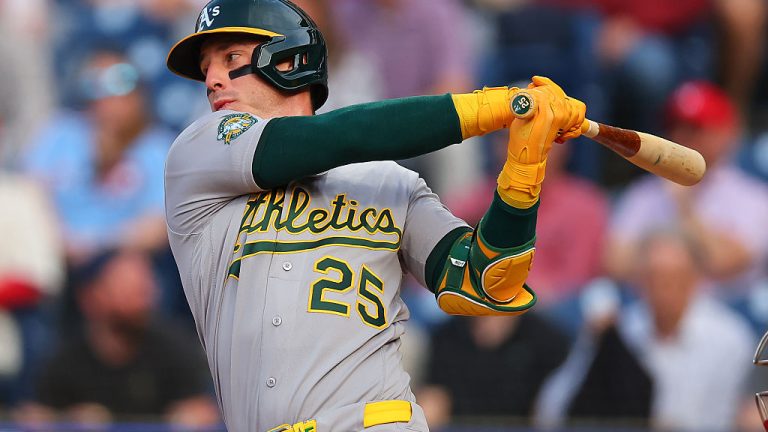
The Athletics have long been in discussion around the trade deadline. More times than not, the discussion starts with their best players and why they will be traded to contenders as the A’s fall out of the race. However, the A’s rarely trade their stars at the deadline, instead opting for an offseason move.
What has been even more rare is locking those same players into long-term deals. Fans grew used to seeing the Athletics’ best players moved once arbitration became too expensive, but that trend has recently changed, and it all started with Brent Rooker when he signed a five-year, $60 million extension in January of 2025.
Rooker, who was acquired off waivers back in 2022, found his footing after he was given an extended runway and plenty of playing time with the A’s. Two years of fan-generated trade rumors were shut down once he signed his extension, as the A’s were happy to retain their middle-of-the-lineup bopper.
Rooker pumped 30 home runs and posted a 122 wRC+ in 2025 but has yet to find his groove in 2026. An early season injury claims some responsibility, but even with that caveat, concerns still linger.
Stats were taken prior to play on June 7.
What Has Changed?
The reason Rooker hit waivers in the first place was due to his massive swing-and-miss issues. Minnesota, where he started his career, was not able to find him consistent at-bats, and once he landed in Kansas City, he did not have much of an audition before the season ended.
In each of these short stints, Rooker’s strikeout rate was above 30%, and neither team valued the 40-man roster spot.
Once Rooker got to Oakland in 2023, he was given a full season to prove himself. He did so by launching 30 home runs, but he was still striking out at a 32.7% clip. He showed improvements in 2024, dropping his strikeout rate to 28.8%, and then to 22.2% last season.
In 2026 his strikeout rate has once again spiked to 32.1%, one of the worst amongst qualified hitters.
The recipe for success with Rooker is rather straightforward: keep pitchers honest with their offspeed and breaking balls, and punish fastballs.
While this doesn’t work for all hitters, players with as much power as Rooker can make it work considering how much damage he can do off velocity.
Rooker is always going to hit most of his home runs off velocity, but taking advantage of breaking balls and offspeed even occasionally helps him see more fastballs. So far, Rooker is struggling on secondaries more than any other time in his career.
Rooker is only hitting .164 with a .218 slugging percentage against breaking balls. On offspeed pitches, he’s hitting .087 with a .227 slug, and both pitch types are forcing a whiff rate over 50%. Against all the offspeed and breaking balls he’s seen this season, Rooker has one extra-base hit — a home run.
While this is not his bread and butter, he was able to stay afloat in years past on these pitches. Each of the past two seasons Rooker has hit at least 10 home runs off breaking balls, even with a 45% whiff rate. This goes to show how small the margin of error can be, and pitchers are recognizing this and adapting against him.
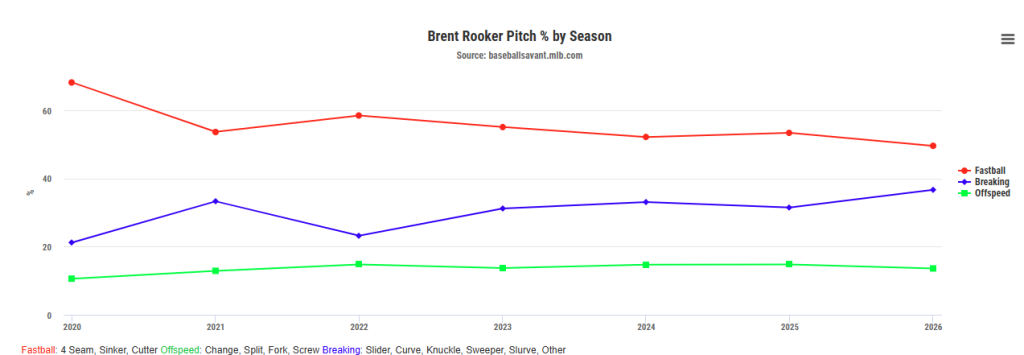
Via Baseball Savant
The chart above shows the frequency each pitch type is thrown to Rooker by percentage. The blue line (breaking balls) was fairly flat over the past few seasons but has jumped by six percent in 2026. If you break it down by month, Rooker saw an increase of nearly three percent from April to May of 2026, and through June 6, albeit a tiny sample, he has seen 53% breaking balls.
If he cannot hit breaking balls at the same level of years prior, then pitchers will continue to feed him more and more. In doing so, Rooker’s results will continue to plumet. We have seen his average exit velocity drop for a third straight season, now sitting below 90 mph (89.5) for the first time since a small sample in 2022.

The second aspect causing Rooker fits is his performance against lefty-handed pitchers. A career .828 OPS hitter off lefties, Rooker was struggled to .163/.217/.302 slash in his first 46 plate appearances off southpaws in 2026. That’s a lousy .520 OPS against lefties when, in the past, this is where he made up ground for his his higher strikeout rate against righties.
Perhaps sample size and injury are playing a bigger factor, but I think it all comes down to how Rooker can force pitchers to get to their fastball.
In the past, when Rooker at least was able to keep pitchers honest and not lean so heavily on breaking balls or offspeed pitches, he’s been effective. Now, he’s running his worst chase rate of the past three seasons, and his struggles could be causing him to press.
Luckily, there’s still time for Rooker to turn this around.
Can Rooker Turn Around His Cold Start?
If injury has impacted Rooker and caused a slow start, then believing in his turnaround is easy. If you think the issues are deeper than simply not be “right,” then you might need more proof than simply waiting it out. However, there is good news — Rooker perhaps is showing signs of life.
Over the past week, Rooker is slashing .273/.273/.591 with two home runs and seven strikeouts in 22 plate appearances. It’s a sample size that usually should be thrown out, and one that contains too many strikeouts, but when you are looking for sings of life any sample can give you hope.
In that sample, Rooker has posted an exit velocity over 100 mph eight times — nearly half of his at-bats. Of those eight, four were against breaking balls or offspeed pitches. Am I grasping at straws? Maybe, but I think this is exactly what I would be looking for to start a turnaround.
We also saw Rooker hit a home run off a lefty — a 108.6-mph home run that traveled 404 feet. Sure, an 89 mph fastball from Tim Hill right down the middle is a pitch that Rooker should destroy, but it’s one that Rooker still needed to see leave the yard.
I am confident that Rooker will find his footing off lefties; he has simply been too good throughout his career not to. Who knows if he finds a groove in a week or a month, but I think when we go back at the end of the year to check his numbers, his OPS versus left-handed pitchers will not be an issue.
While I do think Rooker will turn it around this season, I understand those who have larger concerns. Any profile that has a 45% whiff rate or higher on non-fastball comes with plenty of concerns and reasons to doubt. Add in his less-than-ideal .743 OPS for the second half of last season, and your sample size of underwhelming play grows.
Time will tell if Rooker can turn his season around and save his numbers. A bigger issue than his individual performance has been the hole in the middle of the lineup that the A’s, as a team, cannot fill. Jacob Wilson being out has shortened their lineup, while Tyler Soderstrom, who’s starting to heat up, has mostly been pedestrian.
The A’s inked Rooker to be their veteran and team leader as a number of younger players found their place now and into the future. Part of that leadership role is performance, and so far Rooker has come up short. If the A’s have any hopes of a postseason berth, they will need more out of their slugger.
Become a Member of Just Baseball
Subscribe and upgrade to go ad-free!
* Save 25% by subscribing annually.

Written by