
MLB Draft Notebook: ACC Tournament
The ACC always puts together a great show, and this year's tournament was no exception.
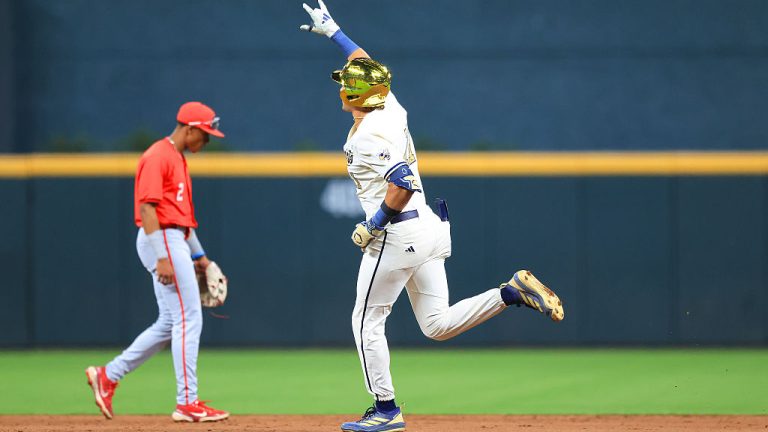
With the end of the college season comes tournament time, and boy, was it magical.
Last week, I was able to sit in on the entire ACC Tournament in Charlotte, NC, hoping to see teams I had yet to see, while also getting secondary looks at players I had already seen throughout the season. As always, the ACC puts together a great show, both on the field and behind the scenes. They deserve kudos for how they handled the entire week.
The storylines were obvious: Pitt’s Cinderella run to the semifinals was a feel-good story for a club that hasn’t seen tournament play since 1995. Georgia Tech’s monstrous form continued, culminating in a regular season and tournament title for the best offense in the country. Plus, how can I not forget the Stanford/Cal elimination game on the East Coast? Who expected that five years ago?
But let’s cut to the chase, the week featured a ton of offense. Truist Field is a bandbox of a stadium, and to the surprise of nobody, 61 home runs were hit throughout the week. The bats will be at the forefront of this article, but there were some quality pitching performances, as well.
With the amount of notes to sift through, I’ll do my best to stay concise on each player evaluated. These evaluations will be heavily utilized for our upcoming Top 250 board, which is slated to come out in short order, and our initial 2027 lists, which will come out later this summer.
Bats
- We’ll start with the Most Outstanding Player of the Tournament, Ryan Zuckerman. A Pitt transfer, Zuckerman brought a need for polish on both sides of the ball to accompany double-plus power. He has toned down the aggression at the dish and improved his swing decisions, which has allowed the power to show up even more. Zuckerman went 8-for-14 on the week with four XBH’s (3 HR, 1 2B), walking once and striking out four times. Strikeouts will always be a part of his game, but Zuckerman achieved exit velocities north of 110 MPH numerous times, including a maximum of 113.4 MPH on a single against Miami. His defense has improved drastically at third base, as well.
When talking to Zuckerman after the tournament, he had this to say about the environmental change and his success:
“I couldn’t do it without my coaches and teammates. They welcomed me with open arms, and everyone feels welcome. I’m forever grateful, and I can here for two reasons: 1. to get better and 2. to win a championship.”
- After spending three years atop the Tech lineup, Drew Burress finally has his conference crown. However, it’s not the only crown he got this week, as he now owns Georgia Tech’s program record for home runs at 58. He passed Jason Varitek with a laser to left field, which left the bat at 117 MPH. Burress went 5-for-12 on the week with a double, four walks, and four strikeouts. He made a few amazing plays at the “eight,” as well. While I do have worries about his ability to handle advanced secondaries at the next level, as well as his size, he has done nothing but mash in his career, and the track record equates to a Top 10-15 pick.
- The Yellow Jacket’s shortstop, Carson Kerce, was another standout, as he went 7-for-13 with two home runs, two walks, and three strikeouts. His ascension to the present has been outstanding, as he’s made the biggest jump in draft rankings of anyone in the country. While he doesn’t project to be a power stick like his teammates, Kerce covers the zone exceptionally well, and he abuses the gaps. He has solid footwork, actions, and arm strength across the diamond, as well. Expect Kerce to hear his name called in the latter half of Day 1.
- Lastly, we can’t talk about Georgia Tech without mentioning Vahn Lackey, who righted the ship after a cool period in April. Lackey ended the week going 6-for-11 with three home runs, four walks, and just one strikeout. Lackey whiffed on just one offering throughout the week, which occurred on a check swing against Virginia on Thursday. All three home runs on the week were pull side tanks, and his ability to work quality at-bats played key roles in posting crooked numbers. His mix of offensive tools, paired with his outstanding athleticism and defense, makes him a shoo-in for a Top 5 pick, and one can assume he doesn’t make it out of the Top 3.
- Moving off of Georgia Tech, we’ll lean into UNC’s offense. Owen Hull, a transfer from George Mason, has been a consistent force for the Tar Heels this year, though he has prioritized the hit tool over raw power. Hull went 6-for-14 on the week with an opposite-field home run in the Championship game. Hull’s swing is more conducive to groundballs, as the swing can get disconnected and “handsy” at times, though the exit velocities are very good. He tends to lace balls to the opposite field, but a swing/approach change can help unlock another tier to his game, especially considering his polish defensively in center. He’s someone who should be drafted in the first couple of rounds on Day 2.
- Another transfer for the Tar Heels, Jake Schaffner has been a fantastic addition at the top of the lineup. Schaffner went 6-for-12 on the week with four XBHs (2 2B, 2 3B) and three walks. The bat-to-ball skills and feel to hit from Schaffner are sublime, and while power will never be part of his game, he works well as a leadoff sparkplug. He has the defensive chops and actions to handle shortstop, though his arm strength can be challenged, and he may fit better as a second baseman in the future. That said, he has done well for himself in the ACC, and Schaffner should hear his name called on Day 1.
- While Boston College was one-and-done in Charlotte, their middle infield duo of Julio Solier and Ty Mainolfi flashed their upside as 2027-eligible bats. Solier is a premier shortstop in the class with fluid actions at the position, and while power has not been his forte this spring, he laced a ball at 109 MPH and has significant bat speed. He’ll need to find more leverage next spring to unlock more power, but the profile is intriguing. Mainolfi registered the same exit velocity later in the game, and like Solier, he’ll need to find more leverage in his swing to unlock more power. That said, his bat-to-ball skills are very solid, and he defends well at second base.
- Another 2027-eligible bat, Miami backstop Alonzo Alvarez was very impressive for the Hurricanes. A switch-hitter from California, Alvarez went 7-for-12 on the week with four XBH’s, all of which came in the 11-2 rout of Stanford. He’s a physical presence in the box with longer limbs and proportionate strength. He will open his stance slightly as a left-handed hitter, while his right-handed stance is more square and even. Despite his size, Alvarez has prioritized the hit tool, and his affinity for fastballs is noteworthy (89% contact rate on the year). His defense is stellar, throwing out two runners on the week with impressive arm strength and pop times of 1.90. His defense gives him a solid floor as a prospect, and scouts want to see the power improve.
- Going back to the 2026 class, Virginia outfielder AJ Gracia had a pleasant week, going 4-for-7 with a double and two walks. The offensive toolset is extremely enticing. The smooth-swinging lefty showed off the hit tool consistently, beating the shift and controlling the zone very well. He whiffed just once during his showing, and his 109 MPH double was among his hardest-hit balls of the year. While he’s likely shifting to left field as a professional, the offensive production is too enticing to pass up in the first round. He should hear his name called between picks 10 and 20.
- Notre Dame had a few stellar bats throughout the week, but none more impressive than sophomore outfielder Jayce Lee. Lee went 6-for-8 on the week, with half of his hits going for extra bases. Boasting extremely long limbs and plenty of projection, Lee has broken out in a huge way for the Fighting Irish, and he’s displayed solid barrel awareness despite his length, utilizing the whole field. While he is an aggressive swinger, Lee has impressive power, and he cracked the 110 MPH echelon in Charlotte. As he fills out, the expectation is that Lee will begin to slug the baseball much more consistently. He’s one to keep an eye on next spring.
- Finding a new home at Duke, outfielder RJ Hamilton is an under-the-radar name to watch in this year’s draft cycle. After playing for the 18U National Team as an infielder, Hamilton has transitioned nicely to the grass, where he has split time between center and right field. He’s a speedy runner with solid routes and a polished glove, and if he goes undrafted this summer, he would slide over to center full-time next year. He has good bat-to-ball skills with some sneaky power, though scouts would like to see the whiffs come down a bit. That said, he’s an impressive athlete, and the glove may be too good to pass up. If he gets taken, it’ll likely be in the middle of Day 2.
- One of the biggest revelations in the conference this spring was Stanford’s Teddy Tokheim, and he continued that form in Charlotte. While he is an aggressive swinger and tends to expand the zone at an alarming rate, Tokheim’s bat-to-ball skills are solid. There are a few moving parts to his swing, though he does a good job of syncing his limbs well and generating quality leverage. He lives on the barrel, as well. Tokheim’s home run to center against Rob Evans was a moonshot. He’ll need to find a place defensively to give him more value, but the bat has proven to be very, very good. He is draft-eligible next spring.
- Last, but certainly not least, Virginia Tech’s Ethan Ball deserves a shoutout. The lone 2028-eligible bat I’ll cover, Ball is a powerful second baseman who decimated three home runs in Charlotte. While his hit tool and plate discipline leave more to be desired, Ball has a beautiful left-handed swing with loud bat speed. The power plays to both sides of the field, and his ability to lift the baseball consistently helps him tap into it. That said, the hit tool will need to take a drastic step forward as he grows as a player and prospect.
Arms
- For Notre Dame, their pitching was carried by workhorse starter Jack Radel, whose illustrious collegiate career ended with 6.1 innings of two-run ball, striking out eight batters along the way. Radel’s fastball was up to 98 MPH early, and he got tons of riding life with some cut, though Radel’s game plan changed when Clemson hitters began to sit on his heater. He proceeded to throw his low-to-mid-80s slider and upper-80s cutter more often to outstanding results. The slider alone garnered twelve whiffs, dropping off the fastball tunnel and diving for the dirt with nasty bite. There were a couple of curveballs and change-ups thrown, as well. Radel boasts a high floor as a starter with excellent extension (7+ feet), great command, and a deep arsenal. There’s a chance that he could hear his name called in the backend of the first round.
- Across his four-year career at Duke, Aidan Weaver has always felt like the odd man out. So, unsurprisingly, he was out for revenge in his start against his former coach on Wednesday morning. Weaver has some of the best stuff in the draft class, though sporadic command has hampered him as a starter. Weaver’s heater ran up to 97 MPH and sat at 93-96 MPH throughout, boasting loud carry and life through the zone. His upper-70s change-up is a nightmarish pitch, displaying excellent velocity separation and outstanding fading life. He has a shorter slider to complete the arsenal. Despite his age and limitations, Weaver should hear his name called rather early.
- Miami’s Rob Evans has been a model of consistency this spring, and he registered the longest outing of the week, going seven strong innings with six strikeouts against Stanford. A bulkier southpaw, Evans pitches to contact and lets his defense do the work, generating thirteen grounders during his outing. Hitting 96 MPH early, Evans sat in the low-90s consistently with sink and tail. His low-80s slider plays off his arm slot well, displaying tighter shape with some sweep and depth. His change-up mimics the fastball, tailing heavily away from right-handed bats. While it’s nothing flashy, Evans pitches with confidence and fire. He should be drafted late in July.
- The biggest pitching storyline of the week, Pittsburgh’s David Leslie put the Panthers on his back. Across 9.1 innings, Leslie struck out fifteen batters and threw 168 pitches across two outings, both of which Pitt won. He was the epitome of “Grittsburgh.” A transfer from DIII, Leslie’s numbers aren’t enticing, but the stuff certainly is. He hit 96 MPH and held fastball velocity well, flashed a solid change-up with depth, but his low-80s curveball was a true hammer with immense depth and bite.
- Lastly, Clemson reliever Ariston Veasey had one of the louder fastballs of the week. Sitting in the mid-90s with significant carry and cut, Veasey boasts a 29% whiff rate on the season, and batters struggled to touch it. He pairs the heater with a sharp low-80s curveball with lateral tilt and solid depth. While he will be a reliever at the next level, it’s loud stuff that should play in leverage situations. Not bad for someone who started as a catcher in high school, if you ask me.
Become a Member of Just Baseball
Subscribe and upgrade to go ad-free!
* Save 25% by subscribing annually.

Written by