
Wyatt Sanford Is the Pirates’ Most Perplexing Prospect
20-year-old Wyatt Sanford represents the ultimate high-risk, high-reward prospect archetype.

Back in July of 2024, the Pittsburgh Pirates entered the MLB Draft with hopes of finding some legitimate offensive pieces to add to their growing stockpile of pitching talent. Despite possessing an organization headlined by arms, the Pirates had routinely struggled to develop legitimate hitting prospects up to that point, and they hoped this class could be the first step toward getting back on track.
Of course, with the ninth overall pick in the draft, the Pirates made the best possible choice they could have made, selecting shortstop Konnor Griffin. After signing with the club, Griffin would eventually go on to become the number one prospect in the sport, earning the label of a generational talent and signing a record-breaking contract shortly after.
Aside from Griffin, though, the club remained focused on continuing to acquire legitimate offensive talents throughout the rest of the class. In the second round, they did this by selecting Wyatt Sanford, another prep shortstop with a high ceiling whom scouts had loved throughout the buildup to that year’s draft.
Since draft day, Sanford has begun to carve out an excellent reputation for himself within the prospect space. This was especially the case in 2026, as Sanford crushed 19 homers, stole 33 bases, and posted a wRC+ above 140.
Any time a middle infield prospect flashes this type of power-speed combination, it’s hard not to get caught up dreaming about what the future may hold. After all, shortstops who are able to slug, steal bases, and play solid defense up the middle are some of the most valuable players in the sport. The idea of the Pirates developing another one of those players to pair with Konnor Griffin is quite exciting.
However, the underlying data tells a much bigger story. Sanford’s 2026 gains and his offensive profile as a whole are far more perplexing than they may initially appear, as he’s less of a finished product than he might seem.
As a result, he’s far and away the most perplexing prospect within the Pittsburgh Pirates’ farm system.
The Good
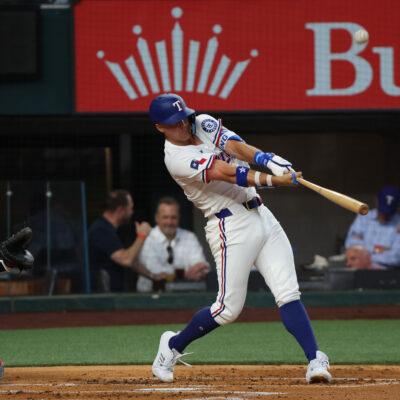
Beginning on a positive note, Sanford’s profile has a lot to be excited about. This is especially true when comparing the 2026 version of himself to previous seasons, as Sanford took many steps forward this year — particularly in the power department.
As mentioned in the introduction, Sanford slugged 19 homers during the 2026 season, blowing his previous career high of five out of the water. He also crushed 18 non-homer extra-base hits, which again set a new career high.
But his gains become even more obvious when digging beneath the surface and comparing his 2025 and 2026 marks.
During the 2025 season, Sanford produced an average exit velocity of just 82 mph, well below the MLB average of roughly 89 mph. Even though Sanford was originally projected to be a hit-over-power middle infielder, this number was still well below where he was expected to be.
In addition to this, Sanford’s hard-hit rate peaked at just 31%, which, again, was well below average. Going one step further, Sanford produced a max exit velocity of just 106.6 mph, further emphasizing how underwhelming his power was initially.
Knowing something had to change, Sanford entered Spring Training ahead of the 2026 season as a completely different player. He put on about 15 pounds of muscle after an offseason of continuously eating his mom’s home cooking, which he discussed on an episode of Just Baseball’s Pirates podcast, Bucco Bantr.
This offseason effort wasn’t for nothing, either. Sanford proceeded to undergo a tremendous power surge, essentially flipping his profile from a hit-over-power shortstop to a power-over-hit shortstop.
For starters, Sanford saw his average exit velocity jump over 7.0 mph, going from 82 mph in 2025 to 89.2 mph in 2026. This is a ridiculous surge in power for just one offseason’s worth of work, and it becomes even more impressive the further you look.
To put into perspective just how wild this jump was, Sanford hit 25 balls in play harder than his 2025 max exit velocity of 106.6 mph during the 2026 season. This included a new max exit velocity of 112.6 mph — a 6.0 mph increase in just one season.
Not to mention, Sanford saw his hard-hit rate jump from 31% to 45%, and he experienced an even more significant surge in average exit velocity against certain pitch types. Take his performance against sliders, which produced an average exit velocity of just 78.2 mph in 2025. In 2026, that number jumped to 93.5 mph.
Sanford has done all of this while being a vacuum cleaner at shortstop, scooping up seemingly any ball that comes his way with relative ease. He’s able to range well to both his right and left sides, which will serve him well as he continues to advance through the pipeline.
Overall, Sanford has seen tremendous growth in his game over the past year, and this development is largely what has helped put him on the radar of the larger baseball industry.
The Bad
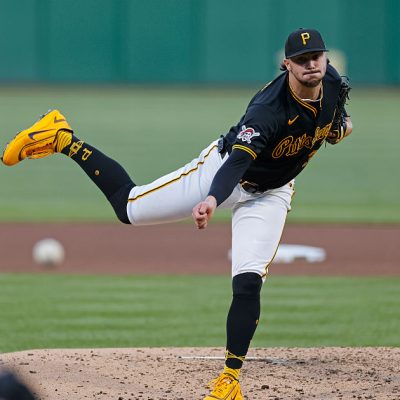
While Sanford’s profile has taken a large leap forward in some areas, it’s also taken a step back in others. In some cases, the regression has been greater than the progress he’s made in the right direction, creating a perplexing overall profile to evaluate.
The largest area where this has been the case has been his overall offensive makeup. As mentioned earlier, Sanford used to be a hit-over-power player who generated most of his production through slap hitting and putting the ball in play. Since taking the form of a power-over-hit player, Sanford has seen his profile go through a complete 180, as he’s now become almost the direct opposite of the player he once was.
As his power continues to rise, his contact rates have fallen in the opposite direction. Last season, Sanford posted an 82% zone-contact rate against all pitch types, which is quite a respectable mark. This season, though, that number has fallen drastically, now sitting at just 72%.
Interestingly enough, this isn’t due to a poor performance against one particular pitch that’s dragged his overall numbers down. Instead, he’s seen a fairly comparable decrease when narrowing the focus to each pitch individually. Take his performance against four-seamers, for example. He posted an 84% zone-contact rate against them in 2025 but saw an 11-percentage-point decrease in 2026, lowering that mark to 73%.
In addition to the drop-off in contact rates, Sanford saw his strikeout rate undergo a tremendous spike. He went from a 19.8% strikeout rate in 2025 to seeing that number leap above 30% in 2026. This wasn’t just a career high; it was the first time in his career that he struck out at a rate above 20%, and he cleared that threshold by more than 10 percentage points.
To be blunt, Sanford’s contact rates this season are a non-starter when it comes to projecting his ability to translate to the big-league level. If Sanford wants to stick in the big leagues, let alone find success at that level, these numbers need to take a pretty significant step forward as he moves up the chain.
When a player makes this much of a pivot toward improving their power, a decrease in contact is expected to follow. However, the tradeoff is rarely this extreme, and this is something Sanford will undoubtedly have to address moving forward. It’s especially interesting given Sanford’s newer stance, which has him in a more upright position with steadier hands in 2026 compared to 2025.
Ultimately, the polarizing contrast between his extreme power increase and contact decline is what makes him such a peculiar player to evaluate. On one hand, it’s easy to buy into what his ceiling could look like with the power he displayed this season. But on the other hand, it’s hard to imagine him being able to maximize this newfound power without making more consistent contact.

What Does a Realistic Future for Sanford Look Like?
All things considered, Wyatt Sanford represents the ultimate high-risk, high-reward archetype in the modern landscape of Minor League Baseball.
On one hand, the physical transformation he underwent ahead of the 2026 season is nothing short of extraordinary. He identified a clear weakness and worked hard to address it, gaining 15 pounds of muscle and unlocking another level of power in his game. That requires serious dedication and work ethic. He isn’t just another slap-hitting middle infielder anymore; instead, Sanford is an actual middle-of-the-order threat with electric defensive abilities.
On the other hand, a strikeout rate above 30% paired with a 72% zone-contact rate is an absolute flashing red light. Major league pitching is ruthless, and arms at the highest level will exploit holes in his swing. If Sanford cannot regain some of the barrel control and bat-to-ball skills that defined the early days of his professional career, that power risks being limited to batting-practice laser shows rather than actual in-game production.
So, what does the future look like for Sanford?
Sanford’s immediate future hinges entirely on his ability to strike a balance between these two extreme versions of himself. He doesn’t need to fully revert to the slap-hitter he was in 2025, nor can he afford to become an all-or-nothing slugger like he was in 2026. If he’s able to find this middle ground with the help of the Pirates’ player development staff, his ceiling remains that of a very good middle infielder who would make for a dangerous pairing with Konnor Griffin.
If he’s unable to rein in the swing-and-miss, his powerful profile risks stalling out as he begins to advance through the upper minors. He’s likely going to face the difficult challenge of reaching Double-A Altoona early next season, which has notoriously been the “make-or-break” point for Pirates prospects in the past.
Either way, as the Pirates continue their quest to develop talent from within, Sanford remains one of the most perplexing players to evaluate in their farm system.
Become a Member of Just Baseball
Subscribe and upgrade to go ad-free!
* Save 25% by subscribing annually.

Written by
Jay Staph, a huge baseball fan and stat nerd, founded and ran his own baseball writing website, BSBWrites, at just 16-years-old. With focal points around prospects,…