
Seattle Mariners Top 15 Prospects
Plenty of bats are on the way for the Mariners, who are looking to complement one of the best starting rotations in the game.
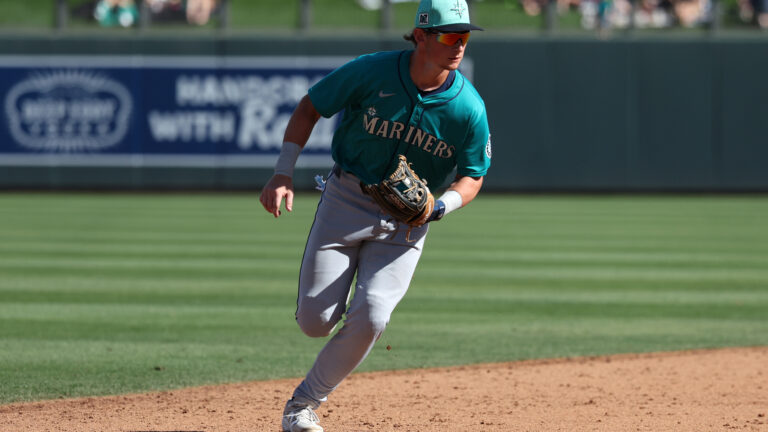
The Seattle Mariners have drafted as well as anyone over the last several years and that’s without the Kade Anderson layup in July. Even with the graduation of Cole Young, the Mariners boast as many top 100 prospects as any system in baseball, headlined by one of the best overall prospects in the game, Colt Emerson.
After a very cost-effective, but still aggressive deadline the depth has justifiably been depleted, something the Mariners are likely not too worried about given their ability to convert talent in the later rounds.
1. Colt Emerson – SS – (Double-A)
Height/Weight: 6’0″, 195 | Bat/Throw: L/R | 1st Round (22) – 2023 (SEA) | ETA: 2026
| HIT | Plate Disc. | GAME POWER | RUN | FIELD | FV |
| 50/60 | 50/60 | 45/55 | 55/55 | 50/55 | 60 |
One of the younger prep bats in the 2023 draft class, Emerson’s strong summer circuit and performance for Team USA helped him rise up draft boards. His polish both mechanically and approach wise have helped him stand out immediately as a pro, with the only hiccups being some minor injuries.
Offense
Emerson has a smooth swing from the left-side with a good feel for the barrel. He already uses his lower half well with a smooth, rhythmic leg kick that he starts early and controls effectively, consistently putting him in a good position to make quality contact. Already flashing above average power, Emerson has added 10-15 pounds of muscle ahead of the 2024 season with room for more in his frame. He has the potential to produce at least average game power as he matures.
He’s a rhythmic hitter and when everything is on time, the head of the bat lives in the zone for a long time, giving him a wider margin for contact and the ability to drive the ball to all fields. He’s very patient with his approach, chasing at only a 16% clip in 2024.
The combination of Emerson’s early load and launch quickness allow him to see the ball longer and make good decisions, but sometimes he can leak forward prematurely, likely because of how early he gets into his back side. That can result in more contact on the ground, which has held Emerson’s power back some.
As Emerson matures, he has a chance to hit for average and around 25 home runs, further bolstered by a knack for getting on base. The hit tool has continue to track closer to plus as he has settled into pro ball.
Defense/Speed
Nothing jumps off the page when it comes to Emerson’s defensive tools, but he is fundamentally sound and has worked hard on his first step and actions. He is at least an average runner with an above average arm and soft hands. His glove has made a huge leap since the end of the 2024 season, now looking like at least an average defender at the position. He is much more aggressive to the baseball, picking it on more opportunistic hops with an internal clock that has improved.
He moves well enough in both directions and throws comfortably enough from different angles to stick at the position. Emerson has successfully fought off the third base risk, looking like an above average defender at shortsotp.
Outlook
Emerson’s feel to hit, approach and likelihood of sticking on the left side of the infield make him a high probability big leaguer while there’s enough power potential to be an impact bat. Now looking like an average or better shortstop while producing plus contact rates and burgeoning power, Emerson looks like one of the better infield prospects in baseball.
His baseball instincts only help elevate his solid tools across the board along with his chances of sticking at short. How much Emerson slugs will ultimately determine his ceiling, but the exit velocities are there. He’s a well-rounded player with plenty of upside.
How Colt Emerson Became One of MLB’s Top Prospects
2. Kade Anderson – LHP – (CPX)
Height/Weight: 6’2″, 185 | Bat/Throw: L/L | 1st Round (3), 2025 (SEA) | ETA: 2026
| FASTBALL | SLIDER | CURVEBALL | CHANGEUP | COMMAND | FV |
| 55/55 | 60/60 | 55/60 | 45/55 | 50/55 | 55+ |
Anderson was a highly touted prep arm in the 2023 class, though he withdrew his name from the draft after undergoing Tommy John surgery in 2022. He put together a solid freshman season in 2024 before breaking out as the best arm in the country as a draft-eligible sophomore.
Arsenal
Everything about Anderson’s game screams high-floor, but there’s plenty to dream on too. He commands four quality offerings with confidence, starting with a 92-95 MPH fastball with good carry and some cut. Anderson’s frame is projectable wit a quick arm, providing optimism for more velo.
Anderson picked up plus whiff rates within the zone on the fastball, along with plenty of weak contact. Interestingly, Anderson’s fastball command can waver more than his trio of secondaries, but he still maintained a strike rate around 64% with the pitch.
Both of his breaking balls look like potentially plus pitches with good shape and velocity separation. Our Tyler Jennings referred to the slider as a “baby sweeper” with good teeth that makes it effective to hitters from both sides of the plate in the mid 80s.
His curveball has impressive tilt in the upper-70s, mixing it in evenly to hitters of each side of the plate. The depth and late bite helped him pick up plenty of contact on the ground while keeping righties in particular in check.
His changeup doesn’t jump off of the page shape wise, but averages 10 MPH in velocity separation and is extremely difficult for hitters to pick up out of the hand, especially off of his hoppy fastball. Opponents hit below .200 against the offering in 2025.
Outlook
While he does not require much development, Anderson and the Mariners are a match made in heaven. He’s likely to fly through the Minor Leagues quickly with a high probability of at least landing as a back end starter. If the anticipated uptick follows in pro ball and or his fastball execution improves, Anderson could reach closer to his No. 2 ceiling.
Film: Louisiana State/Tennessee – April 14, 2024, LSU/South Carolina
3. Ryan Sloan – RHP – (Low-A)
Height/Weight: 6’4″, 220 | Bat/Throw: R/R | 2nd Round (55), 2024 (SEA) | ETA: 2028
| FASTBALL | Slider | CHANGEUP | Cutter | COMMAND | FV |
| 50/60 | 55/65 | 50/55 | 40/50 | 45/55 | 55 |
Sloan was a first round consideration for several teams, but it was the Mariners who were able to reel in the prep right-hander with a $3 million bonus (29th pick value) in the second round. The arrow pointed upwards for Sloan as the draft approached, touching the upper 90s with a pair of intriguing secondaries.
Arsenal
Sloan is a big, powerful right hander with a strong lower half, helping him produce mid 90s velocity without major effort. He works down on the mound well, throwing from a high three-quarters release, resulting in a 5.3 foot release height. This creates a unique angle for hitters from his 6-foot-4 frame.
It’s more natural to throw a sinker from that arm angle, which is what Sloan will mostly throw, but he will also mix in four seam fastballs that will get slightly more vertical movement than horizontal movement. He would likely benefit from finding a way to separate the sinker and four seamer more distinctly if there’s intent behind the variation in shape or by leaning further into a heavy sinker as his sheer velocity and unique angle will push his fastball into plus territory.
Sloan has a great feel for his secondaries, both of which have a chance to be above average or better. His sweepy slider already flashes plus in the low 80s getting more than 15 inches of horizontal movement while hovering around zero in the vertical movement department. From his slot, it is a devastating pitch to righties.
He already shows a decent feel for his changeup in the mid 80s, flashing above average with the tendency to get firm on him. As he finds more consistency with it, he should have a strong third offering that features enough late movement to be mixed in to righties as well.
Outlook
Sloan is the ideal template for an organization that has had plenty of success developing arms. He’s just shy of Logan Gilbert’s body with a unique release and an advanced feel to spin it. There’s some things he likely needs to clean up shape wise with the fastball and while command is far from a concern, how well he is able to hit his spots with so much movement in both directions in his arsenal will help determine his ceiling as well. Sloan has massive upside and he is in the right situation to attain it as he is set to make his pro debut in 2025.
4. Jonny Farmelo – OF – (Low-A)
Height/Weight: 6’2″, 205 | Bat/Throw: L/R | 1st Round (29), 2023 (SEA) | ETA: 2027
| HIT | PLATE DISC. | GAME POWER | RUN | FIELD | FV |
| 40/50 | 50/55 | 40/55 | 60/60 | 45/55 | 50+ |
Tools galore with a feel to hit that may be better than anticipated, Farmelo has a chance to be a dynamic centerfielder. A torn ACL in June of 2024 ended Farmelo’s impressive start to the season with a return expected around mid-way through 2025.
Offense
Starting slightly crouched with his barrel flat, Farmelo gathers into his back side with a sizable leg kick. He sometimes looks rushed with the big move, but cuts down the height of his stride with two strikes or when pitchers are quicker to the plate. It’s also a rather new move for him, using a toe tap in his load as an amateur.
Farmelo’s swing path is geared for lift, but he has showed an improved feel for the barrel and some adjustability that he appeared to lack at points as an amateur, providing optimism for an above average hit tool. There’s above average juice to dream on as Farmelo continues to grow into his frame and gains more comfort swinging for damage in the box.
Farmelo is a patient hitter, already showing a good feel for the strike zone. The improved feel to hit takes some pressure off of the need to slug, but there’s potential for average hit and above average power buoyed by strong plate discipline.
Defense/Speed
An absolute burner, Farmelo turns in double plus run times and has already translated that speed into impact on the base paths and in center field. With an average arm and his elite athleticism, he has the ingredients to be a well above average defender up the middle and a high-volume base stealer.
Outlook
Already an exciting prospect based on sheer tools, strides in the contact department in the early going of his professional career only adds to the intrigue. There’s potential for a dynamic everyday centerfielder who can pack a bit of a punch and get on base at a good clip. It will be interesting to see how he returns from his ACL tear, but given his age and explosiveness, he should bounce back fine. Swing wise, it would be more of a concern if it were his back (left) knee that he injured rather than his right.
Farmelo will enter his age 20 season with less than 50 pro games under his belt, but he has already flashed enough upside both offensively and defensively to be one of the top prospects in the Mariners system. Once gets back into the swing of things, Farmelo has the skill set to see his prospect stock soar in the back end of 2025 and beyond.
5. Lazaro Montes – OF – (Double-A)
Height/Weight: 6’4″, 250 | Bat/Throw: L/R | IFA: $2.5M – 2022 (SEA) | ETA: 2026
| HIT | Plate Disc. | GAME POWER | RUN | FIELD | FV |
| 30/35 | 50/55 | 60/70 | 30/30 | 35/40 | 50+ |
An imposing figure with as much raw power as you’re going to see from a teenage hitter, Montes has 40 home run upside, but swing and miss concerns and limited defense put plenty of pressure on him to reach close to that power plateau.
Offense
A gargantuan human, Montes towers at 6-foot-4, 250 pounds, easily producing elite exit velocities as a teenager. Starting with a wide stance, Montes utilizes a big leg kick that he controls well. For such a big frame, Montes repeats his moves well, but there’s still whiff concern, especially as he faces more challenging pitching.
Montes didn’t quite post the same gaudy exit velocities in 2024, seeing his hard hit rate drop by 7% and his 90th percentile exit velocity by a tick to 105 MPH, but that did not compromise his power as he hit balls in the air consistently as ever, cutting his ground ball rate by more than 10%.
The approach continued to come along for Montes as the 2024 season progressed, not only cutting his chase rate, but making more sound swing decisions overall. The contact rates are concerning, however Montes’ ability to consistently do damage in games and draw walks helps hedge that. The upper levels will be a very telling challenge for the power-hitting lefty, who has sky-high impact to dream on if the hit tool will allow.
Defense/Speed
Montes has worked hard on his agility and reads in the outfield, which in turn has at least placed him on a path to being passable in a corner. His arm has pushed north of average territory and he has drastically improved his ability to attack balls and make throws.
Outlook
With next to no value beyond his bat, it’s going to be important for Montes to hit enough to tap into his double plus power potential. Maintaining his ability to draw walks as he climbs levels will be key for the slugger as well, especially with his likelihood of running a high strikeout rate. If it all comes together, Montes could become one of the most dangerous power hitters in baseball, but he still has a ways to go. If he can continue to cut down the chase rate, the Kyle Schwarber offensive archetype seems like his most likely path to reaching towards his ceiling.
6. Harry Ford – C – (MLB)
Height/Weight: 5’10″, 200 | Bat/Throw: R/R | 1st Round (12), 2021 (SEA) | ETA: 2026
| HIT | PLATE DISC. | GAME POWER | RUN | FIELD | FV |
| 45/45 | 70/70 | 40/45 | 60/60 | 45/50 | 50 |
Ford is very unique. He has come along a good bit defensively, but is still a bit of a tweener offensively. His approach, defense and speed should carry him with the leap behind the dish taking plenty of pressure off of the bat.
Offense
A physical 5-foot-10, 200 pounds, Ford generates impressive bat speed and a lofty swing geared for lift. Ford scrapped the leg kick in favor of a toe tap in 2024, but still battled the tendency to drift forward prematurely. He found more balance and consistency with his lower half heading into 2025 and the results have been evident, especially with velocity. He also featured quite a lofty path that helped him slug more than his exit velocities would imply, but made it difficult to cover the top of the zone.
The shift against velocity has been dramatic for Ford in 2025 as he is giving himself more time to get the barrel out with an uptick in bat speed. His path is slightly flatter which has resulted in a higher ground ball rate, though his exit velocities and contact rates have climbed, helping him do more damage on contact, hitter-friendly PCL aside.
Ford’s elite plate discipline helps solidify his offensive floor as he his likely to get on base at a strong clip even with average contact rates. It’s a unique offensive profile, but even with a 15+ homer outlook he could provide above average production.
Defense/Speed
Drafted as a project defensively, Ford has made significant progress as a blocker and receiver, cutting his passed balls from 20 in 2023 to just five in 2024. Ford’s transfer and arm strength have made gains at the upper levels as well, helping him limit the run game at an improved clip. He should be an average defensive catcher.
An easy plus runner, Ford also saw action in left field for the first time in his pro career towards the end of his Double-A season. The Mariners have somewhat put that experiment on ice as Ford has progressed behind the dish, but could be worth revisiting if he forces his way to the big leagues. An aggressive base runner, Ford swiped 35 bags on 44 tries in 116 games during the 2024 season, though he has been more hesitant to steal in Triple-A.
Outlook
Ford earns high marks for his makeup and work ethic and his steady improvements as a catcher only help validate that assertion. Even if the hit and power are average at best, his superb on base skills and speed should help maximize his offensive value and the uptick in contact and quality of contact in 2025 with what looks like solidly average defense behind the dish only helps solidify his high probability of landing as a big league regular.
7. Michael Arroyo – 2B – (Double-A)
Height/Weight: 5’8″, 170 | Bat/Throw: R/R | IFA: $1.375M, 2022 (SEA) | ETA: 2026
| HIT | PLATE DISC. | GAME POWER | RUN | FIELD | FV |
| 45/50 | 60/60 | 55/55 | 50/50 | 50/50 | 50 |
One of the most productive hitters in Minor League Baseball in 2024, Arroyo showcased much more power than his 5-foot-8 frame would suggest. While he may be defensively limited to just second base, he looks like he can mash his way into being an everyday bat.
Offense
Starting with his feet about shoulder-width apart and his hands just above his shoulder, Arroyo’s utilizes a medium-sized gather along with a barrel tip to get into his launch position. He has shorter levers and great hand-eye, aiding his ability to get to pitches in different locations. Arroyo has the tendency to close himself off with his stride along with a barrel tip, which can make it more difficult to turn around higher velocity but his quick stroke and barrel accuracy helps mitigate that issue.
Arroyo has drastically improved his bat to ball in 2025, upping his contact rate by more than 10%, particularly making significant gains within the zone. A patient hitter, Arroyo leverages his smaller strike zone well, chasing less than 20% of the time and drawing plenty of free passes.
With above average exit velocities and the ability to elevate consistently (32% ground ball rate), Arroyo easily projects for above average power. The hit tool looks like it can be closer to average as well, giving him a well-rounded offensive profile.
Defense/Speed
Arroyo’s footwork and actions have improved drastically over the last few seasons, moving quickly enough laterally to meet the demands of second base with the hands and arm to be at least an average defender at the position. Arroyo is an average runner who will just steal bases opportunistically.
Outlook
Frame-defying power stood out as the calling card for Arroyo in 2024 and he built on the breakout with better bat-to-ball in 2025 without the game power being compromised at all. His superb feel for the strike zone immediately translated into High-A where he walked more than he struck out through his first 30 games while continuing to find the gaps and leave the yard. Arroyo’s improvements defensively paired with the potential for above average power and on base make give him the potential to be an above average regular at the position.
8. Jurrangelo Cijntje – RHP/LHP – (Double-A)
Height/Weight: 5’11″, 200 | Bat/Throw: S/S | 1st Round (15), 2024 (SEA) | ETA: 2027
| FASTBALL | Slider | CURVEBALL | CHANGEUP | COMMAND | FV |
| 60/65 | 60/60 | 50/55 | 40/50 | 40/50 | 50 |
An extremely athletic pitcher who can throw with both arms, Cjintje projects best as a righty though he has only focused his energy entirely on the mound for a few years, giving him exciting upside.
Arsenal
As a right-hander, Cjintje has a four pitch mix headlined by a lively fastball and a pair of impressive breaking balls. His fastball sits in the mid 90s with plus ride from a below average release height. It easily projects as a plus fastball as he gains comfort with his ability to locate it more consistently. In his first full pro season, Cijntje’s fastball command has been the most impressive leap.
The best pitch for Cjintje is his cutterish slider in the upper 80s. He commands it as well as any pitch in his arsenal. It moves most similarly to Jeremiah Estrada’s slider, allowing it to play well even when he misses up, but it can dive right off of the table when he starts it in the lower third. His ability to throw it for a strike has waned some in pro ball, but it has still looked like a plus offering.
His slurvy curveball in the low 80s developed into a reliable swing and miss pitch for Cjintje later in the year and while he only threw it about 10% of the time, it has the looks of an above average offering that can hedge his dependence on a developing changeup to get lefties out.
While the changeup flashes average or better, Cjintje struggled to command it in 2024 and it has been spotty in pro ball, landing it for a trike hardly north of 50% of the time at around 8% usage. He is still learning how to consistently kill vert on the pitch, but it averages 17 inches of horizontal break with about 10 MPH in velocity separation.
As a left hander, Cijntje sits in the low 90s with a fastball that is heavier with sinking action. He will throw a slider off of that which looks like it can be an above average pitch to lefties, but it seems as though Cijntje is more limited upside wise as a southpaw.
Outlook
From the right side, Cijntje has middle-rotation upside. His athleticism on the mound makes it easy to forget that he has only really focused on pitching for a short period of time prior to the draft. His ability to execute and sequence is a work in progress as he is still learning himself as a pitcher, especially since he is two pitchers in one.
The leap fastball command wise in his first pro season stands out, especially with the fantastic characteristics the pitch possesses. With a pair of quality breaking balls to work off of it and a changeup that has at least flashes, there’s plenty to like.
He fits the bill of the low-release, high carry fastball guys that the Mariners identify well from the right side and his secondaries give him a chance to be a strong No. 3 option as he gains more of a consistent feel for them along with locating his heater better. He may benefit from focusing entirely as a right-handed pitcher.
9. Luke Stevenson – C – (Low-A)
Height/Weight: 6’1″, 200 | Bat/Throw: L/R | 1st Round, CB-A (35), 2025 (SEA) | ETA: 2028
| HIT | PLATE DISC. | GAME POWER | RUN | FIELD | FV |
| 30/40 | 55/60 | 45/55 | 40/40 | 45/55 | 45+ |
A sound defender behind the dish with a great approach and the ability to pull the ball in the air at a good clip, Stevenson has the ingredients to be a solid everyday catcher.
Hitting
Starting with his feet shoulder-width apart and his hands relaxed above his shoulder, Stevenson gains plenty of ground with is stride, creating the tendency to be too heavy on his front side. The soft front knee as he plants can create some barrel drag that can make it difficult to cover velocity at the top as well as staying back on softer stuff.
When he is able to keep his weight back, Stevenson has a quick bat with a path geared towards doing damage in the air pull side. Stevenson ran a ground ball rate of just 36% in his draft year helping him launch 19 homers in 61 games.
Striking out 25% of the time in the ACC, there’s some concern that Stevenson won’t hit enough, which played into him slipping outside of the top 30. While he may never be more than a fringy bat-to-ball guy, Stevenson’s plus plate discipline helps his case, and with a more balanced lower half, there should be room for improved contact skills.
Stevenson’s above average exit velocities and batted ball angles give him the potential for above average game power, which paired with his ability to draw free passes, could make him a productive three true outcome bat.
Defense/Speed
Stevenson not only has the ingredients to stick behind the dish, but he could be above average back there with some refined technique. His arm is above average and he is at least an average receiver and blocker heading into pro ball.
Outlook
Hit tool is the biggest variable with Stevenson, who will likely need to clean up his lower half mechanics to put it all together. On the other side of that is not only potentially better bat-to-ball but what could be more impact as well. If the hit tool stalls, it will be important for Stevenson to maintain his plus plate discipline and ability to pull the ball in the air against more challenging arms to carry himself offensively.
Pushing closer to above average defensively than average with improved technique would take some pressure off of the bat as well. Stevenson has enough going for him to give himself a solid chance at landing as an average big league catcher.
10. Felnin Celesten – SS – (High-A)
Height/Weight: 6’1″, 180 | Bat/Throw: S/R | IFA: $4.7M – 2023 (SEA) | ETA: 2028
| HIT | PLATE DISC. | GAME POWER | RUN | FIELD | FV |
| 35/50 | 40/50 | 35/50 | 60/60 | 35/50 | 45+ |
Extremely toolsy and projectable, Celesten earned the second biggest pay day out of the 2023 IFA class. His pro debut was delayed until 2024 due to a hamstring injury, playing just 32 games before undergoing wrist surgery for what Mariners officials called a prior hamate issue that had been lingering. 2025 was his first full pro campaign and while there were some flashes, the reprocussions of the lost reps were evident.
Offense
A switch hitter with an athletic swing form both sides of the plate, Celesten features a big leg kick that he starts early. He has made some adjustments, especially on the left side, to hit the ball in the air more frequently. While a positive development given his 64% ground ball rate in limited action in 2024, Celesten’s exit velocities took a hit in 2025, with a hard hit rate of just 33% and average exit velocity of 87 MPH. His posture in his load and as he prepares to swing makes it really difficult to get the barrel on plane for stuff in the top half of the zone.
Celesten is wiry with room for more strength, which is why he received some generous power projection grades in the early going, but the step backwards in quality of contact in his age 19 season is a bit of a detour. As is common for a lot of right side dominant switch hitters, Celesten’s exit velocities are better from the right side, with a hard hit rate that is nearly double the left, but with more ground balls.
The combination of more loft and less impact from the left side and more impact and less loft from the right side limited his game power in 2025. The positive is that the right side exit velocities reflect that Celesten has at least average raw power in the tank.
The contact rates are roughly average, but Celesten lacks some desired adjustability in the box, reflected by his low out of zone contact rate and poor numbers against secondaries. Still a fascinating project, Celesten has flashed exciting potential, but there’s a lot to tighten up mechanically.
Defense/Speed
Celesten is a great athlete, but it has not totally translated to the defensive side of things. His footwork can get chaotic with hands that are a little stiff. The game can look a little quick for Celesten at shortstop which makes sense given how many reps he has lost due to injury.
Since signing in 2023, Celesten has hardly played more than 120 games at shortstop, so there’s hope that the athleticism and arm strength can keep him at shortstop with more reps and progress.. A good runner, Celesten is still learning how to be a more efficient base stealer, but should be capably of swiping 20+ bags annually.
Outlook
After dealing with injuries, Celesten sprinted through the finish line in 2024, picking up 11 hits in his final 15 at-bats and creating plenty of hype heading into the 2025 season. That somewhat compounded the disappointment of his year at Low-A and High-A, despite still turning in roughly league average numbers.
Celesten has the tools to be a dynamic shortstop, but with 2025’s detour, he has some ground to make up heading into his age 20 season in 2026 to prove that the upside that made him one of the most coveted international free agents in 2023 is still there.
11. Nick Becker – SS – (Low-A)
Height/Weight: 6’3″, 180 | Bat/Throw: R/R | 2nd Round (57), 2025 (SEA) | ETA: 2029
| HIT | PLATE DISC. | GAME POWER | RUN | FIELD | FV |
| 35/50 | 40/50 | 35/50 | 60/60 | 35/50 | 45 |
A projectable 6-foot-3 shortstop who turns in plus run times, Becker offers exciting tools across the board. His operation is simple in the box, with a smooth and rhythmic load into his backside paired with a heel lift with his front foot. The bat speed is already impressive from Becker, which paired with simple and athletic pre-swing moves, bodes well for his transition to pro ball.
An easy plus runner, Becker provides plenty of value with his legs on the base paths and covers more than enough ground at shortstop. His arm is at least average for the position with good hands and an internal clock that only helps his case. Becker is a candidate to break out in 2026.
12. Korbyn Dickerson – OF – (Low-A)
Height/Weight: 6’0″, 195 | Bat/Throw: R/R | 5th Round (152), 2025 (SEA) | ETA: 2029
| HIT | PLATE DISC. | GAME POWER | RUN | FIELD | FV |
| 30/40 | 40/50 | 45/55 | 60/60 | 40/50 | 45 |
After a slow start to his collegiate career, Dickerson transferred from Louisville to Indiana where he turned his loud tools into big production. He mashed to an OPS north of 1.000 with 19 homers in 54 games, flashing exit velocities as high as 117 MPH with an EV90 north of 108 MPH.
Dickerson pairs his standout bat speed with strong run times that help him cover plenty of ground in centerfield. The reads and routes are still a work in progress as his draft year was really the only season getting full time run up the middle, but he has the tools to potentially stick.
An aggressive approach and some present swing and miss paired with less of a track record than some of the other top collegiate bats hurt Dickerson’s stock some, falling into the Mariners lap in the fifth round. Dickerson’s blend of speed and power along with at least a chance to stick up the middle makes him a fascinating upside piece worthy of some patience.
13. Yorger Bautista – OF – (DSL)
Height/Weight: 5’11″, 165 | Bat/Throw: L/R | IFA: $2.1M – 2025 (SEA) | ETA: 2029
| HIT | PLATE DISC. | GAME POWER | RUN | FIELD | FV |
| 30/45 | 30/40 | 35/50 | 60/60 | 40/55 | 45 |
Exciting tools and impressive bat speed made Bautista a prized international free agent in the 2025 cycle, signing for north $2 million. His pro debut has produced mixed results, whiffing far more than you’d like to see in the DSL, but flashing impressive pull side power and exit velocities as high as 108 MPH as a wiry 17-year-old.
Bautista is aggressive, running a chase rate north of 30%, expanding more against fastballs than any other pitch type. He demonstrated more patience as the year progressed, but it will be an important aspect of his game given the below average contact rates he posted in his pro debut.
It’s an unorthodox setup, starting out wide with his weight seemingly in his quads and the barrel of the bat angled behind him as he leans back. The late barrel tip and tendency to come up out of his base as he loads creates variance in his timing which likely contributed to the higher whiff. If he smooths things out operationally, the bat speed could result in frame-defying pop and better contact rates.
A plus runner, Bautista is still learning the finer things in centerfield, but has the ingredients to stick there. He’s a volatile, yet exciting prospect who is a candidate to break out stateside, but could also hit a proverbial wall against more challenging pitching.
14. Teddy McGraw – RHP – (Low-A)
Height/Weight: 6’2″, 210 | Bat/Throw: R/R | 3rd Round (92), 2023 (SEA) | ETA: 2027
| Fastball | Slider | Changeup | Command | FV |
| 45/50 | 60/70 | 60/60 | 30/40 | 40+ |
McGraw looked like a first round pick heading into the 2023 season for Wake Forest before unfortunately needing to undergo his second Tommy John surgery. The Mariners still snagged McGraw in the third round, signing him to a $600,000 bonus, nearly 20% less than the slot value.
He made a few appearances at the end of the 2024 season before he was shut down again with a flexor issue which delayed his start to the 2025 season until mid May. The Mariners were understandably careful with McGraw as he returned to action at High-A, mostly letting him throw in 30-40 pitch spurts.
His fastball gets hit hard–especially the four seamer–but when he is locating the sinker, it can be an effective ground ball pitch. It’s all about the secondaries for McGraw, with a sweepy slider that flashes double plus and a plus changeup. The slider averages 16 inches of horizontal break, with similar characteristics to Jason Adam’s sweeper. The changeup averaging 13 inches of horizontal and zero inches of induced vertical break really makes it appear to fall out of the sky.
The horizontal action on both secondaries plays up from his low three-quarters release and he has a good feel for both. If McGraw can stay healthy, he has the stuff and command to work around his fringy fastball and slot into the back of a rotation. He most likely projects as a reliever who can stretch to multi-inning appearances, but also has the stuff to pitch in late innings.
15. Griffin Hugus – RHP – (CPX)
Height/Weight: 6’2″, 210 | Bat/Throw: L/R | 3rd Round (91), 2025 (SEA) | ETA: 2028
| Fastball | Slider | Curveball | Splitter | Command | FV |
| 45/50 | 55/60 | 45/50 | 35/45 | 40/50 | 40+ |
Hugus struggled with command in two seasons out of the University of Cincinnati before transferring to the University of Miami where he found success as a starter. He cut his walk rate to roughly 8% in large part to his much improved feel for his mid 80s slider that looks like a comfortably above average pitch.
Though the fastball mostly sits in the low 90s, Hugus generates above average carry with it at nearly 2500 RPM on average. The curveball flashes in the upper 70s, but he struggled to command it. The Mariners have had plenty of success with supinators in recent years and Hugus is a candidate to see his arsenal redesigned in the Mariners org.
Other Names to Watch
Ryan Bliss – 2B – (MLB): Acquired in the Paul Sewald trade at the 2023 Trade Deadline, Bliss is a game-wrecker on the base paths, stealing 50 or more bases in both the 2023 and 2024 seasons. The former second round pick out of Auburn looked the part of a quality utility piece in limited big league action in 2024 and cracked the big league roster to begin the 2025 season before going down with a torn meniscus as he was rehabbing from a biceps issue in Triple-A. Bliss has the upside of a second-division regular, but looks the part of a solid bench infielder.
Carlos Jimenez – OF – (Low-A): The 22-year-old Jimenez was signed for nearly $500,000 out of the Dominican Republic as part of the 2020 IFA class, and it’s been a slower climb through the lower levels of the minor leagues. After spending three years playing exclusively in the DSL or at the Mariners’ Arizona Complex, Jimenez turned in his best season to date in 2024, slashing .318/.426/.508 in 81 games, including an .849 OPS in 53 games with Low-A Modesto. He repeated at Modesto in 2025, turning in a 118 wRC+, but spending the whole season at the level. Nothing jumps off of the page data wise, but he has a knack for pulling the ball in the air.
Grant Knipp – C – (CPX): A sixth round pick in 2024 out of mid-major powerhouse Campbell, Knipp had previously enrolled at the University of Alabama before finding a three-year home with the Camels. Knipp’s 2024 season was thrown off a bit by a midseason hamstring injury, but he was one of the best players in America when on the field. In 29 games, Knipp slashed .402/.547/1.029 (1.576 OPS) with 18 HR and 46 RBI. Additionally, Knipp showcased his two-way talents, allowing just one run and striking out six in 5.2 IP on the mound. There isn’t much of a recent sample to work with, but this is a fascinating backstory in a player who can blossom as a catcher with a rocket for an arm. He has yet to make his pro debut, missing the 2025 season with Tommy John surgery.
Christian Little – RHP – (High-A): After struggling to an ERA north of six in his collegiate career at Vanderbilt and LSU, Little was selected in the 11th round by the Mariners who made some tweaks to his arsenal and the improved results have followed. The fastball sits 93-95 MPH with above average carry while his slider looks like an above average pitch. He will mix in a curveball and changeup, but the aforementioned tandem leads the way and would likely play up in relief.
Michael Morales – RHP – (Double-A): A strike-thrower with a kitchen-sink approach, Morales had a great 2024 season between High-A and Double-A before losing more than a tick on his fastball in 2025. With his fastball averaging just 90.5 MPH and his secondaries featuring a bit less bite, Morales saw his strikeout rate drop and ERA climb in his second taste of Double-A. If he can regain his velocity the diversity of pitches could be enough for Morales to eat innings in the fifth spot in a rotation.
Tai Peete – OF – (High-A): Peete made the move to the outfield full time in 2025, gaining comfort as he compiled reps with his plus speed on display. He flashes an intriguing power speed combo from the left side, but he has tinkered a lot in the box, struggling to chip away at his high strikeout rate. Secondaries have really given Peete fits, though he will still be just 20 years old for the majority of the 2026 season.
Brock Rodden – UTIL – (Double-A): A utility infielder, the Mariners grabbed Rodden in the fifth round of the 2023 draft, signing him to a below-slot $200,000 deal. Rodden mashed at High-A in 2024 before being challenged by a Double-A promotion. Though he missed a couple months in the middle of the seaosn with injury, Rodden has looked far improved in the Texas League, posting a 139 wRC+ in roughly 40 games. Swing and miss is an issue for the switch hitter, but his sneaky pop, good speed and versatility should make him a solid bench piece of he can cut down the strikeout rate just a little bit more.
Troy Taylor – RHP – (MLB): Another later round selection by Seattle out of the UC school, Taylor was the Mariners’ 12th round pick out of UC Irvine in the 2022 draft. The 24-year-old was a full-time reliever with the Anteaters after playing his previous two collegiate seasons at Cypress College and Long Beach State, and he has done nothing but come out of the bullpen in professional baseball. Taylor logged a 2.35 ERA with 107 strikeouts in 88.0 IP in the minor leagues in his career, including a 1.27 ERA in 42.2 IP with Everett and Arkansas in 2024, before getting the call to the Show in 2024.
It’s been more of a disappointing 2025 for Taylor as his command backed up, resulting in an ERA north of seven in the PCL and a rough short MLB stint. He boasts a two-pitch mix: a four-seamer that sits 97 MPH, and a sweeper that held opponents to an OPS around .430 in 2024. He still has the potential to be a quality relief option.

Written by
Aram Leighton is the Co-Founder and Executive Editor for Just Baseball. A Syracuse University grad, Aram is one of the hosts of the Just Baseball Show…