
Swing Adjustments Have Colt Emerson Tracking Like One of Baseball’s Best Prospects
A mid-season swing adjustment has unlocked Seattle Mariners' top prospect Colt Emerson to become one of baseball's best prospects.
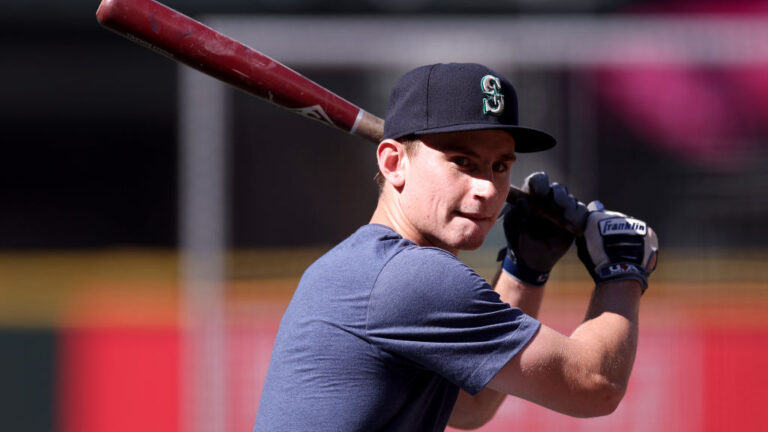
Well before the Mariners selected Emerson with the 22nd pick in the 2023 MLB Draft, Emerson had endeared himself to evaluators with the advanced nature of his game. The kid always hit despite being one of the youngest in his class, highlighted by a superb performance for USA Baseball’s 18U National Team the summer prior to the draft.
It was immediately more of the same in pro ball, making his debut shortly after the draft and his 18th birthday, where he tore through the complex with 15 hits in eight games before posting a 149 wRC+ in 16 Low-A games.
As is the case with many advanced young hitters, the wait for the power becomes the most fascinating variable, especially when there’s clearly room for more. He added roughly 20 pounds to his frame ahead of the 2024 season, but the exit velocities were mostly unchanged, along with a ground ball rate that was still elevated.
Injuries likely didn’t help, dealing with a foot fracture in 2024 that limited him to just 70 games and a hamstring issue that cut his Arizona Fall League stint short. Even as I split hairs, it’s worth noting Emerson hit to a .263/.393/.376 line in Low-A and High-A in what was mostly his age-18 season, with the aforementioned food fracture sandwiched in between.
Emerson entered this season fully healthy and ready to make up for lost time.
How Emerson Has Evolved in 2025
Through the first few months of the 2025 season, Emerson continued to struggle to get the ball in the air. In 55 games at High-A, prior to making the adjustment I’ll touch on in a bit, Emerson hit just .243/.346/.374 with a ground ball rate of 57%. Emerson’s feel for the barrel was still there, running a contact rate around 80% while striking out around 18% of the time.
The struggles to elevate were largely due to a lack of lower-half control. He had a tendency to drift onto his side, causing barrel drag and making it difficult to cover the top of the zone. In that 55-game span, he hit just .188 against four seamers and .147 when they were located in the top half of the zone.
With the barrel lagging behind his body, it causes the path to often be flatter even when he is barreling balls, sapping his game power. His hard hit rate was a respectable 41% during the pre-swing adjustment span, but his average launch angle on hard hit baseballs was just 3 degrees.

While the challenges were most evident against four-seamers, a premature and heavy drift onto the front side is, of course, going to make things more difficult against secondaries as well, with the tendency to roll over.
The Swing Adjustments
Starting on June 13th, Emerson ditched the leg kick in favor of a toe tap that has appeared to help him hold his back side more effectively. With his body not crashing forward prior to his swing, it is easier for him to create more barrel depth.

Getting on plane earlier widens his margin for contact while making it easier to work behind the baseball, creating more loft. The shift in batted ball data backs it up, both with his surface level numbers and the data beneath the hood.
| First 55 Games | .243/.346/.374 | XBH: 14 | GB%: 57% | Hard Hit LA: 3.3° |
| Last 49 Games | .320/.419/.519 | XBH: 23 | GB%: 37% | Hard Hit LA: 12.4° |
Of course, to make such a significant shift in the slash line, you pretty much have to be better against all pitch types, but he is specifically covering elevated four-seamers and spin a lot more easily.
Emerson’s slash line on four-seamers at the top half of the zone is essentially in a different stratosphere. After hitting .147 with a .294 slug against elevated heat in the first 55 games, Emerson has since improved that line to .262 with a .571 slug.
His four homers on fastballs at the top half of the zone since June 13th nearly matches his home run total against all pitch types prior (5), while cutting his chase by nearly seven percent.
The improved barrel depth allows for Emerson to have a wider margin for contact against spin while his improved ability to hold his back side allows him to do more damage even when he is a bit fooled. The more effective path is resulting in plenty more loft in the bottom portion of the zone.
| First 55 Games | OPS: .742 | EV90: 103 MPH | ISO: .146 | Hard Hit LA: 3.3° |
| Last 49 Games | OPS: 1.054 | EV90: 106 MPH | ISO: .254 | Hard Hit LA: 12.4° |

The swing above is one of my favorite from his new and improved stretch. Not only would that likely be a rollover for Emerson in the past, he is elevating it with authority. Even the way he finishes his swing shows you how much more balanced his weight distribution is and the way that he is engaging his back side through his swing.
Emerson also has a better chance to do damage on his B swings, as well as there is more behind him even when he is pulled forward a bit prematurely. Before, he was pushing himself forward regardless of pitch type, really hindering his adjustability.
The B swing homer below on a good changeup is a club that Emerson did not have in his bag prior. His out-of-zone contact rate is up 10% since making the change and while this specific pitch happened to be in the zone, it is a prime example of the shift in batted ball quality.
Even when he is pulled out of his typical mechanics by a good pitch, he still has something behind him and a path conducive to backspin.

What’s the Long-term Outlook and Timeline?
Another huge wrinkle in Emerson’s development has been the strides he has made defensively at shortstop as well. Once viewed by some as a candidate to slide over to third base, Emerson looks like an above-average defender at short; he is attacking the ball with confidence, with a good internal clock and comfort throwing from different angles.
Making such strides as a 19/20-year-old on both sides of the game played a big part in his rise to No. 5 overall on our top 100 prospect update and the Mariners’ confidence to promote him to Double-A at the start of August.
Emerson may not offer tools that jump off of the page, but you’d be hard pressed to poke a hole in his game…especially as he has tapped into what looks like at least average power. He’ll likely get his second taste of Double-A to start the 2026 season with a chance to debut late in the year if he continues on his accelerated pace.
The Mariners feel like they have their shortstop of the future and the timeline fits nicely with J.P. Crawford’s contract set to expire at the end of the 2026 season. Crawford has had a nice career with the Mariners, highlighted by a 2023 season that saw him put up a .380 OBP, 19 homers, a 136 wRC+ and 4.9 fWAR.
With the way Emerson is tracking, it wouldn’t be outrageous to look at Crawford’s career year as something the 20-year-old could potentially replicate more consistently.

Written by
Aram Leighton is the Co-Founder and Executive Editor for Just Baseball. A Syracuse University grad, Aram is one of the hosts of the Just Baseball Show…