
What Was Yordan Alvarez Really Coming Back From?
Alvarez was amazing. I'm just not sure he was the Comeback Player of the Year.
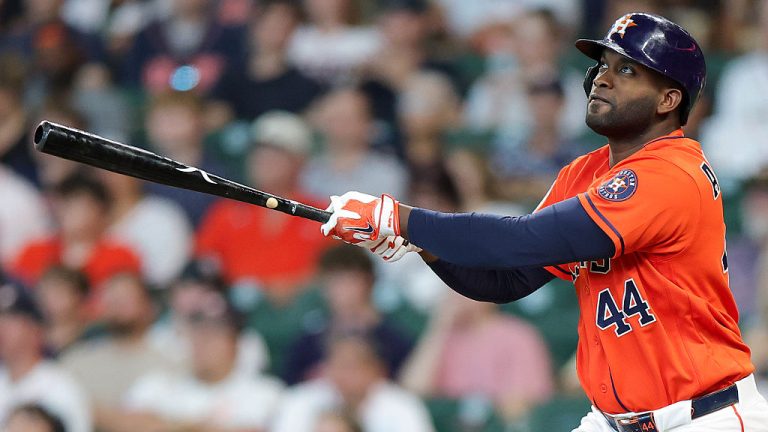
Yordan Alvarez is going to need a bigger trophy case.
On Wednesday, the Houston Astros’ slugger took home his first Hank Aaron Award, presented to the top hitter in each league. He also ended Shohei Ohtani’s five-year reign as the Edgar Martinez Outstanding DH Award winner. The next night, Alvarez was revealed as the unanimous choice for AL MVP.
However, the honor I want to talk about today isn’t his MVP, Hank Aaron Award, or Edgar Martinez Award, nor is it his batting title, All-MLB First Team selection, or the Silver Slugger he’s bound to win in the coming days. Rather, it’s a different prize that doesn’t usually go to players who collect all that other hardware: the Comeback Player of the Year.
Major League Baseball has officially honored a Comeback Player of the Year in each league since 2005. In that time, only one other player has been named Comeback Player of the Year and MVP in the same season: Buster Posey in 2012.
That makes sense. Staging a comeback, whatever form it takes, will present its difficulties. Coming back to be the best player in your league is inevitably going to be even harder.
Yet, as I type this, I feel the need to stress that Posey and Alvarez, and their respective comebacks, are not one and the same. In 2011, Posey was an up-and-coming talent who suffered a devastating collision on a play at home plate – a collision so dangerous that MLB introduced a new rule to prevent it from happening again.
In contrast, Alvarez was already an established superstar in 2025. He lost the bulk of his season to a small fracture in his finger and, later, a sprained ankle.
I don’t mean to diminish how disheartening the year must have been for Alvarez, especially considering his broken finger was initially misdiagnosed. Still, I think his selection for this award raises some fascinating questions about what a comeback really is.
How Can You Come Back If You Never Really Left?

The Comeback Player of the Year has become one of my favorite awards.
Easy access to statistics, the widespread adoption of advanced metrics, and the prevalence of betting odds have removed so much of the mystery and debate surrounding who will and who should win the major awards, like the MVP and Cy Young.
That’s because the criteria for those awards are relatively straightforward, and it only takes a handful of stats to identify the most likely (or most deserving) recipients.
Comeback Player of the Year is different. According to MLB.com, it was introduced to recognize players who “re-emerged on the field.” But what does it mean to re-emerge? That’s up for each individual voter to decide.
I wrote about this question for FanGraphs a few years ago. So, to avoid repeating myself, I’ll share a few thoughts directly from that article.
There is a difference between the best comeback and the best comeback player. The former implies a player who saw the most significant year-over-year-over-year decline and subsequent improvement in his numbers; the latter conjures up an image of the best overall player who had some sort of bounce-back season.
Does a comeback season necessitate a deep, underlying improvement in a player’s profile, or are the surface-level numbers more relevant?
There’s no easy answer for how long a player has to struggle for his reemergence to qualify as a comeback.
Voters also have to consider what, exactly, the candidates are coming back from. The most straightforward answer is a prolonged slump or decline phase… It gets more complicated when we consider injuries; from which injuries must a player come back rather than simply return?
That last point is particularly relevant when it comes to Yordan Alvarez. I’m not convinced he actually came back, because I never thought he went anywhere in the first place.
No player in MLB saw his fWAR drop further from 2024 to ’25 than Alvarez. He went from a 5.2 fWAR campaign in 2024 to a 0.6 showing the following year.
Then, as you might imagine, no player in MLB saw his fWAR rise higher from 2025 to ’26. Alvarez bounced back for 6.8 fWAR this past season – more than a six-win improvement.
If the Comeback Player of the Year could be boiled down to a few numbers, he would have a rock-solid case.
Yet, the reason Alvarez saw his WAR drop so precipitously in 2025 was that he only played 48 games. He hit the injured list in early May with what the Astros called right hand inflammation. They later discovered he had a small fracture in his ring finger. He finally returned well into August… only for a sprained ankle to end his season in mid-September.
There’s no doubt it was a frustrating lost season for one of the most talented hitters of his generation. But that’s just it. It was so frustrating to watch because we all knew Alvarez could (and would) have been so much better if he were healthy.
In the 48 games he managed to play, he posted a .797 OPS and a 118 wRC+. Numbers like that would be worth celebrating for most hitters, but they were a huge step back for Alvarez. We’re talking about a player who came into the year with a career .973 OPS and a 166 wRC+.
A near-200-point drop in OPS is genuinely concerning. If his injuries weren’t just keeping him off the field but also hurting his performance on the field, there would have been more legitimate reason to worry about Alvarez entering 2026. Except there wasn’t.
Take a look at his Baseball Savant percentile rankings in 2024, ’25, and ’26. According to all of these quality-of-contact and plate discipline metrics, he was almost exactly the same hitter all three years:
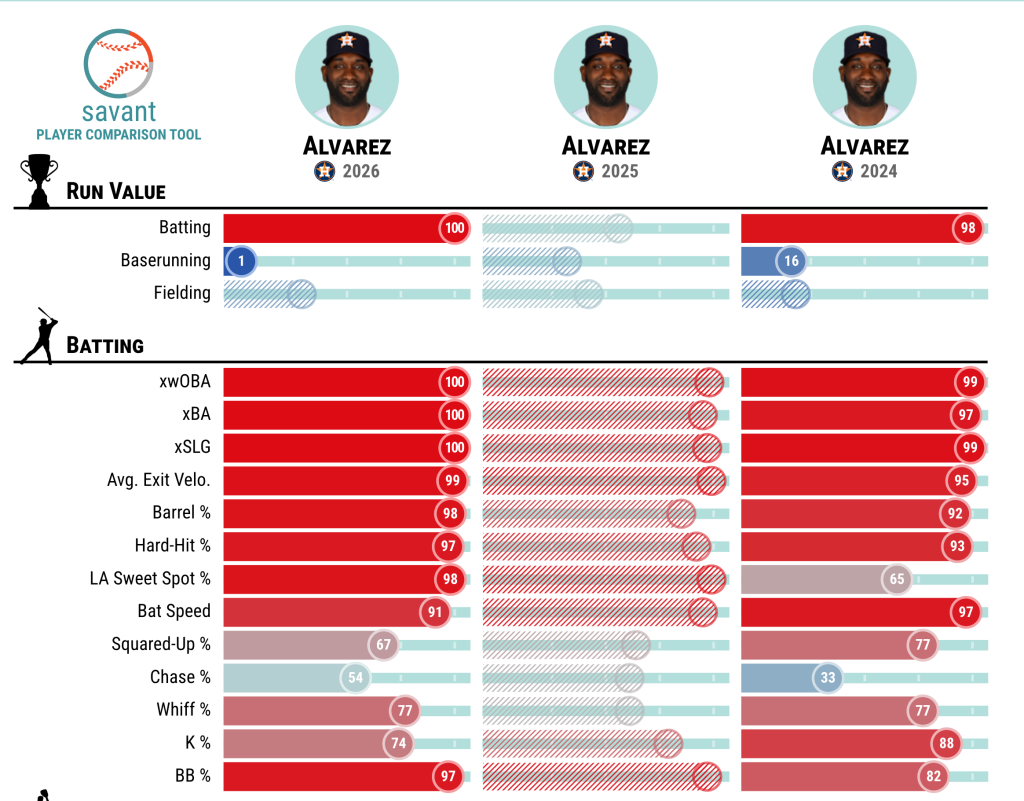
If Alvarez had taken enough plate appearances to qualify in 2025, his average exit velocity would have ranked second in the AL. His hard-hit rate and xwOBA would have ranked fourth.
I should also point out the difference in his numbers from before his first IL stint (.646 OPS and 75 wRC+ in 29 games) and after (1.031 OPS and 185 wRC+ in 19 games).
In other words, the only cause for any kind of concern about Alvarez was his poor performance in a month-long sample in which he was playing through injury. In other other words, there was no cause for concern at all. Alvarez has returned from numerous injuries in his career and never stopped mashing. He has also had multiple 29-game stretches of similarly poor performance. That’s just called being a baseball player.
Despite his lost time and uncharacteristic surface-level numbers in 2025, Alvarez entered 2026 with some of the rosiest projections in the league. ZiPS, Steamer, and PECOTA all saw him as a top-five hitter in MLB and the second-best in the AL, behind only Aaron Judge.
Similarly, when Just Baseball’s Peter Appel ranked his Top 100 MLB Players ahead of the season, he had Alvarez in the top 20 overall and the top 10 among AL position players. That’s an inner-circle stud.
So, I return to the question that sparked this article. Did Alvarez really come back at all? Did he re-emerge?
Maybe you think he did. Fair enough! Clearly, a plurality of members on the voting panel agreed. His year-to-year fWAR presents a good case, and the narrative is compelling too. The oft-injured superstar set a new career high in games played and might have even put himself back on a Hall of Fame trajectory.
There’s also the matter of considering who else it could have been. Maybe you wouldn’t call Alvarez the perfect candidate, but you just don’t see a better choice. That’s also fair. Off the top of my head, I could make a case for Foster Griffin, Shane McClanahan, Gerrit Cole, or even Reid Detmers. Still, I agree there’s no obvious right answer.
Even so, I’m not sold. Before anyone can “re-emerge,” they must first disappear, or at least retreat. To me, in a baseball context, that means I need at least some reason to doubt the player in question will ever reach his once-great heights again.
I had my doubts about plenty of players in 2026. But I never had a shred of doubt when it came to Yordan Alvarez.
Become a Member of Just Baseball
Subscribe and upgrade to go ad-free!
* Save 25% by subscribing annually.

Written by
Leo Morgenstern is one of the managing editors for Just Baseball. He is also the managing editor at Jays Centre. His writing has appeared all over…