
Under-the-Radar Free Agent Options for Each Position
These players won't command top dollar in free agency, but they could fill a hole for your favorite team in 2027.

MLB’s CBA negotiations with the players’ union will certainly impact the offseason. I’m sure that we’ll see a vast number of changes, teams operating in a different manner, and even the potential of a salary cap/floor. While we don’t know the exact details of what will be changing, we certainly know that there will be change.
One thing that is not changing is everybody’s excitement to play hypothetical general manager over the offseason. This player makes sense, that hole needs to be filled, this trade would be a perfect fit, and so on. Don’t get me wrong, it’s one of my favorite games as well.
However, not every single team can operate in the same manner. Budgets and historical data tell us that a chunk of the league will not be competitive or interested in shelling out top dollars for impact free agents. The ol’ bargain bin hunters.
Small-market teams especially have to hit on these smaller deals. Their margin for error is much smaller, although their need to fill the position might not be. Today we’re going to look at under-the-radar free agents for each position, and you can decide if any of these players fit your favorite team’s needs.
Starting Pitcher
Kris Bubic – 55 IP, 3.76 ERA, 3.54 FIP, 9.16 K/9, 4.25 BB/9
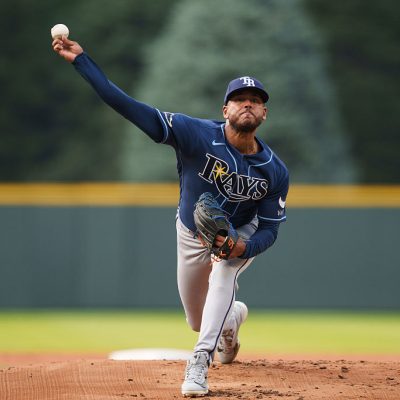
Bubic is a name that everybody is familiar with. A promising lefty who has always come with a “what if” scenario due to a long list of injuries. There’s never been a question about his talent, but staying on the field has held him back time and time again.
A low-90s fastball that still carries a 25%+ whiff rate due to a high IVB paired with a good changeup and sweeper has always given Bubic strikeout upside. Not only can he produce swing-and-miss, but he rides a high groundball rate, giving him a combination that can easily lead to success. The only problem is deciding how much of a risk your team is willing to take.
To me, Bubic is worth the roll of the dice, especially for teams that cannot afford high-end, top-tier pitchers.
Tarik Skubal, Trevor Rogers, Matthew Boyd, Robbie Ray, Shota Imanaga, and Foster Griffin are a few of the lefties who are available in free agency that might be a better fit for certain contenders. If a small-market team is willing to take a risk and give Bubic multiple years, potentially with some options, they might be able to land a high-upside lefty.
Relief Pitcher
Tyler Alexander – 3.70 ERA, 3.10 FIP, 7.40 K/9, 2.84 BB/9
You could pick from a number of arms and make a compelling case for them to be on this list, but I’ll go with Alexander. The former starter has converted well into a Swiss Army knife piece out of the bullpen, being used in multiple situations, including to pitch bulk innings, as an opener, and for matchups against lefties.
When you watch Tyler Alexander pitch, nothing’s going to jump off the page. He’s a low-velocity pitcher who relies heavily on his sweeper against lefties and a plus changeup and cutter against righties to navigate lineups. Generates enough swing-and-miss, but producing groundballs and weak contact is his bread and butter.
Maybe I overvalue arms who can pitch well in different roles, but I always find it important for bullpens to have such players. Texas made some changes to his pitch sequencing and allowed him to rely on his four-seamer less, and the results were better. I’d be happy to sign up for Alexander and see if you can compound these changes into results.
Catcher
Jake Rogers – .161/.276/.287, 4 HR, 61 wRC+
If you think Rogers is a bad answer for this exercise, you are right. This goes to show just how weak the free agent catcher market is outside of the top three names, who all have red flags of their own. You could sign up for 37- or 38-year-old catchers who are similar to Rogers, or you can go with a younger option.
We’ll keep this extremely simple. Rogers provides little to nothing offensively but has always been praised for the way he manages a pitching staff and plays behind the plate. He’s going to be cheap, and should only be relied upon as a backup, so expectations should be relatively low.
First Base
Ryan Mountcastle – 8 games in 2026 due to injury
I know, I know, we’re heading into 2027, not 2023. Mountcastle is far removed from his best seasons in Baltimore, has dealt with a few injuries, and has not shown much in the past couple of years. To expect him to join your team and give them a healthy 162 while hitting for power might be a little too pie-in-the-sky for some. And you are probably right.
The good news is Mountcastle doesn’t have to be an everyday answer for your team. If he’s brought in as a flier who could be an answer on the short side of a platoon, he’s worth the risk. An .811 career OPS off lefties is helpful, and he has always posted great batted-ball data. There’s a non-zero chance he turns out to be more, but a baseline of being the short-sided platoon bat isn’t too bad.
I can’t imagine Mountcastle gets anything more than a one-year deal for very little money. What’s the risk? A couple million dollars? I could see the fit on both contenders and rebuilding teams. You either get a short-side platoon or you roll the dice, play him every day, and hope to move him at the deadline.

Second Base/Third Base/Shortstop
Edmundo Sosa – .247/.283/.429, 9 HR, 89 wRC+
Sosa has spent the past few seasons in Philadelphia as one of the better bench players in baseball. His versatility was stretched even further in 2026, as he appeared in more games in left field than any other position. Still, I’m not cheating by placing him in the infield for this exercise.
While I might not view Sosa as an everyday starter, I do view him as one of the best bench players and someone you often need on winning teams. A veteran who can play all over, comes with a ton of experience, has some pop, and is a good defender? Sign me up.
I don’t expect Sosa to get paid like a starter, which makes him an option for just about any team. If your starter did go down and Sosa had to fill in, you wouldn’t lose much sleep. Worst-case scenario, he is a short-side platoon infielder that gives your team a stronger bench and a veteran leader.
Mauricio Dubón – .276/.321/.399, 12 HR, 99 wRC+
A lot of what I said about Sosa can be copied and pasted here.
Dubón is one of those glue guys that every winning team always seems to have. A fantastic defender who can literally play all over the field, hits lefties well, and puts the ball in play is the type of player managers will always value. Don’t underestimate how important it is to have a good defender that can plug in for any injury.
Dubón is certainly not known for his bat, but it isn’t a complete zero. Power’s never been part of his game, but he is coming off a career-high 12 home runs in 2026 while also posting a career-best 99 wRC+. Back-to-back years of posting at least a 2.2 fWAR while playing over 130 games for Houston and Atlanta, real contenders, speaks for itself.
I cannot think of a team that couldn’t use a player like Dubón.
Outfield
Michael Conforto – .240/.331/.469, 15 HR, 119 wRC+
Conforto might not be the same player he once was back in his Mets days, but I think the way Chicago used him last season was intriguing and a recipe for success. The occasional start at DH with a bench role in the corner outfield, but most importantly as a crucial pinch-hitter.
Conforto still offers a very professional at-bat and enough pop to change the game with one swing. He was strategically used often as a pinch-hitter in big moments or late-game situations, hunting matchups, and you could tell he took pride in that identity. A .303/.361/.788 slash with four home runs as a pinch-hitter is impressive.
I would copy and paste the exact role that Chicago used him in last year. Some starts against righties, a bat off the bench, and a veteran leader who could help a young team. Maybe I’m ridiculous, but I still believe Michael Conforto is a solid hitter.
Become a Member of Just Baseball
Subscribe and upgrade to go ad-free!
* Save 25% by subscribing annually.

Written by