
Luis García Jr. Has Found His Power at First Base
The Nationals' offense has been scorching, and beyond the usual suspects, Luis García Jr. has emerged as one of the biggest catalysts thanks to a massive power surge.
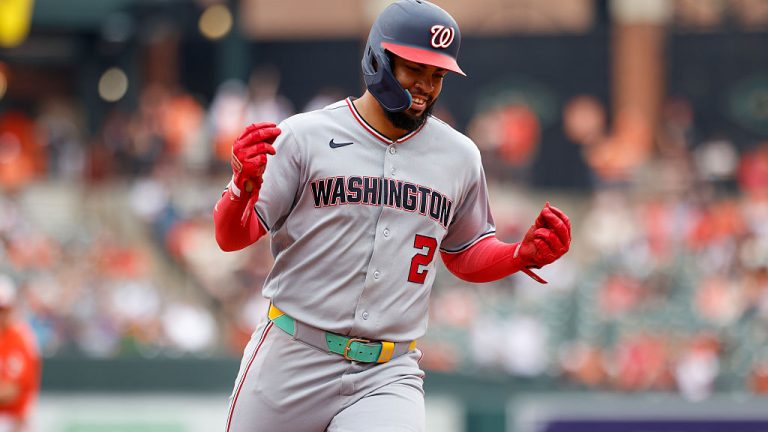
The 2026 Washington Nationals have soared to heights they haven’t experienced in years, largely thanks to their incredible offense.
While All-Stars like CJ Abrams and James Wood might steal the show at first glance, an offense doesn’t end up leading the league in runs scored and sitting amongst the top five in home runs, OPS and wRC+ from just two productive hitters.
Luis García Jr. has been one of those complementary pieces, emerging as a driving force behind the Nationals’ offensive breakout this season and elevating his game to a whole new level.
The Nats knew they had something with García after his 2024 campaign where he posted a career-high 110 wRC+ and 3.0 fWAR. However, after a dreadfully poor season both at the plate and in the infield at his natural second base position in 2025, Washington sought out a change for García in 2026.
In 139 games spent mostly at second last year, García followed up his career year with a 91 wRC+ at the dish and poor defensive metrics, headlined by -17 DRS and -7 OAA.
What remained, though, was his power. After a career-best 18 homers in ’24, he followed that up with a similar mark of 16 in ’25.
And this season, after moving García one space over in the infield to first base, he’s kicked his power metrics into another gear, surpassing his career-high home run total already, and it’s only the beginning of July.
Stats were taken prior to play on July 7.
Luis García Jr. Is Putting MLB on Notice With His Immense Power Boost in 2026
Through 299 plate appearances and 85 games, the Nationals’ first baseman already has 19 homers, placing him second on the team and within the top 20 in all of baseball. He’s tied with traditional power threats like Pete Alonso, Pete Crow-Armstrong, Shohei Ohtani, and Juan Soto.
His power isn’t defined solely by home runs, though. His .558 slugging percentage, which leads the Nationals and ranks sixth in baseball, reflects his ability to drive the ball all over the field, as evidenced by his 16 doubles and three triples.
Looking deeper at his underlying metrics, García has seen a very noticeable shift across the board in quality of contact statistics. He’s hitting the ball harder, barreling more baseballs, swinging the bat faster, and producing much higher average exit velocities.
| Stat Type | 2025 Result (Percentile) | 2026 Result (Percentile) |
| Hard-Hit % | 45.8% (63rd percentile) | 47.1% (81st percentile) |
| Barrel % | 9.0% (50th percentile) | 10.5% (65th percentile) |
| AVG Exit Velocity | 90.2 mph (55th percentile) | 92.1 mph (89th percentile) |
| Bat Speed | 72.4 mph (55th percentile) | 73.5 mph (66th percentile) |
García’s expected metrics also reinforce just how legitimate this breakout has been. While he’s ranked in the 90th percentile or better in expected batting average (xBA) in each of the past three seasons, his expected slugging percentage (xSLG) has consistently lagged behind.
That changed in 2026, as he jumped from the 78th percentile in xSLG last season to the 88th percentile this year. Simply put, his increase in power has made him a more well-rounded hitter.
It’s not as of he’s changed his approach much, either, as his result output when it comes to fly balls, ground balls, and line drives remains all within a percentage point of his 2025 totals.
What he’s managed to do is attack opposing pitchers from more angles and use all fields, but most notably by pulling the ball more frequently—a change that has coincided with his power surge.
| Batted Ball Type | 2025 Results | 2026 Results |
| Pull % | 40.4% | 43.3% |
| Center % | 39.7% | 35.3% |
| Opposite % | 19.9% | 21.4% |
While nobody can answer that question except García himself, it’s not unreasonable to infer that his move to first base has helped alleviate some of the mental pressure he may have felt at second base after struggling defensively a year ago.
I’m not saying first base doesn’t come with its own difficulties; however, we’ve all seen the famous scene in Moneyball where Billy Beane moves the dead-armed Scott Hatteberg to first base, and Hatteberg immediately becomes a 3.2 fWAR player after posting -1.2 fWAR as a catcher in Boston the year prior.
The amount of ground García needs to cover now is far less than at second, and the routine is a lot easier and more predictable at first. And average to near-average totals in DRS and OAA (0 and -1, respectively) only fuel this argument.
The Nationals were staring in the face of potential one-hit wonder in García. But one positional change has given them a legitimate big three with García complementing their All-Stars in Wood and Abrams. And there’s certainly reason to believe he should be there in Philly next week right alongside them.
Not all great offseason additions come from external acquisitions. Sometimes, the biggest improvements come from maximizing the talent already on the roster, and the Nationals’ handling of García is proving exactly that.
Become a Member of Just Baseball
Subscribe and upgrade to go ad-free!
* Save 25% by subscribing annually.

Written by
Caleb Moody is a contributing writer for Just Baseball and has been covering topics across Major League Baseball with them since he started as an intern…