
Justin Wrobleski Is the Dodgers’ Latest Pitching Revelation
Justin Wrobleski has been remarkably consistent in his first season as a full-time starter, even if the underlying numbers suggest some regression may be ahead.
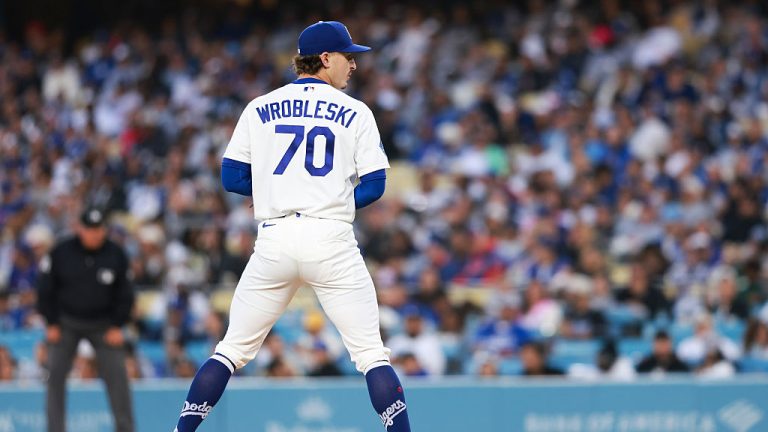
The Los Angeles Dodgers have built a reputation over the past decade for doing something few organizations can consistently replicate.
Every time injuries and underperformance threaten to derail their rotation, someone unexpected seems to step forward.
Mike Bolsinger helped stabilize the staff in 2015, pitching to a 3.08 ERA into the All-Star break over 73 first half innings.
Alex Wood became an All-Star in 2017.
During an injury-riddled 2018 season, Ross Stripling became an All-Star and Walker Buehler broke into the majors to carry a significant workload.
Tyler Anderson and Tony Gonsolin were All-Star revelations in 2022.
Bobby Miller emerged as the team’s No. 3 starter as a rookie in 2023.
While some of those seasons proved to be little more than memorable snapshots of careers that never quite reached those heights again, every one of them played a significant role in the Dodgers’ success and helped position the club for October.
Justin Wrobleski appears to be the latest name added to that list.
Whether his breakout proves sustainable is still very much an open question. But regardless of what the next few months bring, there is no denying what he has meant to the Dodgers through the season’s first three months.
With Blake Snell, Tyler Glasnow and others spending significant time on the injured list, while Roki Sasaki and Emmett Sheehan have struggled to find consistency, Wrobleski has become the third-most dependable starter on a club with baseball’s best record.
More Than Just An Innings Eater
When the Dodgers moved Wrobleski from the bullpen into the rotation in early April, the expectation was simply for him to hold down the back end until reinforcements arrived. He’s done much more than that.
Across 13 starts since joining the rotation on April 6, the left-hander owns a 2.51 ERA, a 1.00 WHIP and a 9-2 record while throwing 82.1 innings — second on the club only to Yoshinobu Yamamoto over that span. His nine quality starts trail only Yamamoto and Shohei Ohtani on the Dodgers.
Overall, among qualified starters across baseball, his ERA ranks 13th while his WHIP ranks seventh. He has surrendered just 68 hits, walked only 18 batters and allowed seven home runs. Those are All-Star caliber numbers.
Advanced value metrics agree that he has been an extremely valuable contributor. His 1.9 bWAR and 1.8 fWAR place him alongside names like Zack Wheeler, Dustin May and Michael Busch.
Consistency Has Been His Greatest Strength
The remarkable part of Wrobleski’s season is how rarely he’s had an off night. Since joining the rotation on April 6, he has completed at least five innings in every start except one, when he fell just one out short. More impressively, he has allowed two earned runs or fewer in 10 of his 13 starts.
Even his rough outings deserve additional context.
Against Atlanta, baseball’s hottest team and owner of the best record at the time of the matchup, Wrobleski surrendered four runs in the second inning before retiring hitters over the next five frames. Because the Dodgers trailed throughout the game, they left him in to absorb innings, eventually finishing 8.2 frames after allowing three late runs.
The final line looks ugly, but it was a sacrifice in service of his teammates, keeping a taxed bullpen fresh.
A few starts later in Milwaukee, a four-run first inning could have sunk him. But instead he regrouped to finish five innings.
The same thing happened more recently in Pittsburgh. After Los Angeles built an early lead, one difficult fifth inning (four runs allowed) inflated his line before he departed.
Outside of the four-run second against Atlanta, the four-run first against Milwaukee and the four-run fifth against Pittsburgh, Wrobleski has surrendered only 11 earned runs across 79.2 innings as a starter. That’s a 1.24 ERA.
So, while the occasional big inning haunts him, everything surrounding those innings has been outstanding. There also aren’t many obvious situational weaknesses.
He owns a 2.50 ERA at Dodger Stadium and a 2.89 ERA on the road. He has pitched well during day games and night games alike. Opponents are hitting just .190 against him with the bases empty and only .205 with runners in scoring position.
The first trip through the lineup has been his least effective, with opponents batting .263. The second time through, that average plummets to .163 before climbing only slightly to .208 during the third trip.
A Different Pitcher Than He Was Last Year
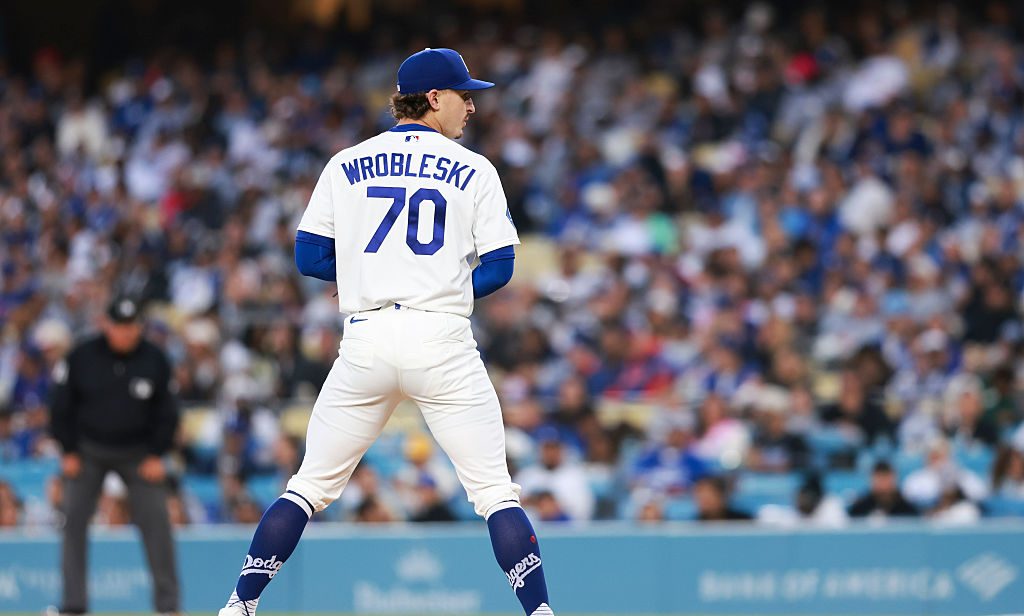
Last season, working primarily as a reliever, Wrobleski attacked hitters with a much more varied pitch mix. His four-seam fastball accounted for just 29% of his pitches, while he leaned heavily on his sinker, cutter and a broader mix of secondary offerings.
This season, the four-seamer has become the centerpiece.
He throws it half the time, pairing it primarily with a slider that now makes up another 31% of his arsenal. The sinker has become more of a complementary pitch, especially against left-handed hitters, while the cutter has almost disappeared entirely.
His fastball has gone from producing an average run value in 2025 to ranking in the 99th percentile this season. Overall pitching run value has climbed into the 96th percentile, driven almost entirely by the effectiveness of that four-seam fastball.
But it’s an unusual profile. Most pitchers who transition from relief to the rotation lose effectiveness with their fastball as velocity drops.
That has happened here, too. Wrobleski’s average fastball has fallen from 95.6 mph to 94.1.
It hasn’t mattered in part because he’s locating it exceptionally well, particularly at the top of the strike zone, and hitters have struggled to do meaningful damage against it. Opponents are batting just .185 with a .370 slugging percentage against the pitch, making it one of the more effective fastballs in the National League despite relatively ordinary velocity.
The Numbers Suggest Regression Is Coming
For as impressive as Wrobleski’s season has been, the underlying metrics paint a much different picture than the surface numbers.
His 2.71 ERA comes alongside a 4.32 expected ERA. His 3.62 FIP remains respectable, but his 4.50 xFIP points toward more regression than improvement.
Wrobleski’s strikeout rate has fallen dramatically from 27.1% as a reliever to just 15.4%, ranking in only the seventh percentile league-wide. His whiff rate has dropped all the way into the fourth percentile, meaning very few hitters are missing his pitches.
At the same time, opponents are making plenty of quality contact. His average exit velocity allowed, hard-hit rate and expected batting average all rank near the bottom of the league.
Ordinarily, that combination produces far more runs.
So why hasn’t it?
The answer begins with his command.
Wrobleski owns one of the best walk rates in baseball, ranking in the 93rd percentile. He rarely gives away free bases, forcing opponents to string together multiple hits in the same inning.
He also has shown an ability to avoid the one mistake that hurts pitchers most. Despite allowing plenty of contact, he has surrendered only seven home runs over 86.1 innings.
There is almost certainly some good fortune involved in those outcomes. Pitchers rarely maintain such a large gap between their ERA and expected numbers indefinitely.
That doesn’t necessarily mean collapse is coming. More likely, it means the 2.71 ERA eventually begins moving closer toward the mid-3.00s
What Happens When Everyone Returns?
This becomes one of the Dodgers’ more fascinating decisions.
On paper, a healthy rotation featuring Yoshinobu Yamamoto, Blake Snell, Tyler Glasnow, Shohei Ohtani, Emmett Sheehan and Roki Sasaki leaves little room for Wrobleski.
But the Dodgers know as well as anyone that pitching depth is a necessity.
And, even if his ERA rises, Wrobleski has outpitched Sasaki and Sheehan considerably. He works into games. He pounds the strike zone. Most importantly, he gives one of baseball’s best teams a chance to win nearly every time he starts.
Could he eventually shift back into a multi-inning relief role? Perhaps.
Has he earned the opportunity to remain in the rotation as long as performance allows? Absolutely.
Even if Wrobleski follows the path of former Dodgers lefties Alex Wood and Tyler Anderson—All-Stars whose peaks ultimately proved relatively short-lived—there is no doubt he has already left his imprint on a club chasing the ultra-rare three-peat.
He’s been one of the club’s steadiest starters, one of the biggest reasons Los Angeles owns baseball’s best record entering the second half, and another reminder that no organization develops and deploys pitching depth quite like the Dodgers.
Wrobleski is fiery. He’s gritty. He’s got moxie. You can’t project intangibles, but sometimes your eyes tell you as much as the numbers do. Wrobleski pitches with a level of conviction, swagger and confidence that suggests he’ll weather whatever regression comes his way and continue taking meaningful innings for the Dodgers deep into the dog days of summer, and perhaps into October as well.
Become a Member of Just Baseball
Subscribe and upgrade to go ad-free!
* Save 25% by subscribing annually.

Written by