
Has Kodai Senga Found His Ideal Role as Mets Closer?
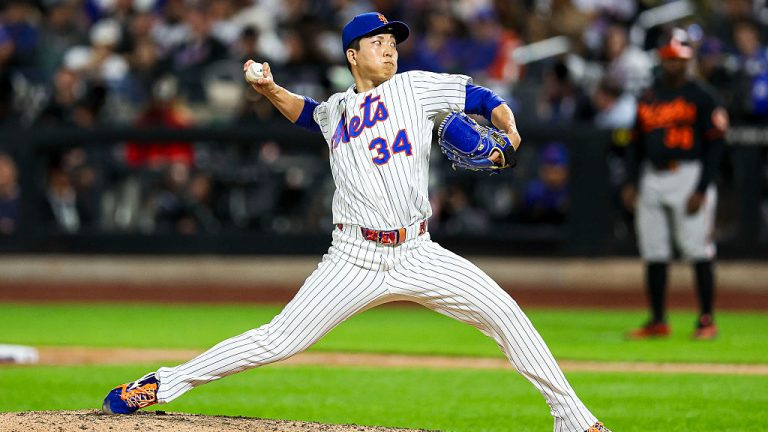
The Mets appear to have found the ideal role for Kodai Senga, as he's been largely successful in his first try at closing out ballgames.
Despite a season full of countless failures for the New York Mets in 2026, they may have found a victory as the season winds down.
Kodai Senga’s major league career ebbs and flows about as much as possible. From looking like a future frontline starter during his rookie season to back-to-back injury-riddled campaigns, Senga now makes a last-resort move into the bullpen that proves to be fruitful.
So far, the move has worked out well for the Mets, who simply did not know what to do with the right-hander after he struggled mightily as a starter in 2026.
Let’s take a deeper dive into why Senga could stick as a back-end reliever and what it means for New York moving forward.
Who Ya Gonna Call?
Prior to the trade deadline, the Mets’ bullpen was by far the strongest part of their roster. Despite closer Devin Williams struggling in his first year with the team, New York capitalized on the success of Luke Weaver, A.J. Minter, Huascar Brazobán, and Brooks Raley, dealing all four at the deadline.
Suddenly, the Mets have four open spots in their bullpen and opt to give Senga a crack at filling one of them. Add in the fact that the aforementioned Williams is on the injured list, and the door is wide open for Senga to get a shot.
In his first 15.1 innings since making a conversion to full-time reliever, Senga has pitched to a 2.35 ERA and converted seven of his eight save opportunities. The only blown save came on Tuesday, when Baltimore’s Pete Alonso dramatically blasted his 300th career home run to tie the game in the ninth inning.
Taking a deeper look, it becomes clear why the Mets had the idea to transition Senga to the bullpen following his struggles as a starter. The 33-year-old uses a pitch mix that is typical of relievers: a high-velocity fastball with a strong off-speed offering to play off the heater.
In Senga’s case, that off-speed pitch is his now-infamous “ghost fork,” which he uses 26.8% of the time this season. Additionally, his fastball has come back to life after transitioning to the bullpen, reaching as high as 100 mph on the radar gun in early August.
The effects of allowing Senga to only have to toss one inning and throw at maximum velocity without having to conserve energy for later innings pay dividends. He also almost completely ditched the cutter and sweeper in favor of a two-pitch mix, fully embracing his role as a closer.
The quality of his stuff is never in question; it is the reason why the Mets sign him prior to the 2023 season. Now, Senga maximizes his talent in shorter outings, with the potential to slam the door on wins as a key part of New York’s roster.
Could the Back-End Be Senga’s Long Term Home?
2027 is the final year of Senga’s five-year, $75 million deal with New York. In today’s market, that is not a bad price point for a player who could be an effective back-end reliever.
Senga will certainly be on the Mets’ roster next season, and following his success out of the bullpen this year, it is safe to assume that he will continue to pitch in that role next season.
It is hard to find a player in baseball who has had as confusing a career as Senga. There is no telling if he can be effective out of the bullpen over the course of a full season. It seems as if every time things appear to be trending in the right direction, he takes a nosedive in the opposite direction, whether due to injuries or poor performance.
This transition will force Senga to take on an entirely new routine, especially during the offseason, as he will not be ramping up to throw 85–100 pitches every fifth or sixth day. Instead, he will be ramping up to throw 15–20 pitches in one high-intensity inning.
Tack on the possibility that Senga would potentially have to pitch on back-to-back days, and this situation becomes even hairier. One problem that he has caused during his time in the big leagues is his preference to pitch on five or six days’ rest, which he became accustomed to in Japan. For years, the Mets built their rotation a certain way due to Senga’s demand to remain on that schedule stateside.
It is nothing short of a major adjustment, and there are countless examples of pitchers who have failed to convert from the rotation to the bullpen or vice versa. Senga has the talent, but it remains to be seen whether or not he has the fortitude to convert himself into a reliever and be an impact arm out of the bullpen for the Mets in 2027.
Become a Member of Just Baseball
Subscribe and upgrade to go ad-free!
* Save 25% by subscribing annually.

Written by
Joe Browne is an aspiring sports journalist and is currently a sophomore at St. John's University. Joe is a lifelong Mets fan who is also passionate…