
Zac Gallen Continues To Trend in the Wrong Direction
Gallen signed a prove-it deal with the Diamondbacks this winter. So far, the only thing he has proven is that he's not the same pitcher he once was.
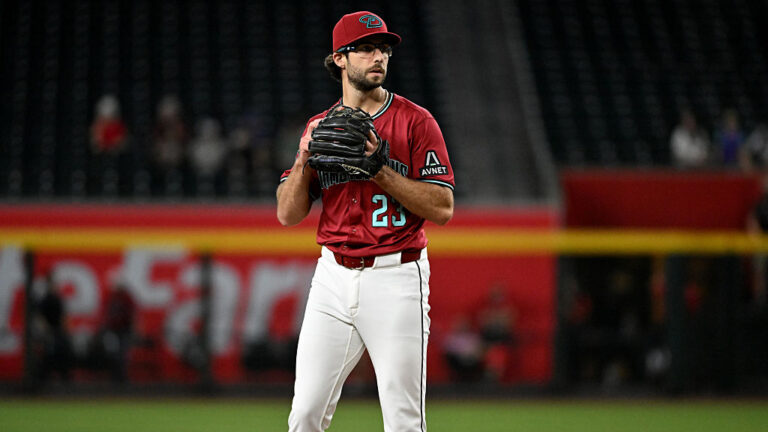
Ahead of the 2025 season, the Arizona Diamondbacks inked Corbin Burnes to a six-year, $210 million deal that helped establish one of the best rotations in baseball. Well, at least on paper. Burnes was the ace, with Zac Gallen, Merrill Kelly, Brandon Pfaadt, and Eduardo Rodriguez rounding out a rotation that mixed stars with proven veterans and a high-upside young arm.
Fast forward a little over a year, and the picture looks different. Burnes has been out with injury, Kelly is showing his age, Pfaadt did not take the next step, and Rodriguez is picking up some slack. And Gallen? He’s dropping like the Tower of Terror.
Gallen went from one of the better arms in the National League from 2022-2024 to settling for a one-year prove-it deal in 2026. So far, the only thing he has proven is that he’s not the same pitcher he once was.
Gallen’s Struggles Are Compounding
After a few consecutive years of Gallen leading the Diamondbacks pitching staff in most categories, earning an All-Star appearance in 2023, I was willing to view his 2025 as just a down year. We see pitchers have uncharacteristically down seasons only to bounce back the next year, and Gallen was too talented to write that off as a possibility.
However, after 13 starts this season, I think it’s fair to say Gallen’s struggles were not simply a down year, but a downward trend. In 2025, Gallen saw his K/9 drop to below 9.00 for the first time in his career, while more balls also started to fly over the wall, leading to a 4.83 ERA and 4.50 FIP.
Giving up hard contact was nothing new, and Gallen’s ability to generate groundballs usually saved him from too much damage. However, batters saw their barrel rate double from the year prior, and the result was 22 home runs against. The home run rate against Gallen went from 2.1% in 2024 to 3.8% in 2025, which happens to be the same number this season.
While Gallen’s 2025 season was not nearly up to his standard, it was still an acceptable season. 2026 has been a different story.
A 5.32 ERA and 5.02 FIP are ugly. What’s uglier is his 6.02 K/9, which flirts with the worst in baseball. He’s not walking many batters, and I do not think it’s due to amazing command but rather hitters squaring Gallen up before they even get deep enough in counts to potentially draw a walk.
Even when Gallen gets to two strikes, he’s not able to put batters away. So far, there have been 69 batters who have reached two strikes, and they are slashing .294/.355/.413, good for a .768 OPS. I think you can attribute these numbers to Gallen no longer having his put-away pitch.
When Gallen was at his best, his curveball was regularly producing a 40% whiff rate and served as his strikeout pitch more than any other offering. A pitch Gallen could start in the zone and have the bottom fall out, leading to swing and miss or topped baseballs that end up in an infielder’s glove. Once he started to lose some of the pitch’s effective movement, batters started to take advantage.
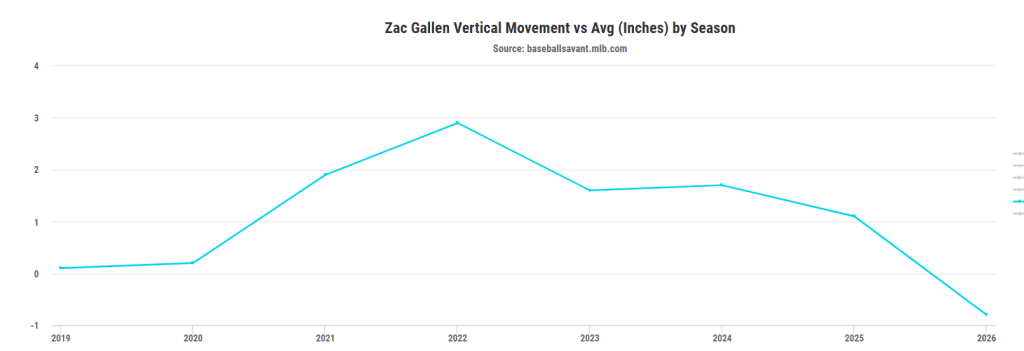
The graph above shows the vertical movement (drop) compared to the average curveball. In 2025, the pitch started to flatten out, and in 2026, that trend has only worsened. Pitches that start in the zone are no longer darting south in the same manner as before, which has led to more pitches batters can do damage on. The results speak for themselves.
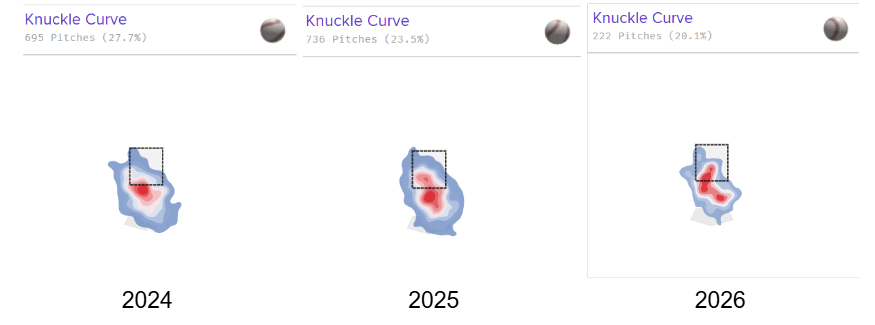
The heat maps above show the locations of batted balls off Gallen’s curveball from 2024-2026. In 2024, Gallen allowed only a .148 AVG and .230 SLG off the pitch, which ballooned to .219 AVG and .438 SLG in 2025 and a .300 AVG with a whopping .500 SLG in 2026.
In the three seasons from 2022-2024, Gallen allowed a total of nine home runs off his curveball. He allowed nine in 2025 alone. After using the pitch second most only to his fastball in 2024, he has dropped his curveball usage each year since, throwing it 8% less often this season than he did two years ago.
Losing the effectiveness of his best pitch has obviously caused fits for Gallen. The way he attacks hitters has changed; he’s leaning into his slider more, which is a rather pedestrian pitch from a movement and velocity perspective. If Gallen is going to turn it around, he’ll either have to regain his curveball or reinvent the way he pitches.
Falling Flat When Arizona Needs Him Most
Arizona knew that Corbin Burnes would miss a good chunk of the 2026 season due to his injury from last season. Coming back from Tommy John surgery is a long process, even without any setbacks. Instead of investing in a different arm to help lift the rotation, the Diamondbacks gave Gallen another chance.
The contract was a one-year deal worth roughly $22 million with $14 million deferred. A chance for Gallen to find his footing again in a place that was familiar and with a staff that saw what the best, and worst, versions of Gallen looked like.
There was no secret that Arizona’s rotation needed help. Michael Soroka has been an important add, but at the time, he looked closer to a flyer than a rotation stabilizer. Brandon Pfaadt came with concerns, and he’s already found himself back in Triple-A Reno. Eduardo Rodriguez yo-yos from productive to lost with the best of them.
The front office needed an arm that could anchor the rotation. Someone to step up and fill the ace void and provide a high floor until Burnes returned. Gallen was supposed to be the answer. Instead, he is creating more questions.
Not to mention, the Diamondbacks are not exactly a team oozing with cash. Giving out $22 million is not a move that they can afford to whiff on, especially when they have several needs both in the pitching and hitting departments. Injuries have shortened their depth, but so has not having the money to allocate to better options.
I’m not entirely sure what a fair expectation would have been for Gallen. Teams stayed away all winter and refused to pass out a deal with term for a reason. Even the most pessimistic projections would not have pointed to the numbers that Gallen has put up through his first 13 starts. While there’s still time for him to turn it around, what we have seen through nearly half of a season does not give me much confidence that he will.
Final Thoughts
A prove-it year that goes sour is something no one wants to see. Stability and security is what Gallen was hoping to earn ahead of another free agency, and all signs are pointing right back to where he was last winter. Hoping for something different. This time it will come with less money.
What happens from here will be interesting to follow. I still view Gallen as a talented arm, and at 31 years old, there are still plenty of years ahead for him. Every team needs an innings eater, and perhaps that is the title he’ll have to accept. But, a different team getting Gallen, tweaking a few things, and unlocking his former self is not out of the realm of possibility.
Become a Member of Just Baseball
Subscribe and upgrade to go ad-free!
* Save 25% by subscribing annually.

Written by