
From Card Collector to Cooperstown: How Josh Rawitch Preserves Baseball’s Stories
Starting from the fascination of being a young card collector, Josh Rawitch brings that passion to preserving history at the Hall of Fame.
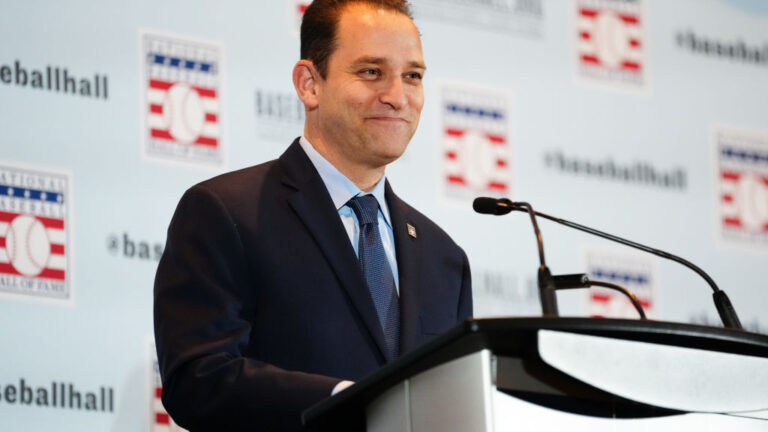
Josh Rawitch still sounds a little stunned when he talks about it.
“It’s crazy cool,” Rawitch said, “I grew up collecting cards. It’s kind of mind-blowing to see that I have my own card. Certainly not something I thought I’d ever have, but I love it.”
For Rawitch, the president of the National Baseball Hall of Fame and Museum, the moment was more than a novelty. It was a full-circle moment, a tangible link between the kid who once ripped open packs of baseball cards and the executive now responsible for preserving the game’s most meaningful artifacts for generations to come.
The same sense of connection between past and present, fan and game, sits at the center of Rawitch’s work in Cooperstown.
Falling in Love With the Game
Rawitch’s relationship with baseball didn’t begin in boardrooms or galleries. It started with a small envelope in the mail.
“The way I fell in love with baseball was my uncle sending me the very first pack of cards I ever got,” Rawitch said. “I can picture a couple of the random guys that were in there that I think of as my first cards.”
Those early moments stuck. Rawitch said the years between 1983 and 1991 became his formative era as a fan, a time when the game, its players, and their cardboard likenesses helped shape his identity.
Decades later, that same childhood fascination informs how Rawtich approaches the Hall of Fame’s mission: telling baseball’s story through artifacts that once lived inside its biggest moments.
Selecting What Belongs in Cooperstown
When artifacts arrive in Cooperstown, they are evaluated not just for their rarity but for the stories they carry.
“What we are often looking for is obviously things that are unique, things you can’t just find anywhere else,” Rawitch said. “But we also like things that tell stories, like game-used artifacts from modern-day events.”
This philosophy guided the Hall’s selections from the 2025 World Series, a Fall Classic that was one of the most compelling in recent memory. Rather than focusing on a single player, the Hall sought artifacts that reflected the depth of the postseason’s narrative.
Among Addison Barger’s cleats from his grand slam in Game 1, an item that freezes one explosive moment in time. Another was Trey Yesavage’s glove, chosen not solely for his historic Game 1 performance, but because it symbolized his entire postseason journey.
Another artifact came from Max Scherzer, whose baseball from the World Series marked the first time a pitcher appeared in the Fall Classic for four different teams.
Even the bats added layers to the story. Rawitch recalled the process of collecting Freddie Freeman’s bat and batting gloves, as well as Miguel Rojas’ bat, items that together reflected both individual excellence and made October so memorable.
“Our view is, how can we preserve it so that 50, 100 years from now, their grandkids or just any kids or adults that are coming to the Hall of Fame in 2125 can look at some of these major moments the way we look at Babe Ruth or Ty Cobb,” Rawitch said. “So that moment is preserved here for the sake of history.”
Capturing All of Baseball’s History
Preserving baseball’s history, Rawitch emphasized, means looking beyond Major League Baseball.
The Hall of Fame has made a conscious effort to collect artifacts that represent the game’s expanding global and cultural footprint, including new professional leagues outside of the U.S.
This includes interest in items from the new Women’s Professional Baseball League, as well as emerging international venues like the Baseball United League in the Middle East.
Rawitch said conversations with such figures, such as Hall of Famer Barry Larkin, have centered on capturing those moments early, even down to something as simple as a game-used ball, before they’re lost to time.
The goal, he said, is to ensure Cooperstown reflects the full scope of baseball’s evolution, not just its most familiar chapters.
Turning Artifacts Into Emotion
Collecting artifacts is only part of the Hall’s mission. How those objects are displayed, and how they resonate with fans, is equally important.
When building exhibits, Rawitch said the Hall considers its diverse audience, including visitors of all ages, backgrounds, nationalities, genders, and team fandoms. Different generations, he noted, consume content in very different ways.
“You see kids run straight over to touch screens and video games,” Rawitch said. “Adults are more likely to stop and watch a video. Older adults are more likely to read the text on the wall.”
Rather than forcing every visitor into the same experience, the Hall aims to create layered exhibits that speak to multiple audiences at once. In recent years, that has meant incorporating more technology, screens, and interactive elements alongside traditional displays.
One example is the Hall’s Hideo Nomo exhibit, which allows visitors to feel how Nomo held the baseball for his forkball, digging his fingers into the seams the same way he did on the mound. The tactile experience gives fans a physical connection to a pitching style that helped redefine the game in the 1990s.
For Rawitch, those moments of interaction are what turn history into something personal.
“I think when you look at something that was actually there in a moment, that you can look at, it transports people,” Rawitch said. “Whether they were actually alive and at that game or not. It’s about being connected to that game.”
Looking Ahead to 2050
That sense of connection also drives how Rawitch thinks about the Hall’s future.
“Our job is to make sure this place feels as important in 2050 to American society as it did 50 years ago,” Rawitch said. “From our standpoint, it’s about staying relevant for the next generation.”
Staying relevant, he said, doesn’t mean abandoning tradition. Instead, it means protecting the credibility that has defined Cooperstown for decades, particularly inside its most sacred place.
The Meaning of the Plaque Gallery
For Rawitch, the plaque gallery remains the heart of the Hall of Fame, and its integrity is non-negotiable.
He said maintaining a transparent and trustworthy election process is essential so fans understand how players are elected, why others fall short, and why induction remains one of the hardest honors in sports.
This exclusivity, Rawitch believes, is what gives the Hall its power.
“The secret sauce of Cooperstown is that it is very, very hard to get into the Hall of Fame,” Rawitch said.
Election requires 75 percent of the vote, whether through the writers’ ballot or the era committee, a threshold Rawitch ensures only the game’s top one percent are honored.
“For us, it’s about 75 percent of the voters,” Rawitch said. “It is a hard bar to clear, and we really want them, when they’re elected, to know they are a part of the absolute best of the best.”
That difficulty, he said, is what ensures the Hall’s meaning endures.
A Lasting Connection
For Rawitch, everything — the artifacts, the exhibits, the plaques — ultimately serves the same purpose: connection.
The Hall to spark nostalgia while creating new memories, linking generations through objects that once lived inside baseball’s biggest moments. It’s about giving fans something tangible to hold onto, whether that’s a game-used bat, a historic baseball, or a story passed down through time.
And in many ways, it all traces back to that first pack of cards.
Decades after ripping open an envelope sent by his uncle, Rawitch now finds himself on the other side of the experience, responsible for preserving the very objects that once fueled his childhood imagination. The kid who collected baseball cards is now helping decide which pieces of the game will be saved for the next generation to discover.
In Cooperstown, Rawitch isn’t just collecting baseball history. He’s protecting the same feeling that made him fall in love with the game in the first place — ensuring that, someday, another kid can open a pack, see a name, and begin a lifelong connection to baseball.

Written by
Ethan is an aspiring sports analyst who has a passion for all sports. He was a collegiate baseball player and is now finishing up his schooling…