
How the Sinker Unlocked Everything for Brewers’ DL Hall
The Milwaukee Brewers have enjoyed a career-year from DL Hall, who has turned into a trusted weapon in the back-end of their vaunted bullpen.
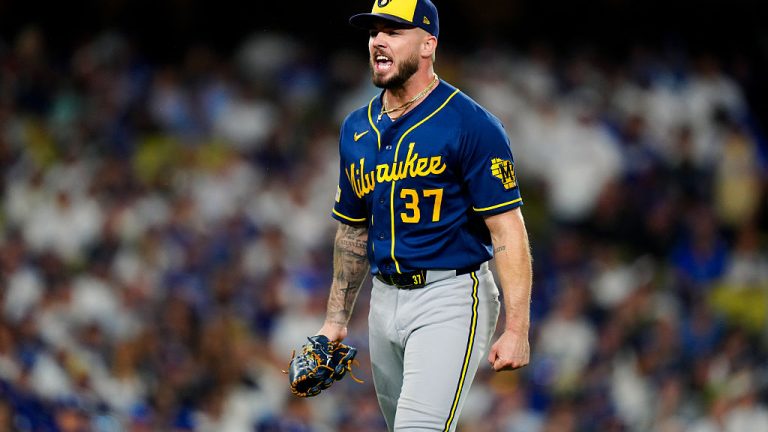
ST. PETERSBURG, Fla. — When DL Hall showed up to Brewers camp in 2024, he was eager to prove himself, perhaps even more so than in his first big league stint with the Orioles the year prior.
Being one of two prospects acquired for Cy Young winner Corbin Burnes was not lost on him, but he was coming off of his most frustrating year physically as he tried to fight through a back issue that popped up at the end of his 2022 season.
“I fought all of ’23 just trying to break even, and was able to get myself to a good enough point to come back in the playoffs that year and throw pretty well,” Hall said. “But it wasn’t natural; I felt like I was grinding through it still.”
Hall joined the big league team at the end of August after the Orioles were dealt the crushing blow of losing Felix Bautista for the season. He proved to be much more than backfill, pitching to a 3.26 ERA in 19 1/3 innings while striking out 23 and walking just five. He also tossed 3 1/3 scoreless innings against the Rangers in an ALDS that saw his team get swept.
Even in shorter spurts, Hall’s average fastball velocity was down a tick from where he sat as a starter the year prior, but still averaged 95.6 mph. While 2023 was in large part a success for Hall, it set up for what may have been the most trying stretch of his career.
Hall believes that the back issue may have created the cascade of injuries that followed, both lower body and upper body.
He made the Brewers team out of camp, struggling through four starts before going down with a knee injury. Hall returned to action in the Minor Leagues a month later, where he would stay until August as he built back up.
He returned to the Brewers bullpen at the end of the regular season with some better results, but his diminished four-seamer was getting hit around to the tune of a .395 batting average and just a 12% whiff rate.
Hall once again started behind the eight ball in 2025 when a lat issue held him out for most of camp and the first two months of the season. As he worked back, the velocity continued to sit closer to the low 90s than the upper 90s and even triple-digit figures that he had been accustomed to earlier in his career.
“It’s probably one of the hardest things I’ve faced in my baseball career,” Hall said. “I [went from] feeling like the man, throwing 100, just blowing guys’ doors off to some of the lowest points. Am I ever going to be able to feel like myself on the mound again? Throwing hard was such a part of my identity, so when I didn’t have it, it took me down to a place that I’ve never really been before.”
Trying to rediscover himself on the mound was a challenge in itself, but doing it with a new ballclub in which he was eager to prove himself only compounded things.
“I think the biggest thing when DL came over, I think he had a hard time finding where he fit in our group,” Brewers pitching coach Chris Hook said. “It’s like, ‘Hey, you’re really good, you’re going to be here for a while.'”
It was clear to Hall that he had to make some adjustments, though. He was very hesitant to implement a sinker because of the poor results it yielded for him at the lower levels of the Minor Leagues earlier in his career, but once he started throwing it, he realized it was far better than the version of the pitch he remembered.
With his injuries, Hall’s slot naturally changed a bit, in a way that he believes may have hampered his four-seam shape somewhat, but enhanced his sinker. Hook believes the new pitch also helped him move more effectively on the mound as well.
“I think it just kind of cleared him up, and it let him use his hand a little bit,” Hook said. “He started getting a little bit of a three-quarter, and he could start seeing some conviction and that was starting to be really special.”
Hall entered the 2026 season all in on the sinker, and the results have undoubtedly followed.
The 28-year-old held opponents to a .153 batting average on the pitch and did not allow a single extra-base hit while going to the offering 36% of the time in the regular season. He mixed it evenly to both lefties and righties, both of whom hit well below the Mendoza Line against the pitch.
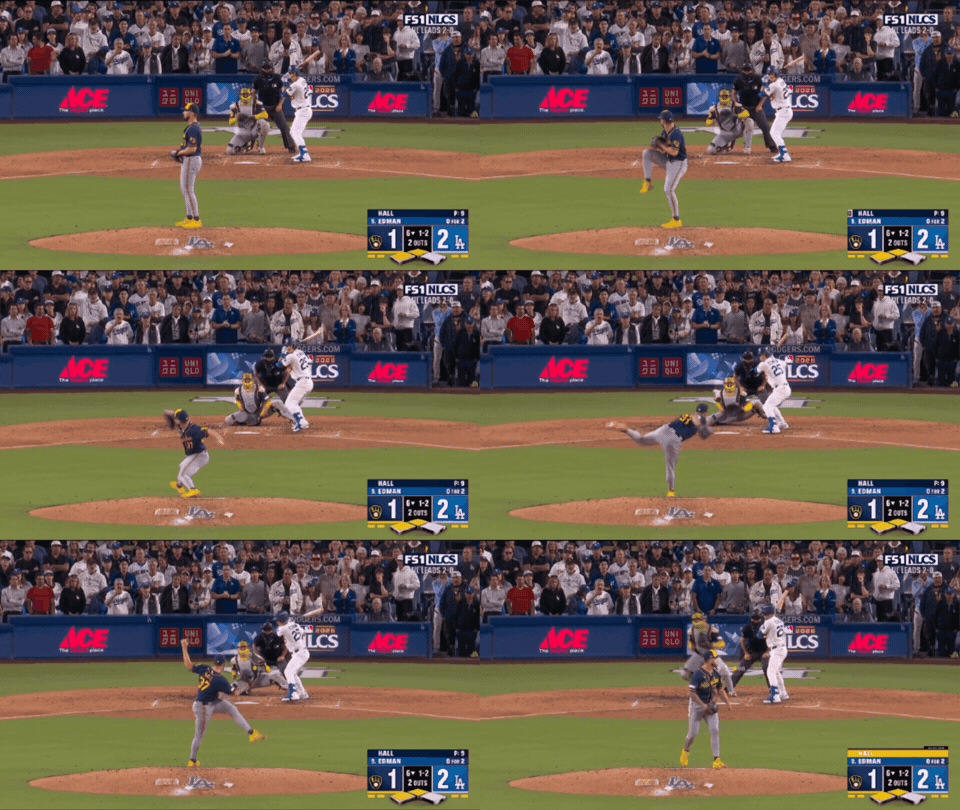
What was initially a pitch implemented as a workaround for underwhelming velocity by his standards has become even more of a strength as Hall’s velocity climbed back up through the 2026 season. He was getting outs at 93-95 mph in the early going of the season with the sinker, but by the second half, he was averaging 96.3 mph on the pitch.
Hall carried the momentum into the postseason, where he has pitched 6 1/3 scoreless innings, ticking up to 97 mph in the small sample while touching 99 mph for the first time since 2023.
In addition to a new foundational pitch, Hall has continued to tack on offerings to his now extensive repertoire of seven pitches.
“I’ve got that confidence of, ‘Oh, I can simplify, I don’t have to think so much, I can go right at guys and throw two or three pitches,'” Hall said. “But also, if I get in sticky situations and/or feel like somebody’s seeing something well, like, I have four other offerings that I can, you know, try and go to.”
Hall’s changeup has benefited from the implementation of his sinker as well, as he creates nearly an identical look out of the hand now with more than 10 mph in velocity separation on average. Hall has enjoyed the best whiff rate of his career on the pitch (39.1%), trusting it as a putaway pitch against righties.
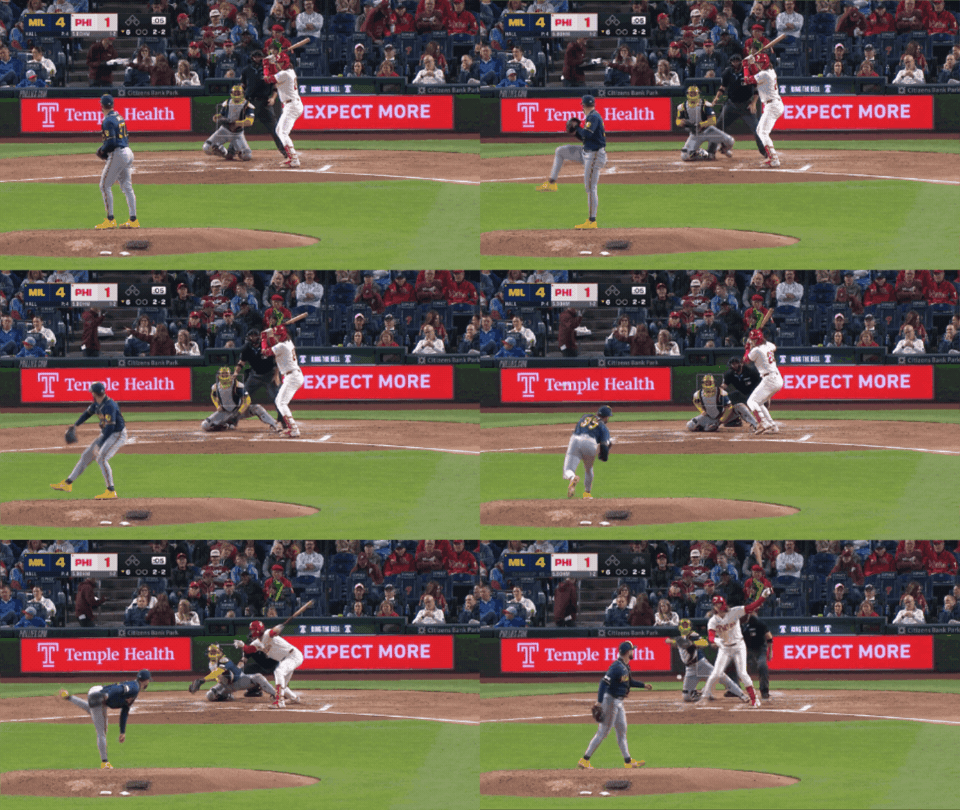
As the velocity has come back as well, Hall is throwing his curveball harder than he ever has at the big league level at 82 mph on average, helping him hold opponents to a measly 3-for-35 against the pitch with an average exit velocity of just 82 mph.
“Once he started getting on time for the sinker, and then having some success with it, you could see little by little just the conviction in the pitch start going up,” Hook said. “He’s like, ‘Oh yeah, I can play this off of that.'”
Hall will still mix in the four-seamer, which now plays much better as an eye-level changer around 10-12% of the time and a sweeper that has become a back pocket putaway pitch for lefties. Hall decided to play around with the pitch in a bullpen session in Los Angeles during the 2025 NLCS against the Dodgers.
He was not on the Brewers roster for the series, but in hearing discussions about the team’s lefties needing to go to sweepers against Shohei Ohtani, he felt like it was a pitch he could potentially add to his arsenal as well. Within that session, Hall was ripping sweepers with 20 inches of horizontal.
Earlier in the year, Hall noticed he was getting takes on the bigger sweeper, though, so he started going to the shorter slider in the upper 80s to then set up the bigger sweeper as a chase pitch in the mid-80s. Including the postseason, Hall has gone to the two pitches a combined 18% of the time while holding opponents to a 3-for-53 clip with whiff and chase rates north of 40%.
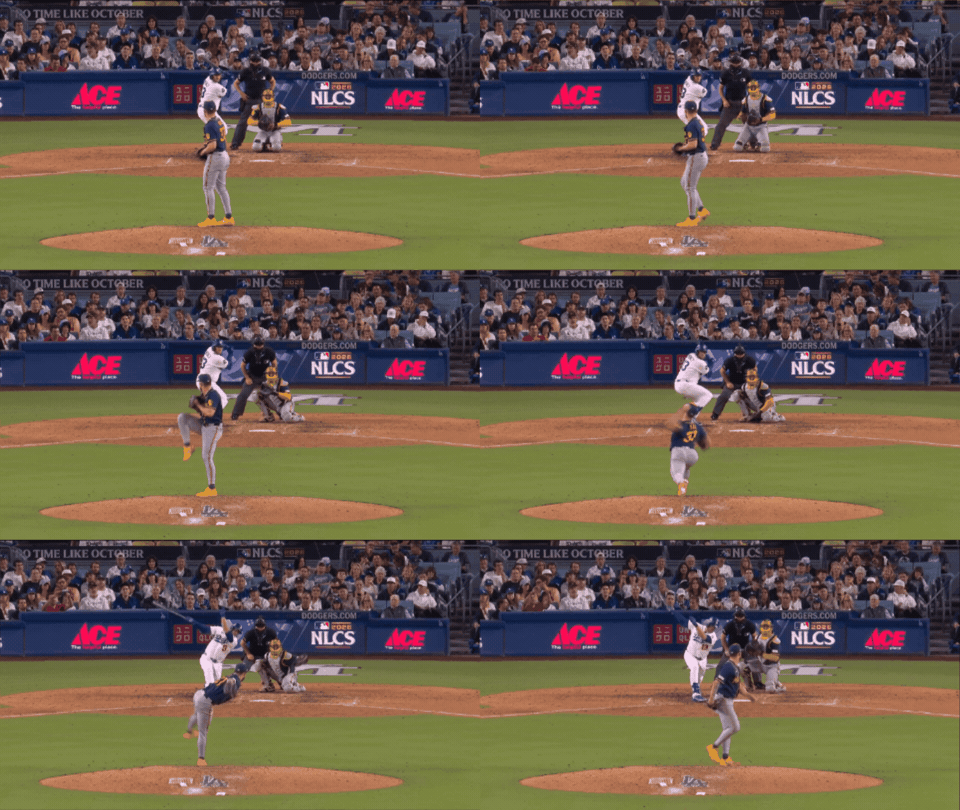
“He’s a unique guy and obviously has a starter’s repertoire, but I think right now, he’s really settled in on who he is and what he feels really convicted of,” Hook said. “The pitch calmness that he has, to me, is the biggest growth.”
The sum of the aforementioned parts has been a breakout year for Hall in 2026, sporting a 1.91 ERA over 61 1/3 innings.
A year removed from not being able to contribute to the Brewers’ postseason efforts, Hall has now played a key role in helping the Brewers get to the doorstep of their first World Series title in franchise history. He’s done so with a different identity than the guy who first arrived in Milwaukee.
“I’m a guy who gets outs. That’s all I’m aiming to do,” Hall said. “I feel confidence that it doesn’t matter if I’m 92 or 98. I can get outs.”

Written by
Aram Leighton is the Co-Founder and Executive Editor for Just Baseball. A Syracuse University grad, Aram is one of the hosts of the Just Baseball Show…