
What To Make of Dillon Dingler’s Up-and-Down Season
Even with his second-half struggles, there should be little doubt that Dillon Dingler is the Tigers' catcher now and into the future.
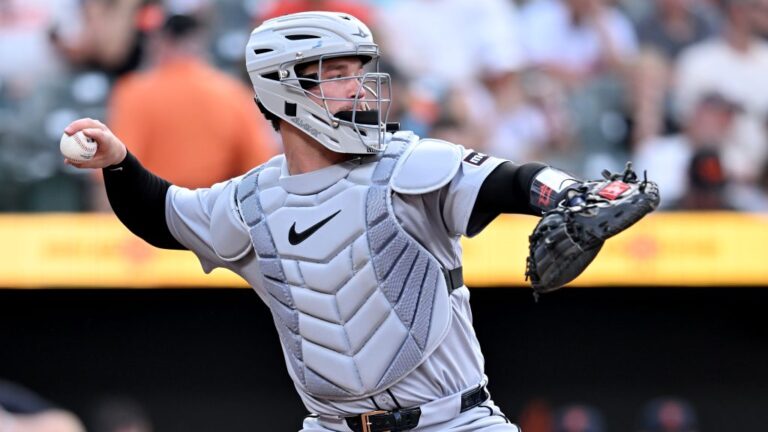
There was a point this season when people were saying Dillon Dingler was the best catcher in baseball, and they were right. This wasn’t coming just from Detroit Tigers fans who watched him every day, but from the national media as well. You know those graphics they flash on TV showing the top five in a category? Dingler’s name was all over them.
The recognition first came with the advent of the ABS system. Catchers now had an opportunity to challenge the umpire’s calls, and Dingler quickly rose to the top of the leaderboards. His defense was always spectacular, and his arm made social media highlight reels, but his bat is really what cemented him as the best catcher in baseball.
Until he wasn’t.
A rapid downward spiral at the plate quickly turned Dingler from an All-Star catcher into a detriment in the Tigers’ lineup. Now the question becomes: Was Dingler’s first half a reachable ceiling, or was it a bump in the radar?
First Half vs. Second Half
Every year, it’s hard to remember how large the sample size is in baseball. A hot start to the season quickly gets you excited about the changes and potential of a player, only to realize you’re only 20% through the year. For Dingler, his hot start lasted four months.
In April and May, Dingler looked like the player we had seen last year, only now with more power. In 2025, Dingler never had a month in which he hit more than three home runs. In 2026, he did so four times, with five home runs in April, six in May, eight in June, and four in July.
Hitting only 13 home runs in 2025 (469 PA), Dingler more than doubled that number, launching 27 (607 PA) this season. A jump in ISO from .147 to .203 across a full season is not something you just do by luck, but rather through legitimate improvement.
The power uptick was real, and it wasn’t only seen in leaving the yard. Dingler was also collecting doubles, having at least five in each of those months. Watching his at-bats, you could tell that this was a player who truly did look like he had taken the next step offensively. Once the weather heated up, his bat continued to as well.
June and July were by far Dingler’s best months. While players improving with the weather is nothing new, Dingler doing so only made me more confident in what he had become as a player. A legit All-Star, great defender, and middle-of-the-order bat that the Tigers could rely on for years.
Although he was still chasing too many pitches out of the zone, he was making enough contact on strikes to make the equation work. Improvements in his own contact rate, along with a continued trend of pulling the ball in the air more, were great signs for a player of Dingler’s profile.
He finished the first half slashing .262/.323/.508 with 19 home runs, good for a 129 wRC+. Then the second half came.
A .217/.272/.358 slash with eight home runs (in roughly 100 fewer at-bats) led to a 75 wRC+ and plenty of discussion among Tigers fans. While trading away Tarik Skubal and Casey Mize certainly didn’t help the Tigers’ chances of making the playoffs, Dingler’s drop-off also played a significant role in the Tigers’ struggles down the stretch.
You saw how much a dip in his power quickly changed his production. From 40 home runs, based on his first-half pace, to only 16 in the second half. Granted, fewer games, but only roughly 100 fewer at-bats. Players who swing at as many balls out of the strike zone as Dingler are susceptible to streakiness or poor stretches. As a pitcher, if you throw fewer strikes and still get outs, well, you’ll keep doing that.
So, what do we really make of the difference between the first and second half? This is Dingler’s first year as a full-time starter, which could play into his second-half numbers dipping. We’ve seen players wear out at the end of the season before. Maybe it was just a bad stretch that snowballed on him. Possible.
To me, the most likely scenario is a truth that we often forget. When you have two extremes, like his first and second half, the answer typically falls somewhere in the middle. Maybe Dingler isn’t as good as his first half and not as bad as his second.
Dingler’s Outlook
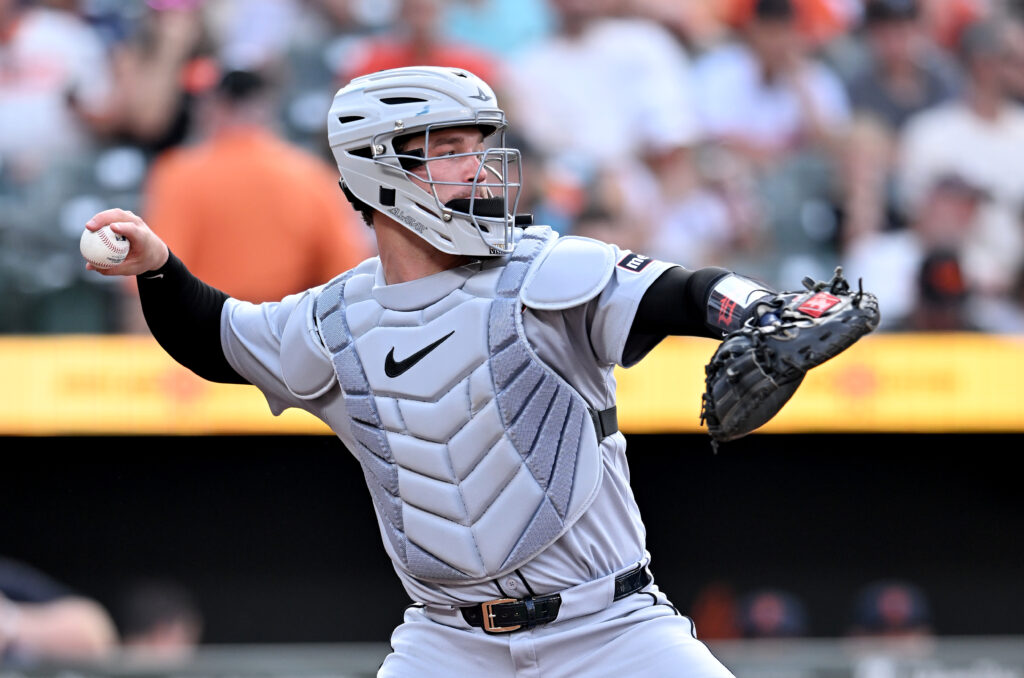
There are a million different statistics and metrics in baseball that we all value differently. Personally, I like wRC+ because it not only is park-adjusted but also works off of the entire league’s average to show you how much better a player is, offensively, compared to the rest of the league in that particular season.
Dingler’s wRC+ in 2025 and 2026 were almost identical. Last season was 108 and this season was 107. When you dive deeper into the comparisons, you’ll see that he got to these numbers in very different ways.
| Slash | HR | ISO | K% | BB% | wRC+ | fWAR | |
| 2025 | .278/.327/.425 | 13 | .147 | 23.5% | 4.9% | 108 | 4.1 |
| 2026 | .243/.302/.446 | 27 | .203 | 22.9% | 5.6% | 107 | 4.9 |
His increased power drove his production this year, while last year he was able to hit for a higher average, leading to a higher on-base percentage and pushing his wRC+ to 108. You could look at more metrics such as barrel rate, hard-hit rate, and xwOBA and notice almost identical numbers from last year to this year as well.
What I’m trying to get at here is that Dingler can find success in more ways than one. Personally, I prefer the power Dingler we saw in 2026 because I feel like it is more sustainable for someone of his profile to find success year in and year out by leaning into power instead of batted-ball luck.
If you told me I could sign up for Dillon Dingler posting between a 105 and a 110 wRC+ going forward, I would sign up for that right now. While that might not seem phenomenal, it’s important to remember that catchers usually are not as good of hitters as other positions. In fact, there were only four catchers to post over a 115 wRC+ in 2026. Dingler’s 107 ranked eighth among qualified catchers.
It’s hard to say what Dillon Dingler’s ceiling is as a player. He’s 28 years old but only has two full seasons under his belt, and I don’t see his profile changing much. If he’s able to improve his chase rate and lay off more pitches outside of the zone, that would drastically improve his consistency at the plate. However, we have not seen evidence that he can do that since joining the Tigers.
If Dillon Dingler is what he is, that’s okay. Actually, that’s great. The most important part of the catcher position is managing a pitching staff and providing defense behind the plate, and there are few better than Dingler in that aspect. Hell, we see players of his defensive caliber not hit a lick and have 5- to 10-year careers.
Above-average offense, elite defense, and power from the catching position is something I’d sign up for every single day. Not to mention, the Tigers have Dingler under team control until 2031, which will take him through the prime of his career. A consistent 4-5-win player on a pre-arb deal is massive for the Tigers and how they build the rest of this team going forward.
Final Thoughts
Detroit’s season did not go nearly as we had all planned. Injuries were a massive part of it, but underperformance was also an issue. A flock of young players entered throughout the year, and figuring out which ones will be part of the future is still a question.
But one answer that Detroit has is behind the plate. Even with his second-half struggles, I have no doubt that Dillon Dingler is the catcher now and into the future for the Tigers.
Become a Member of Just Baseball
Subscribe and upgrade to go ad-free!
* Save 25% by subscribing annually.

Written by