
7 to 22: The Swing That Revived Cody Bellinger’s Career
Micah Franklin first built an impressive resume as a hitter. Then, he used his knowledge to aid Cody Bellinger's astonishing comeback.
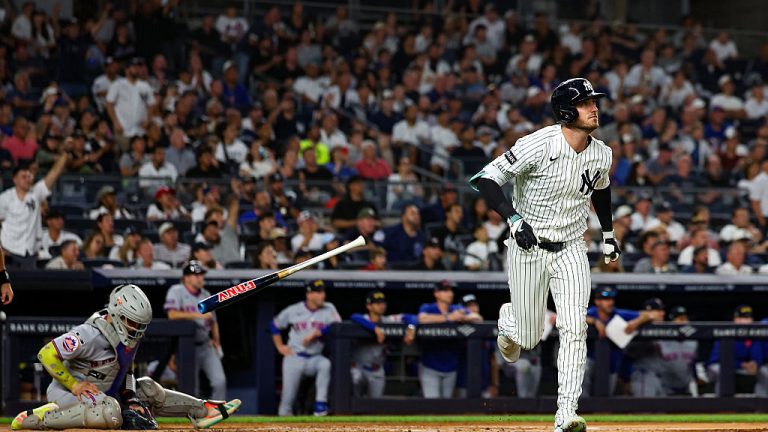
All Micah Franklin ever did was hit. In the minor leagues, MLB, KBO, and NPB, it didn’t matter. After a career of waiting for his shot, he translated all the base hits he kept in storage into Cody Bellinger’s bat.
When Franklin learned on the fly through the professional ranks, teaching hitting looked very different.
“It was a little different back in the olden days, as we call them,” Franklin said with a chuckle. “We didn’t have a hitting coach.”
Franklin and his teammates depended on the “hitting coordinator,” who came around once or twice a season. Traditionally considered a grind, minor league baseball has since seen legitimate facilities and pay structure upgrades. In contrast, during Franklin’s time, they made the most of what they had.
“I didn’t have a cage until my second year in Triple-A. By then, I think I was in the fifth year of my minor league career,” he said. “We had tees, and then sometimes we would soft toss to each other against the chain-link fence. You know, this was minor league ball. So you had to figure out what you were doing in a game.”
Still, the challenging environment was no match for Franklin’s blistering bat. Across a substantial sample of 1,141 minor league games, he posted an .866 OPS, mashed 200 home runs, and had more than 1,000 hits.
His success carried overseas when he played in Korea and Japan, posting an OPS of .887 across four seasons.
It’s no surprise Franklin was such a consistent offensive threat because one of his mentors was the always docile, yet superlative Willie McGee.
“I met Willie McGee at 19. In the offseason, I got a lot of work in with him; we would go 500 swings a day. No coaching, really, just talking about different things and how to hit the ball,” Franklin said.
“It was more like, ‘Hey, stay inside the ball. Let’s go the other way.’ You’d start left-handed. The first 25 swings the other way, then 25 swings up the middle, left-center; 25 swings; 25 line drives up the middle; 25 line drives right-center. Then you go right-handed and reverse it. Now, if you hit a pop-up or roll over, you don’t count that. Your concentration is on the task, so you’re hitting line drives. You’re not trying to hit the ball as hard and far as you can. You’re trying to have bat control and body control that way.”
Franklin implements the skills he acquired as a successful professional player in his post-pro career as a hitting coach.
As a coach, Franklin emphasizes a program he’s titled “7 to 22.” The approach is simple: If you attack the ball between 7 and 22 degrees, it creates a bat path that promotes consistency and builds a steady foundation for success.
Some see Franklin’s philosophy and assume he’s created a cookie-cutter mentality for all hitters. In reality, it’s anything but.
“I do not teach hitting one way,” Franklin said. “A lot of people will say, ‘Yeah, you do,’ but no. Actually, I don’t.”
Due to his knack for adaptation, Franklin experiments with all kinds of tools and approaches. His experience around the game has led him to a conclusion about all the tech craze surrounding modern baseball.
“I don’t think there are any, in my opinion, advantages of the new technology,” he said. “That’s with me going all in on the new technology, learning, getting educated from body movement to caveats to all this scientific stuff. Because even when I was all in on it and teaching it, I realized that it is hampering the kid. It’s putting a crutch. These kids don’t know how to do anything else now.”
The quick adjustments he learned to make during his own playing days seem to have become a lost art. Kids are struggling to make them, and it’s a trickle-up effect that’s even left some MLB hitters guessing.
“I changed all the time, and within the at-bat, I changed depending on that type of pitcher,” he said. “What got me quicker to the ball or quicker to what I wanted to do in that situation? So I changed my approach, my thinking, so much. In today’s game, kids don’t know how to change enough.”
One of those kids was Cody Bellinger.
Bellinger came up with the Los Angeles Dodgers and had a riveting start to his MLB career.
Over his first three seasons, from 2017 to 2019, he earned a Rookie of the Year, an MVP, two All-Star selections, a Gold Glove, a Silver Slugger, and 17.2 bWAR. It was a start that seemed almost too good to be true.
Then 2020 happened: masks, disease, isolation, and fever dreams. But there was still baseball.
Unfortunately for Bellinger, it wasn’t the same brand he anticipated. His OPS dipped to a then-career-low .789 in the shortened season. Although the Dodgers won a World Series, casting the best kind of shadow over his dormant year, cracks were beginning to show.
2021 solidified the regressive state, as Bellinger’s -1.6 bWAR was among MLB’s worst. Pair that with a sub-.600 OPS, and he had entered career-threatening territory.
This steep and puzzling drop-off left most of MLB questioning the root cause.
Franklin wasn’t confused at all. He knew exactly what to do.
Long before Bellinger was hitting “Belli-bombs” at Chavez Ravine, he was just a kid in the desert, playing on a scout team that Franklin assembled.
“Mike Fedders and I, we put a whole book together for the D-backs because we weren’t drafting local kids. We’re like, ‘What the hell? There are all these local kids here. How come we aren’t drafting them and other teams are?’
“Well, they paid for a scout team for two years. And this scout team was handpicked, so it wasn’t like a traditional scout team. The D-backs paid, and they said, ‘Go and find players.’ So I did.”
That’s where Franklin met Bellinger.
“Cody was there: this long, lanky kid who kept hitting triples. And these fields are big out here in Arizona. On those big fields, all he did was hit one-hoppers or balls off the center field and left-center field walls. He didn’t really pull balls, and that’s what he did. He was amazing. Through minor league ball, he was doing the same thing.”
With Franklin, Bellinger was a lean, doubles machine with a great arm and good defense. Suddenly, after his MLB debut, he didn’t look like that same player.
“He started pulling the ball in his rookie year, went to the major leagues, and then stayed in LA,” Franklin said. “And I’m not gonna say the Dodgers messed him up. Well, I will say they messed him up, but I will also say they made him into an MVP. So you’ve got to give them credit for that, too.”
As Bellinger’s approach evolved toward pulling the baseball, he became yet another pull-happy, homer-hungry slugger who thrived in The Show — an archetype fans are used to in modern baseball.
Franklin knew better.
“When they worked with him, they had him go from hitting the ball the other way to learning how to pull the ball better because he got older, and that’s what naturally happens. Well, guess what? When you stop working on the other stuff and only work on the drills that are helping you pull in the air, you eventually start continuing to pull, continuing to pull, continuing to pull, and guess what? You forget the other stuff, and you don’t even know how to go back to it anymore.”
Bellinger knew what he wanted to do. He’d done it for years. He had the natural juice to hit baseballs very far. But in those deep counts, or contact situations, his new approach took over. He couldn’t find the same swing that once landed him on Franklin’s D-backs scout team.
“Boom! It didn’t work,” Franklin exclaimed.
“So now he’s texting during the season. I think it was the 2020 season, showing me BP on the field, doing all this other stuff. We didn’t have the drills. We didn’t have anything for him to understand because he didn’t have a foundation. He lost his foundation. So at that point, now whoa, oops, he gets non-tendered.”
From MVP to clutter, cast away from the same city he helped to a world championship, Bellinger had hit rock bottom. At a wedding, surrounded by other big leaguers, his career was reborn.
“So at that point, we’re at Jamie Westbrook’s wedding,” Franklin recalled.
Westbrook is another one of Franklin’s pupils, who had a brief stint with the Boston Red Sox in 2024.
“Pat Murphy was there, and Bobby Dalbec. All these guys get DFA’d or non-tendered. It was really interesting. You can imagine. There was a lot of drinking going on since they just got let go. So we’re like, ‘Hey, let’s go hit.’”
Those three words — “Let’s go hit” — may have saved Bellinger’s career. But it literally took baby steps.
“At the start, we didn’t hit. All we did was learn how to step back to the pitcher again, straight, because he couldn’t keep a ball fair. I mean, he opened up so badly that anytime he hit a ball hard, it would either go foul or to the first baseman. It was disastrous, as we know. Everyone saw it. So, we learned how to step. Then we learned how to keep our direction with a swing. Then we learned how to keep our direction while hitting the ball at 50 miles an hour.”
“People don’t understand,” Franklin continued. “They come here, and I tell them to try to hit a ball at 50 mph, but they can’t. High school kids, college kids can’t. I’m like, ‘Dude, how hard is this?’”
Through rigorous trial and error, Franklin and Bellinger developed a process that worked. At times, however, it took some mental manipulation.
“Cody’s such a late starter; it’s unbelievable,” Franklin said. “Well, everyone’s like, ‘All right, Micah, you need to tell him to start earlier!’ Well, that’s like a four-letter word to him. He can’t. We’re like, ‘Don’t you think if he could start earlier, he would?’”
Franklin used drills that positioned Bellinger’s body so he had to start earlier. As the body matures and becomes stronger, more ways exist to compensate for a lack of mechanical intuition. Bellinger is a strong professional athlete, so it was necessary to keep him within a controlled environment while making such finite adjustments.
“We had to figure out different drills where he’s starting earlier and doesn’t even know it, because his body is getting to an autonomous state,” Franklin said. “So we put a foam roller on him, so he just rolls. You know, when you roll your back out or roll your leg out or whatever. So we put that on his foot, and he has to roll earlier. We also used a ball. So it was drills like that, while making sure he maintained his direction; those were huge. Not pulling the ball, just staying up the middle or the other way, just like he did back in high school. We had to find his old self somewhere in his memory.”
Bellinger’s process included two-to-three-hour cage sessions where Franklin said they’d hit the ball only 90 to 110 times. The cycle was swing, talk, adjust, repeat.
After that, Bellinger signed a one-year prove-it deal with the Chicago Cubs ahead of the 2023 season.
He played two great years in Chicago, and then headed for the Bronx, where he’s now in the midst of a newly inked five-year, $162.5 million deal that’ll keep him in pinstripes through 2030 (barring opt-outs).
In the four years since Bellinger was ousted from Hollywood, he’s back on the big screen. His Silver Slugger in 2023 and most recent All-Star selection in 2026 have all but cemented a comeback that’s nothing short of remarkable.
During this recent success, Bellinger has become less of a good power hitter and more of a good hitter with power – like a fellow Yankee legend.
“When I wrote this down way back when I did a scouting report in high school, I said he’s very much more like a Paul O’Neill hitter,” said Franklin. “That’s who he is right now versus the guy that’s an MVP hitting balls way, way out. That’s just not him. Especially at the age he’s at now.”
Bellinger may have started his career as one kind of player, but it wasn’t who he was at his core. Franklin knew, the baseball Gods knew, and even Bellinger himself may have known.
Still, few outfielders impact a game the way Bellinger can, and the stats matured alongside his approach.
This season, Bellinger ranks in the 81st percentile in batting run value and is an elite defender across the board. It took time to re-establish what he once was, but his 9.7 bWAR (and counting) across the past two seasons is profoundly consistent and can only be rivaled by stardom.
Franklin played professional baseball from 1990 through 2004. He traveled to chase his dreams and never found an environment he couldn’t hit in.
Baseball, the game of storytelling, still feels the vibrations of Franklin’s pro career, if not through the might of his own swing, then through the knowledge he’s weaponized to create some of baseball’s best hitters.
Other MLB stars who have put in work in Franklin’s cage include Matt Chapman, Jazz Chisholm Jr., and Nationals’ superstar James Wood.
Baseball is a paradoxical game that can’t be understood through one lens, but Franklin’s approach and his athletes’ hard work made a star reborn.
Franklin is still in the cage, day in and day out, shaping the next generation of hitters, and he knows all too well, as does Bellinger, that baseball is a game where you’ll never be perfect.
“In baseball, you can’t put the person in the perfect position; you need to put them in the most efficient position.”
Become a Member of Just Baseball
Subscribe and upgrade to go ad-free!
* Save 25% by subscribing annually.

Written by
AJ Stone is a sportswriter and journalist currently attending the University of Missouri School of Journalism. His work has appeared on Redbird Rants, Heavy.com, Arcadia News,…