
The Teams That Create the Most Pressure
...and why aggression isn't always better.
In Part 1 of this series, I established that pressure carries a measurable offensive signal beyond the three true outcomes. After accounting for power, plate discipline, strikeouts and first-base opportunity creation, context-adjusted aggression still maintained a positive relationship with run production.
Yet, that does not mean every team should run more.
Pressure can be created through opportunity volume, aggressive advancement or some combination of the two. Notably, the teams that generated the most value from 2021 through 2025 did not all follow the same formula, and the most aggressive clubs were not always the most efficient.
So, the question is not whether aggressive baseball is better. What’s more useful to ask is how different teams turn the opportunities available to them into additional offense.
The Dodgers Created Pressure Without Forcing It
According to my model, the Los Angeles Dodgers generated the most gross pressure value in the five-year sample (2021-25) despite carrying an approximately league-average aggression profile.
That initially appears contradictory. If pressure comes from steals, extra bases and forcing the defense to complete additional plays, how can a relatively conventional baserunning team create more of it than anyone else?
The answer begins before the runner decides whether to go.
Good offenses create traffic. They reach base, extend innings and continually place runners in situations where another advance becomes possible. Even when those runners make ordinary decisions, the sheer volume of opportunities can produce substantial cumulative value.
The Dodgers did not need to manufacture pressure through an extreme running philosophy. Their hitters created it naturally.
That distinction is why raw stolen base and advancement totals are incomplete. A team may accumulate additional bases because it pursues an unusually high percentage of its opportunities. It may also reach those totals because it produces more opportunities than almost anyone else.
Those are different offensive identities.
The Dodgers’ identity is built upon the most valuable offensive skills. Reaching base and hitting for power create immediate production while also establishing the conditions that allow pressure to follow.
This is also the least accessible model. Most organizations cannot replicate the Dodgers’ depth of offensive talent. For those teams, the question becomes whether they can extract more value from the opportunities they do create.
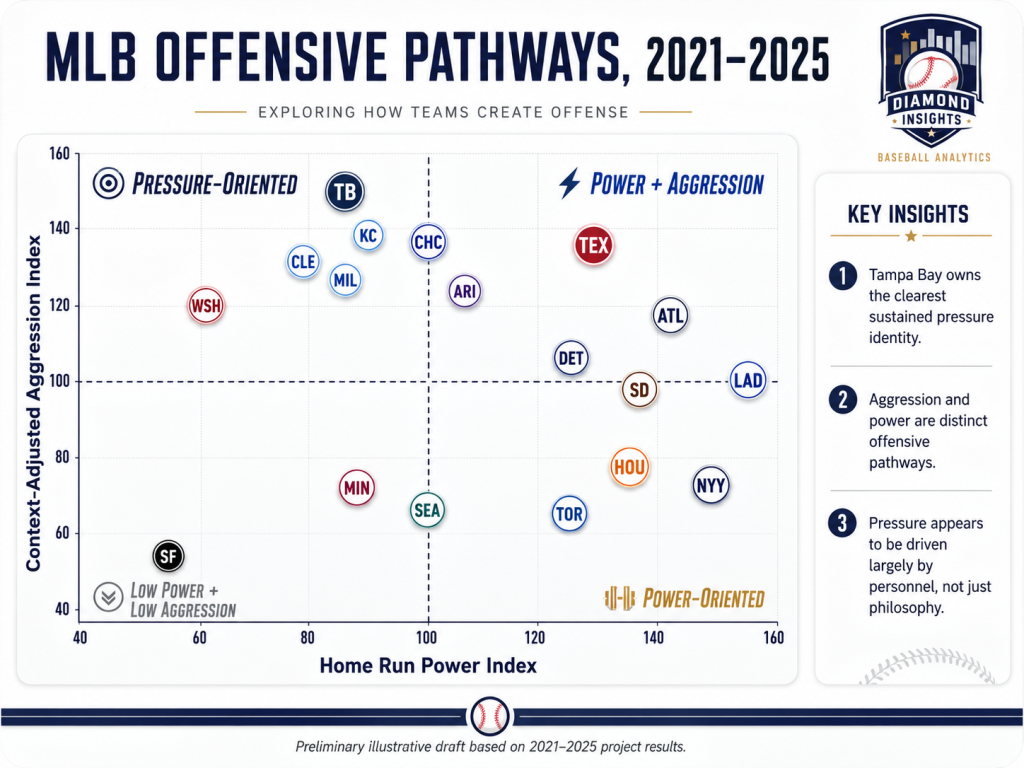
The landscape from 2021-25 makes this distinction clear. Los Angeles occupied the extreme end of the power spectrum without running at an unusual rate. Tampa Bay, Kansas City, Cleveland and Milwaukee generated offense through a more pressure-oriented pathway.
Aggression and power were not opposites. They were separate levers.
Tampa Bay Kept Pushing
The Rays displayed the clearest sustained pressure identity in the sample.
From 2021 through 2025, Tampa Bay produced an average Context-Adjusted Aggression Index of 124.5 and finished above average in all five seasons. The Rays were not occasionally aggressive because one roster happened to contain several fast players. They repeatedly attempted more advances than expected across changing seasons and personnel groups.
Their 2025 team offered the clearest recent example.
Tampa Bay attempted 453 tracked advances against approximately 381 expected, creating 72 additional attempts beyond the league baseline. Its Aggression Index of 131.5 was the highest in baseball.
The Brewers, Cubs, Red Sox and Rangers completed the top five.
These clubs were not merely stealing bases. Their willingness to advance appeared across multiple parts of the game, including steals, first-to-third decisions, scoring from second and tag-up opportunities.
A team can run frequently while remaining conservative on contact. It can also avoid traditional steal attempts while repeatedly challenging outfield arms. Pressure is not one tactic. It is the accumulation of decisions that require the defense to complete another part of the play.
Kansas City, Cleveland and Milwaukee joined Tampa Bay as the teams with the strongest pressure identities in the five-year sample. All four finished above average in at least four of the five seasons, and each created substantial gross pressure value without consistently living near the top of the home run leaderboard. However, their approaches were not identical.
The Royals produced the most gross pressure runs of the four but also showed the greatest year-to-year volatility. Cleveland’s profile was less aggressive than Tampa Bay’s, but it was remarkably stable. Milwaukee remained consistently pressure-forward without producing the same aggression mix value as the Rays or Royals.
The common thread was not one specific tactic. It was a roster that repeatedly found ways to force additional defensive execution.
Aggression and Efficiency Are Different Skills
It can be tempting to treat this aggression leaderboard as a ranking of which teams ran the bases best. That fails to tell the full story.
Attempting more advances creates more chances to add value, but it also exposes the offense to more outs. Once the clearest opportunities have been taken, increasing volume requires accepting closer decisions.
The 2025 Mets produced the strongest advancement-efficiency profile in baseball. They successfully completed 94.6% of their tracked attempts and recorded approximately 18 more successful advances than expected. Their Efficiency Index of 147.1 easily led the league.
They did not lead baseball in aggression.
That is not a contradiction. A selective team should convert a larger percentage of its attempts because it concentrates its decisions in the safest situations. The runner goes when the defense is unlikely to complete the play and stays when the opportunity is less certain.
An aggressive team will eventually challenge stronger arms, advance on shallower contact or accept situations in which the cost of an out is higher.
The relationship between aggression and efficiency reflects that tradeoff. In the five-year sample, teams that ran more often were not automatically better at converting those attempts. The raw relationship between the two was moderately negative.
That does not mean aggression was inherently harmful. It means success rate cannot be evaluated without volume.
A runner who advances safely on nine of 10 attempts may appear more efficient than one who succeeds on 18 of 22. The second runner, however, may still create more total value despite making additional outs.
The opposite is also possible. A team can generate plenty of movement without producing enough additional bases to justify the runners it loses.
The goal is not to maximize either column. It is to identify the chances that are worth taking.
The Cubs Found the Best of Both
The ideal pressure offense combines elevated volume with sound execution.
The 2025 Cubs provided one of the clearest examples. Chicago ranked third in my Aggression Index at 120.1 and second in my Efficiency Index at 118.4. The Cubs attempted more advances than expected while still converting them at an above-average rate.
Tampa Bay paired its league-leading aggression with the third-best efficiency score. Boston also appeared near the top of both leaderboards.
These teams were not preserving a pristine success rate by avoiding every close decision. They also were not creating movement for its own sake.
They found enough favorable opportunities to run more often without surrendering value through excessive outs. That is more difficult than simply assembling a fast roster.
The runner must read the ball, anticipate the defender’s route, understand the game state and account for the strength and positioning of the throwing arm. A third base coach processes much of the same information in seconds. Pitchers, catchers and middle infielders are simultaneously trying to eliminate the opportunity before it develops.
Pressure is not speed by itself. It is the combination of physical ability, decision-making and preparation that allows a player to turn an available opening into a profitable advance.
Is Pressure an Organizational Philosophy?
When the same organizations repeatedly appear near the top of a leaderboard like this, the natural explanation is philosophy.
The Rays pressure opposing defenses because that is what the Rays do. Cleveland finds value on the margins because it is embedded in the Guardians’ developmental system. Kansas City runs because the Royals build athletic rosters and give those players freedom.
There is probably some truth in each explanation.
Organizations establish an acceptable level of risk. Coaches prepare players for opposing pitchers and outfield arms. Teams decide whether a close play will be treated as a reasonable attempt or an avoidable mistake.
The player-level results suggest that personnel may be the larger driver.
Individual aggression was considerably more stable from season to season than individual advancement efficiency. Players who attempted more advances than expected generally continued to do so, including after changing teams. Roster composition also helped explain future team aggression.
That suggests pressure identity may be acquired as much as it is taught.
Some runners recognize openings sooner, while some accelerate quickly enough to turn a marginal chance into a favorable one. Others read the ball off the bat well or possess the confidence to challenge the defense before it can prepare for the play.
Those traits tend to follow a player around.
A manager can encourage aggression, but he cannot give every runner the same instincts, speed or tolerance for risk. Telling a conservative group of players to start taking more bases may create more outs rather than more pressure.
The better approach is to identify players who already possess these skills and place them in an environment that improves the quality of their decisions.
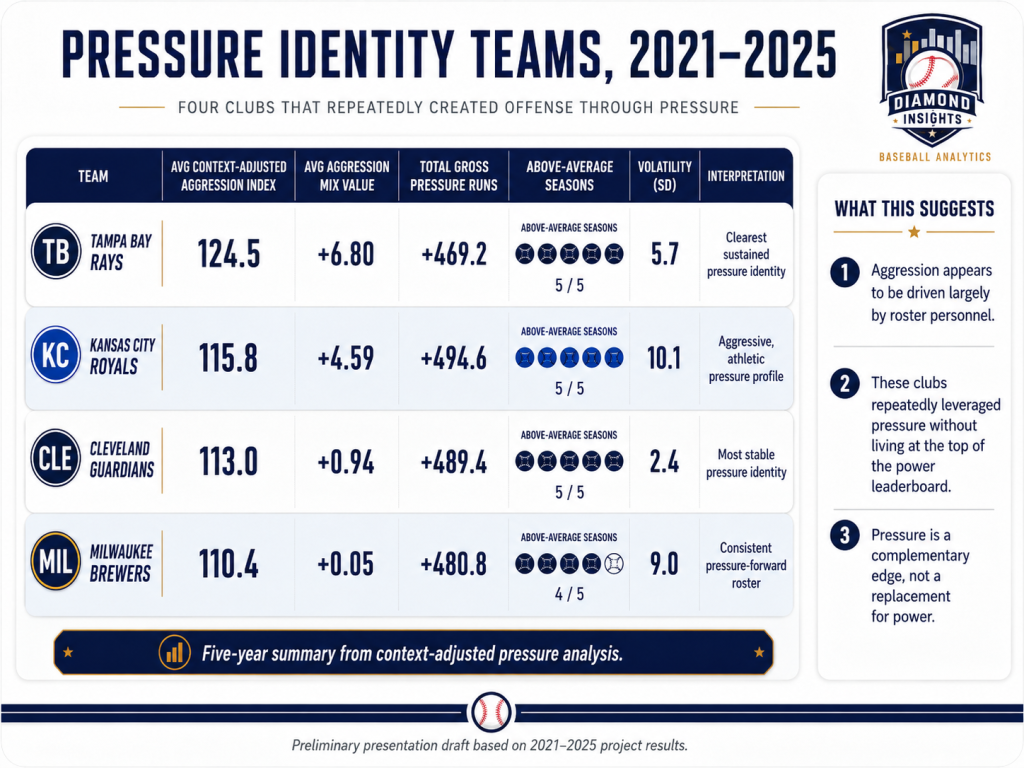
The sustained team profiles support that interpretation. Tampa Bay possessed the clearest identity, Cleveland the most stable and Kansas City the highest gross pressure total of the four. Milwaukee remained consistently above average despite producing little additional aggression mix value.
Each club arrived at pressure through a different roster composition. The repeatability suggests something real, but not necessarily something produced by a universal organizational mandate.
Can Pressure Close a Slugging Gap?
Every team would prefer to build an offense around hitters who reach base and drive the ball over the fence. Nothing in this analysis changes that.
A home run is definitive. The defense cannot prevent the runner from advancing, and the offense cannot run itself into an out.
Pressure is less certain. It requires a sequence of opportunities and decisions, any one of which can fail. Pressure cannot replace power.
That is to say, a team with a severe slugging deficit will not erase it by stealing more bases or sending every runner from first to third. A lineup that rarely reaches base will not create enough opportunities for aggression to matter. Poor contact does not become valuable merely because a defender is asked to field it.
But rarely is a front office executive deciding between a 35-home run hitter and an aggressive baserunner. Teams are choosing among imperfect players.
A hitter with average power who reaches first frequently, produces difficult balls in play and consistently recognizes profitable advancement opportunities may contribute more than his traditional offensive line initially suggests. Another player may possess similar speed but generate little pressure because he rarely reaches base or repeatedly chooses the wrong moments to run.
My framework offers another way to separate them.
As Part 1 showed, a three true outcomes model explained 68.2% of the variation in team run production from 2021 through 2025. Adding pressure creation and context-adjusted aggression increased that figure to 74.6%.
The foundational skills still did most of the work. Pressure helped explain part of what remained.
For teams that cannot assemble a lineup with elite power throughout, that remaining part of the equation matters. Turning a single into a runner at third changes what the next hitter needs to accomplish. Advancing on a fly ball can remove the need for another hit. Challenging an outfielder can produce a rushed throw, a missed cutoff or an extra base that was not available at the beginning of the play.
None of those events is as valuable as hitting the ball over the fence. They do not have to be.
The goal is not to replace slugging. It is to reduce the number of runs a team must find through slugging alone.
Aggression With a Purpose
Baseball debates have a habit of reducing strategy to two opposing camps.
One side wants teams to stop giving away outs. The other wants more runners in motion, more pressure and a return to manufacturing runs. Both can find an individual play that seems to prove their argument.
However, the broader results support neither extreme.
The Dodgers created more gross pressure value than anyone through the volume generated by an elite offense. Tampa Bay, Kansas City, Cleveland and Milwaukee repeatedly pursued more advances than expected. The Mets showed how a selective approach can produce elite efficiency. The Cubs and Rays demonstrated that elevated aggression and strong execution can coexist.
There is no universal target for how often a team should run.
The correct level depends on who is running, who is defending and what the next base is worth in that moment.
Pressure becomes valuable when it forces the defense to complete another difficult action without exposing the offense to excessive risk. It becomes counterproductive when aggression is treated as an identity rather than a decision.
Teams should not run simply to prove they are willing to run.
They should build rosters capable of recognizing when the next 90 feet are available — and take them before the defense has a chance to recover.
Become a Member of Just Baseball
Subscribe and upgrade to go ad-free!
* Save 25% by subscribing annually.

Written by