
Can Braden Montgomery Be the Answer the White Sox Have Been Searching for in Right Field?
Braden Montgomery made history in his debut for the White Sox. Now he's trying to live up to his top prospect billing on a more consistent basis.
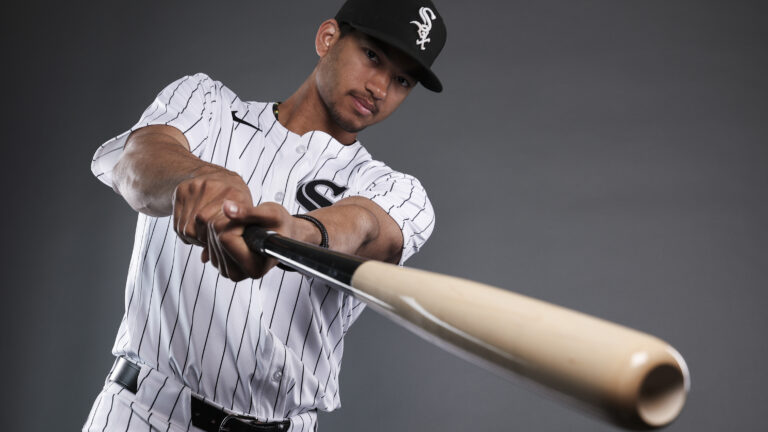
Nearly two years after a fractured ankle ended his college season, Braden Montgomery completed his long road back with a swing that sent the ball into the White Sox bullpen.
During spring training, Montgomery was asked whether he was knocking on the door to the major leagues or preparing to knock it down.
“I’ve taken my time and put a lot of thought into preparing, and I’m sitting in the car waiting outside,” Montgomery said on the White Sox Podcast. “I sent the text, ‘I’m outside,’ waiting for the response. And then once I get in, all hell breaks loose.”
Three months later, Montgomery got the call and could not have scripted a better major league debut.
The rookie outfielder launched a two-run walk-off homer in the 10th inning to give the Chicago White Sox a 6-5 victory over the Atlanta Braves, instantly etching his name into franchise and MLB history. The moment carried even more significance because 362 days earlier, Montgomery had delivered another walk-off blast for High-A Winston-Salem.
Montgomery began the season at Double-A Birmingham. Less than two months later, he was batting sixth and starting in right field for the White Sox. By the end of the night, he had collected his first major league hit, driven in three runs and earned a place on one of baseball’s most exclusive lists.
A fractured right ankle ended his Texas A&M season on June 8, 2024. Montgomery hit a walk-off home run for Winston-Salem on June 12, 2025. His first major league homer followed on June 9, 2026.
The chronology is striking, but the determination and adjustments between those milestones explain how Montgomery reached Chicago and why the moment carried so much weight.
Stats updated prior to games on June 19.
A First Game That Made History
Montgomery arrived at Rate Field after opening the season with Double-A Birmingham and spending just over a month at Triple-A Charlotte.
His debut began with a strikeout against Grant Holmes, but Montgomery adjusted quickly. He later explained on MLB Network that he recognized the slider Holmes used to put him away and was better prepared for it in his second plate appearance.
After taking two more sliders to move ahead 2-0, Montgomery stayed behind a fastball and lined a 106.9 mph single into left field to score Jacob Gonzalez for his first major league hit.
The hit also gave Montgomery his first major league RBI. A few innings later, his next two RBIs ended the game.
Chicago entered the bottom of the 10th trailing 5-4. With two outs and Andrew Benintendi on third base, Montgomery stepped to the plate against Iglesias, who opened the at-bat with a changeup and went back to it on the next pitch.
Montgomery stayed through the ball from the left side of the plate. His 343-foot drive carried into the White Sox bullpen for the first home run Iglesias had allowed all season.
The swing completed a 2-for-5 debut with three RBIs. Montgomery became the fifth player in major league history to hit a walk-off home run in his first game. He joined Billy Parker, Josh Bard, Miguel Cabrera and Carlos Pérez.
Montgomery was not sure the ball would leave the park. He initially thought it would at least clear the outfielder and keep the game alive.
“I had no clue,” Montgomery told reporters. “I hit it and I thought it would at least get over his head. I was excited that at least we didn’t lose.”
Instead, he circled the bases to a roar from the Rate Field crowd. His teammates mobbed him at home plate, and moments later, Montgomery made his way back onto the field to celebrate with the family and friends who had made the trip to Chicago.
“It was something out of dreams,” Montgomery said. “It’s something that I couldn’t have even drawn up any better myself.”
The Injury That Changed His Timeline
Montgomery entered June 2024 as one of the top players in college baseball. He had also positioned himself as a possible top-five pick in the upcoming draft.
His season ended in the first inning of Texas A&M’s Super Regional opener against Oregon.
Montgomery tried to score from second base on a single and injured his right ankle while sliding into home. Medical personnel placed the leg in an air cast before helping him from the field. The Aggies later confirmed that he would miss the remainder of the season.
The injury kept Montgomery out of the College World Series as Texas A&M advanced to the championship round. It also ended a season in which he hit 27 home runs and established himself as one of the country’s most dangerous power hitters.
Boston still selected Montgomery with the 12th overall pick in the 2024 MLB Draft. Despite the setback, he remained highly regarded by evaluators and was on the radar of teams picking near the top of the board, including the White Sox at No. 5. The injury prevented him from appearing in a professional game that summer.
Five months later, the Red Sox sent Montgomery to Chicago in the Garrett Crochet trade. The White Sox also received Kyle Teel, Chase Meidroth and Wikelman González.
Montgomery was the only player in the return who had yet to play professionally when the trade was completed. He eventually became the last member of the group to reach the majors.
His professional career began with Single-A Kannapolis. Montgomery earned a quick promotion to Winston-Salem and established himself as one of the best hitters in the White Sox system.
On June 12, 2025, he came to the plate in the ninth inning of a tie game against Bowling Green. Montgomery drove a pitch 382 feet at 102 mph to give the Dash an 8-7 win.
That home run came 369 days after the ankle injury. His major league walk-off followed 362 days later.
The setting was bigger, but Montgomery’s knack for delivering in the biggest moments remained.
The Work Behind the Promotion
The White Sox did not promote Montgomery because of one productive week.
He reached Chicago after hitting .314/.422/.548 across 56 games between Birmingham and Charlotte. That production amounted to a 152 wRC+. Montgomery walked in 15.1% of his plate appearances and posted a 24.8% strikeout rate.
He closed his minor league stay with his best stretch of the season. Montgomery hit .474/.580/.711 over his final 10 games and drew more walks than strikeouts.
The finish came after Montgomery made changes to improve the shape of his contact.
White Sox personnel had been monitoring how frequently his hardest contact went into the ground. Montgomery opened his stance slightly from both sides of the plate and worked on keeping his front shoulder closed for longer.
The adjustment gave him a better chance to stay on pitches away instead of rotating early. It also helped his bat work through the zone rather than down toward the ball.
White Sox hitting director Ryan Fuller praised Montgomery’s ability to recognize differences between his swings and make the necessary corrections.
“It’s really fun to see him hitting with power through center field,” Fuller told Sox Machine. “It’s not cheating to the pull side. It’s driving the baseball through the middle of the field.”
His two hits in the debut offered an early example of that progress.
Montgomery recorded both from the left side of the plate and drove them to left field. Rather than trying to generate pull-side power by rushing the barrel, he stayed behind each pitch and trusted his natural strength to do the rest.
The results from one game do not prove that every adjustment will carry over, but they do suggest that the different pieces are starting to come together.
Montgomery’s preparation has been just as deliberate.
He has regularly used high-velocity pitching machines to face fastballs and breaking pitches that are more difficult than what he expects during games. The goal is to remove as much surprise as possible before stepping into the batter’s box.
“Preparation is everything,” Montgomery told Sox Machine earlier this season. “The more you can see it before you actually have to see it in the game, the better off you’ll be.”
That attention to detail carries beyond his work at the plate. Montgomery has made a habit of staying behind after games to help clean the dugout, including after a three-hit performance on his 23rd birthday. The routine reflects the accountability and team-first makeup the White Sox have prioritized while building their next wave of talent.
That approach helped Montgomery rise from Birmingham to Chicago in less than two months.
An Everyday Role in a Competitive Season
Montgomery’s promotion was not intended to be a brief look.
“We’re not going to call him up here and sit him on the bench,” manager Will Venable said before the youngster’s debut.
Venable acknowledged that Montgomery had produced more from the left side during his career. He still described the switch-hitter as an everyday player who would only sit when a matchup or normal rest called for it.
The White Sox had a clear opening for that kind of player.
Chicago’s right field situation had been a revolving door for many years, and they had to hit their Montgomery quota for the day with Colson Montgomery sidelined by a back tightness flare-up. Chicago had recently used Rikuu Nishida and Jarred Kelenic against right-handed pitching without finding consistent production.
Montgomery gives the club a chance to address the position without moving another regular out of place. His arrival also makes the lineup less dependent on early substitutions.
Venable had often used his bench aggressively before Montgomery’s promotion. The approach could create a favorable matchup in the middle innings, but it sometimes left the White Sox with fewer options when the game reached the opposing team’s best relievers.
An everyday hitter changes that calculation. Montgomery can remain in the lineup when the opposing manager changes pitchers. The White Sox can let him work through difficult matchups instead of treating every late-inning plate appearance as a reason to make another move.
That development is significant because Chicago is working to compete now while continuing to nurture the growth of its young core.
The White Sox improved to 35-31 with Montgomery’s walk-off and moved within a half-game of the AL Central lead. He became the 12th player to make his major league debut for Chicago in 2026.
A couple of days later, Junior Pérez became the club’s 13th pre-All-Star break debut, tying the 1944 Reds for the MLB record. Despite that turnover, the White Sox have remained in the division race.
The youth movement has not prevented Chicago from competing. In several cases, it has driven the club’s improvement.
Montgomery also joined Jacob Gonzalez among the organization’s recent position-player promotions. Gonzalez reached Chicago after his own Triple-A breakout.
Montgomery gives the White Sox the power they had been missing in right field. His plate discipline should also help him remain productive when the hits stop falling. His opportunity should also extend beyond the current injuries.
When Montgomery arrived, several key players were already sidelined. Munetaka Murakami was rehabbing a Grade 2 hamstring strain. Presumed starting right fielder Austin Hays was on the 60-day injured list with a left calf strain after suffering a setback during a Triple-A rehab assignment. Kyle Teel remained out with a knee injury, and Colson Montgomery was dealing with back tightness.
Those absences increased the need for another dependable bat, but Braden Montgomery’s role is not tied to one player’s return. The White Sox promoted him because they believe he can become their long-term answer in right field.
The Real Evaluation Starts Now
Montgomery could not have created a better first impression. His first 32 plate appearances have offered a more realistic look at where he is.
His surface-level production has been uneven. Montgomery is hitting .194/.219/.355 with a 28.6% strikeout rate and has drawn only one walk. However, the contact underneath those results has been much more encouraging.
According to Baseball Savant, Montgomery owns a 91.9 mph average exit velocity and has posted a 47.4% hard-hit rate. He has already produced two barrels in 19 opportunities. His .256 expected batting average sits well above his actual mark, while his .412 expected slugging percentage suggests the early results have undersold the quality of his contact.
The early data also shows where his swing still needs work. Montgomery has put 57.9% of his batted balls on the ground and carries a 4.8° average launch angle. The adjustments he made in the minors helped him drive the ball more consistently, but he still needs to turn more of that hard contact into line drives and fly balls.
His swing decisions have not been reckless. Montgomery’s 25% chase rate is better than the league average, and he has made contact on 84.8% of his swings at pitches in the zone. The trouble has come when pitchers get him to expand. His chase-contact rate sits at 41.7%, which helps explain the early strikeout total.
The next step in his development will be adjusting to how major league pitchers attack him. They will continue to challenge him with velocity at the top of the zone and breaking pitches designed to draw him out of it. Learning to recognize those sequences and make the necessary adjustments will take time, and there are likely to be some growing pains along the way.
The White Sox appear prepared to let him work through them in the majors. An everyday role gives him enough plate appearances to adjust when the league identifies a weakness and keeps one hitless game from becoming a referendum on whether he belongs.
His speed can help while the bat settles. Montgomery’s 28.9 feet-per-second sprint speed ranks in the 90th percentile. He has also recorded one out above average through his first 71 innings in right field.
Those early numbers are too small to define him, but they offer a clearer picture than the batting line alone. The contact quality supports the offensive upside that brought him to Chicago. His debut showed what that upside can look like.
One game will not define Braden Montgomery, and his first stretch in the majors will not determine what he becomes. Still, his path from Texas A&M to game-winning moments in Winston-Salem and now Rate Field has shown why the White Sox believe in his upside.
If Montgomery can pair his elite bat speed and hard contact with more consistent results, the profile becomes far more intriguing. The underlying metrics suggest there is still untapped offensive potential, giving the White Sox reason to believe he could develop into the long-term answer they have been searching for in right field.
Become a Member of Just Baseball
Subscribe and upgrade to go ad-free!
* Save 25% by subscribing annually.

Written by
Adrian White covers the Chicago White Sox for Just Baseball and FutureSox. He studies sports management at Florida Atlantic University and focuses on player development and…