
The Key to Oneil Cruz’s Rebound: A Simple but Effective Swing Adjustment
Cruz is having a great season. His resurgence is a product of a commitment to improving his game, not just a hot stretch.
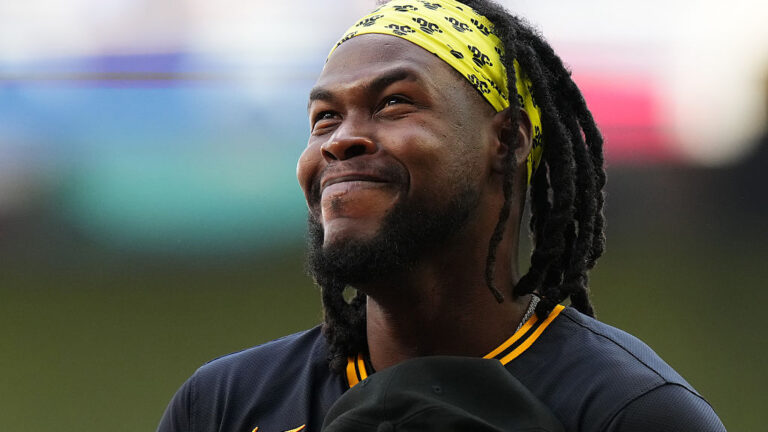
Every year, the beginning of the MLB season produces some truly electric breakouts, as players across the league (both young and old) open the season on a tear at the plate. However, oftentimes these hot starts tend to fizzle out as reality sets back in. For Oneil Cruz, it seemed like this was going to be the case, as he began to revert to his career-normal production after an unreal beginning to the season.
In fact, through the first month of the season, Cruz was hot enough to warrant discussions as to whether or not he was destined for this year’s All-Star Game in Philadelphia.
Through his first 16 games of the season, Cruz was slashing a ridiculous .355/.429/.645 with five homers, a .425 wOBA, and a wRC+ that fell just short of reaching the 200 mark (195). It seemed like the alien-like tools Cruz had showcased in spurts were finally being put together, and it was happening during a huge season for the Pittsburgh Pirates.
However, fast-forward to the next month or so, and Cruz slowed down drastically. From April 14 to May 25, he went on to slash .214/.271/.377 with an absurd strikeout rate that crept up near 40% (38.6%) and a wRC+ of 77. It was a nightmare stretch, and it began to raise a ton of doubt that the version of Cruz we had seen early on was legit.
Under the hood, Cruz’s swing was falling apart as well, which was the origin of his struggles. Through this stretch, he wasn’t getting unlucky, but his previous mechanical inefficiencies had made their way back into his time at the plate, which was really destroying his offensive ceiling.
That’s when Cruz went back to the drawing board and made a change. On May 29, Cruz made a noticeable adjustment to his swing, and he’s been much more productive offensively since. His resurgence this season is a product of commitment to improving, not another hot stretch. Unlike earlier this year, Cruz’s success is sustainable, and it’s all because of this adjustment.
Breaking Down the Swing Change
In order to truly dissect and understand the changes Cruz has made at the plate, we’ll be taking a look at two separate swings from May.
On the left in the following images is a swing from May 22, where Cruz ended up striking out during a rough plate appearance. This is when I first dove into the swing struggles he was facing, as Bucco Bantr‘s Adam Shorr brought it to my attention while watching Cruz in Toronto.
On the right in the following images is a swing from May 29, when I first noticed the adjustment Cruz had made at the plate. It was a drastically different-looking setup that immediately jumped out at me on my TV when watching the game, and I knew I had to break things down after this point, especially when Cruz began to get hot again from this change.
Beginning with the setup, there are some very obvious differences between the two images:
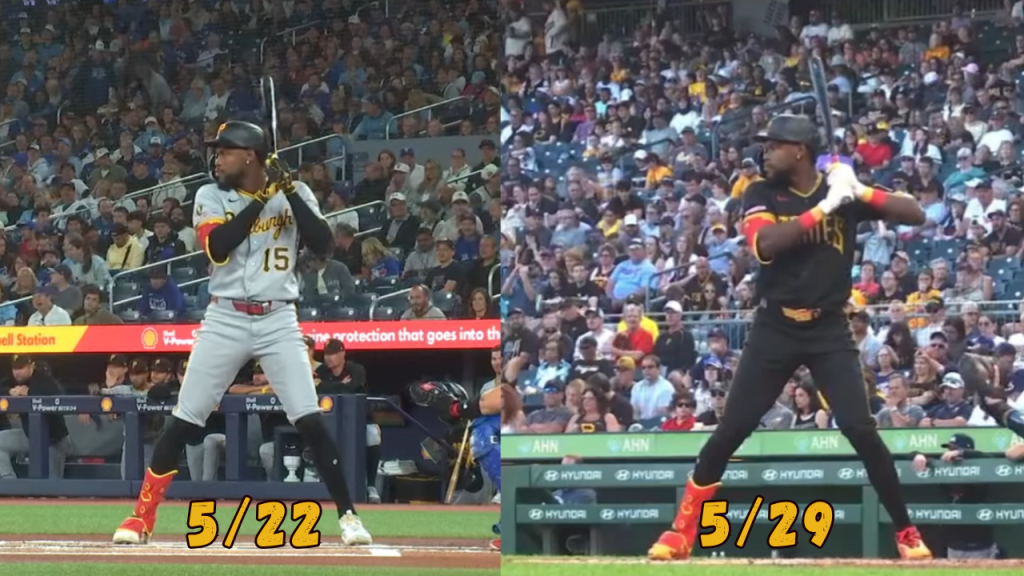
For starters, the main change that we’ll be honing in on during this swing evaluation — Cruz’s hand positioning and back elbow — is very noticeable here.
Throughout his career as a professional, Cruz has remained loose at the plate with a ton of rhythm in his hands. This has been something that’s arguably worked to his benefit, as he’s remained loose until his load, which allows him to load into a better position without losing himself from being so tense throughout the entire swing.
However, this wasn’t the case this year, as Cruz’s looseness had caused his elbow to drop and his hand positioning to change drastically, which put him in a bad position from the first moment he was in the box. It was far too lackadaisical, and as we’ll examine soon, it was causing his entire swing to work straight down.
On the right, Cruz’s elbow is up, and his hands are more loaded by his shoulder than before. This is the position Cruz inevitably loaded into in the past, except he’s just getting to it earlier, which leaves less room for him to load incorrectly or inconsistently, something he often faced during his cold streak I mentioned earlier.
Moving to the beginning of Cruz’s load, a few things immediately separate themselves from the rest of his swing:
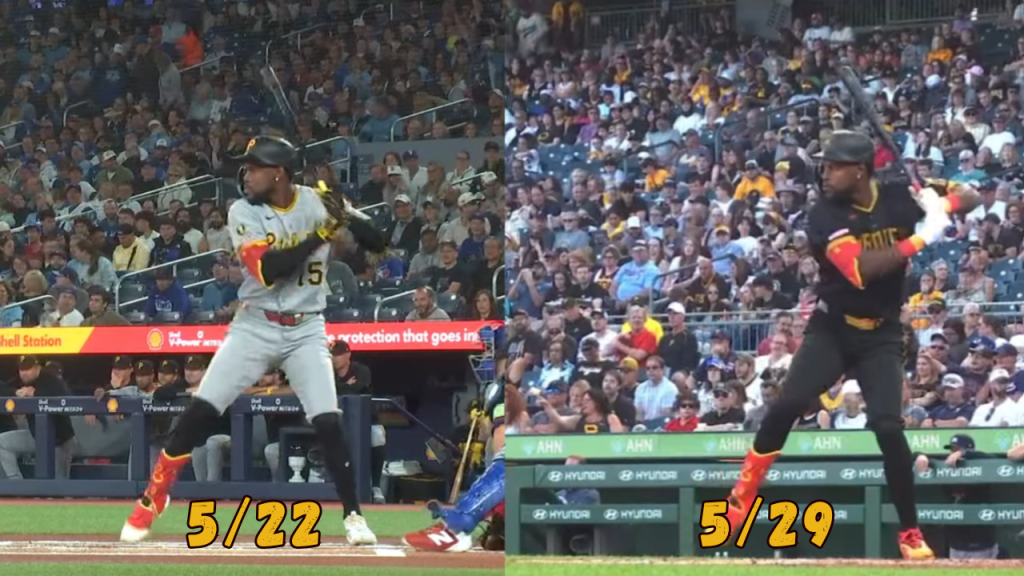
On the left, Cruz begins his load with this strange half-leg-kick type of movement, which was irregular and seemed to be hurting him because he wasn’t fully committing to the leg kick he’d been accustomed to in the past. It also harmed his ability to load into the back side, which you’ll see in the contrast between the two swings I presented.
On top of that, while Cruz’s hands are in a similar position, his elbow is a lot lower, which again caused his back side to immediately collapse. He’d work downwards from the start of the swing, and this also hurt his bat path. When comparing this to the swing on the right, Cruz’s elbow is upwards and even with his shoulders, which keeps the barrel in the slot to work directly to the baseball.
In the next image, the contrast between Cruz’s load and the importance of his new hand positioning stands out significantly:
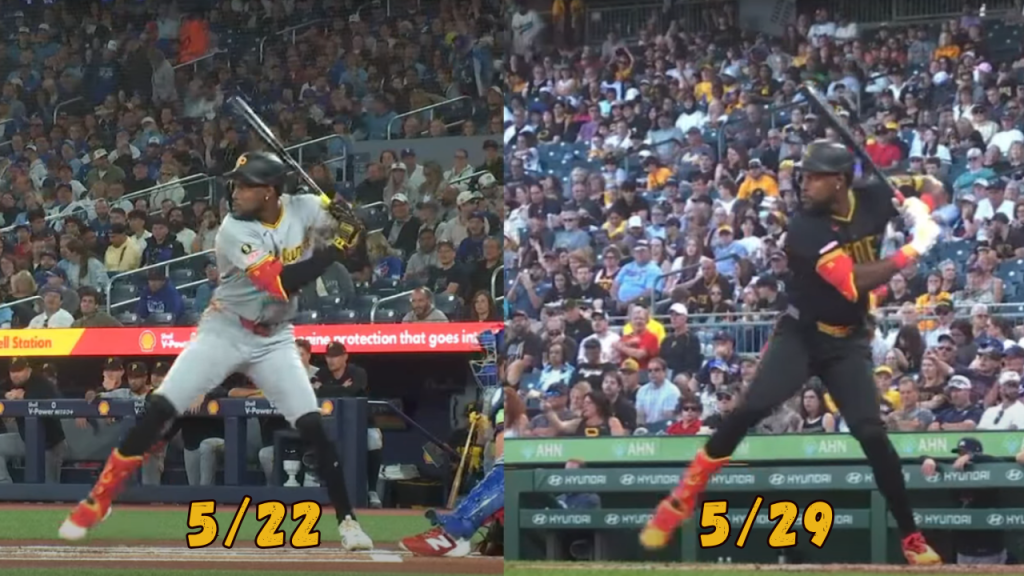
Beginning with the load, Cruz is able to coil into his back hip and load in a way that allows him to work effectively behind the baseball, rather than it being a rushed, half-load like on the left.
You can see here how much better of a position Cruz is in by looking at where his head is positioned. On the left, it’s more towards the front of his body, which is due to the quick, inefficient load. On the right, his head remains stacked over the center of his body, even though he’s loaded into his back side.
Moving on to the hand positioning, you can see how much better the barrel position is in the swing on the right. Rather than already visibly working downwards (on the left), Cruz’s hands are loaded into the correct slot, which helps reduce the “barrel drag” he has later in the swing and allows him to work straight to the baseball.
In this next image, the same two movements I’ve been honing in on are present, with a few other things noticeable as well:
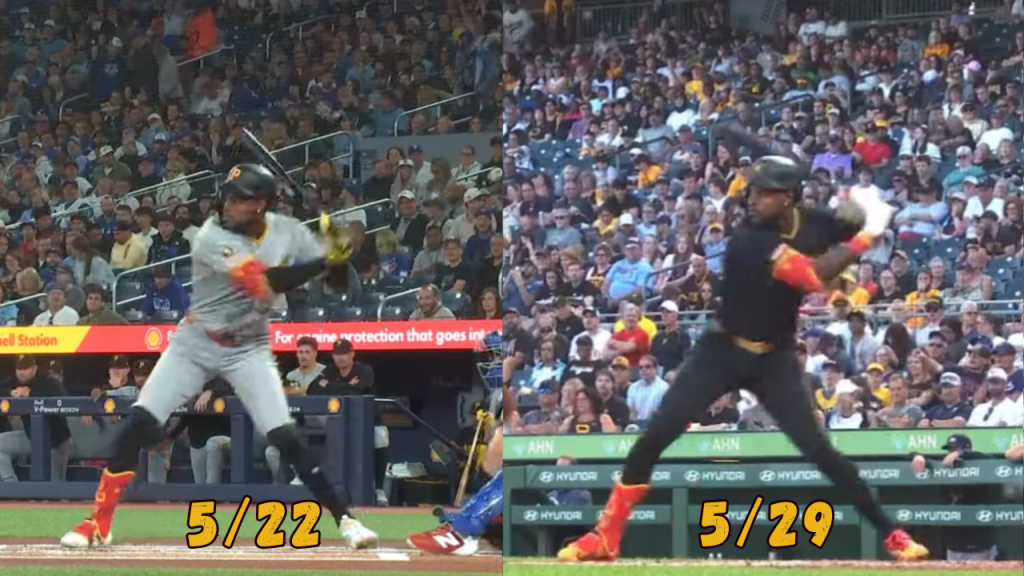
Firstly, this is the first frame where you can really notice the downward movement I’ve been talking about this entire time. On the left, Cruz’s hands are already dropping, and his entire back side is collapsing. What made matters worse was Cruz’s barrel positioning. His barrel is still behind his head, but in a way where it’s lagging behind the rest of his swing. This is what barrel drag looks like, and what caused him to struggle against heaters during this cold stretch.
On the right, it’s a completely different story. For example, Cruz’s hands are still up and in the slot, ready to work straight through the zone. Going one step further, his back side is still intact, and Cruz hasn’t lost any of the energy he built up during the load.
Also, Cruz is a lot more on the front side in the image on the left, which led to his hips opening up far too soon as well.
This next side-by-side shows the contrast between the two swings at Cruz’s point of contact, and the differences are eye-opening. Of course, as I mentioned earlier, the swing on the left is a whiff by Cruz, but this is where his contact point would be:
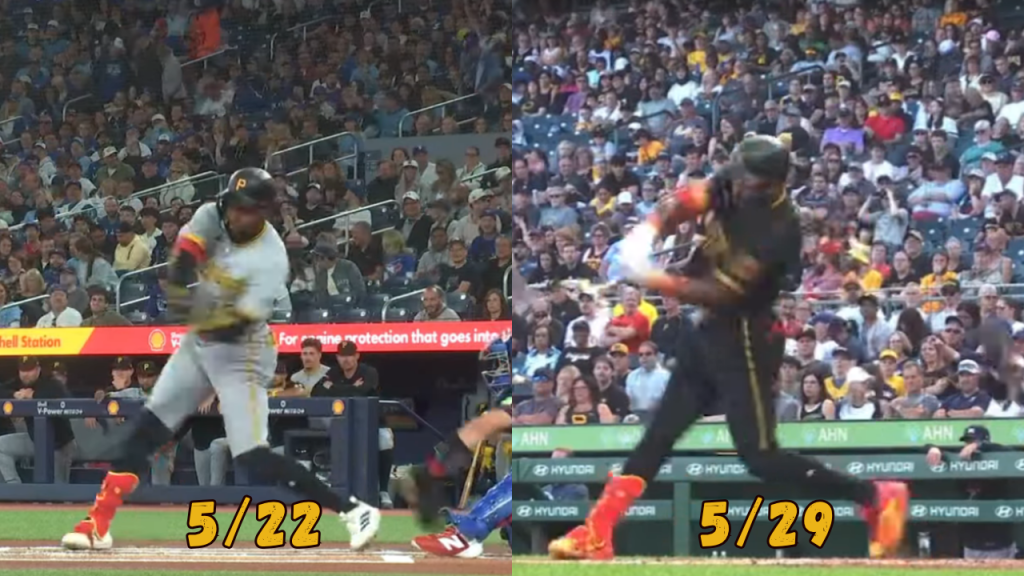
On the right, Cruz’s swing is a thing of beauty. He has the perfect amount of space in his swing needed to produce impressive long balls, which is fitting because this was his 110-mph, 450-foot shot into the Allegheny River. You can see what a difference it makes to work from this new and improved slot, as he’s much better set up to impact the baseball now and correctly work behind the pitch.
On the left, this couldn’t be further from the case. Cruz is lunging at the pitch, and his back side has fully collapsed here. To be blunt, there’s no world where Cruz could correctly impact the baseball from this position.
Lastly, we’ll take a look at the swing through the point of contact:
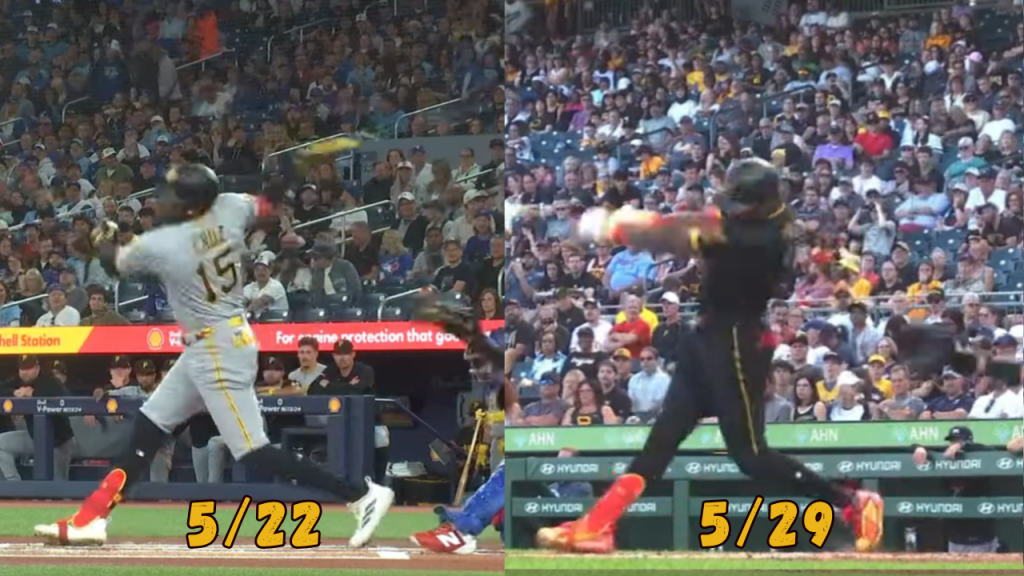
On the right, Cruz is able to fully extend through the baseball. This is evidenced by the fact that his head is still over the center of his body and looking down through the point of contact. His back side is also still fully intact, which is a major difference from the two swings. Essentially, he’s able to fully work through the baseball here. On the left, this couldn’t be further from the case.
With Cruz now in a position where he’s able to more consistently impact the baseball, as opposed to previously collapsing and working downward, he’s seen night-and-day results. This change has fully salvaged his season, which is truly impressive.
Cruz’s Encouraging Numbers Since
While it’s important to take a look at the swings themselves, this can only tell a portion of the story. When combining this with Cruz’s numbers since the adjustment, we’re able to complete the puzzle and tell the full story of why this swing change has salvaged his season.
On the surface, since Cruz made this adjustment on May 29, he’s slashing a ridiculous .333/.543/.708 with three home runs, a .526 wOBA, and a 241 wRC+ (as of June 8). Notably, his strikeout rate is down to 28.6% during this stretch as opposed to 38.6% during his worst stretch of games.
Digging a little deeper, one of the biggest places I’ve noticed Cruz improve is against fastballs. From April 14 to May 25, Cruz slashed .247/.299/.383 with a .682 OPS against heaters, alongside an abysmal 30 strikeouts. Since making the swing change, Cruz has slashed .500/.714/1.250 against fastballs, in addition to a 1.964 OPS. Most notably, he’s only struck out three times on fastballs since this adjustment.
Cruz has made similar strides against breaking balls, as he’s torn the cover off spin since making his adjustment. During his struggles, Cruz slashed .217/.280/.435 with 20 strikeouts and a .715 OPS against breakers. Since May 29, he’s slashed .333/.556/.833 against them, with just two strikeouts and a 1.389 OPS.
Importantly, Cruz’s added impact is visible here, as he’s posted an average exit velocity of 99.3 mph against breaking balls during this span, a mark nearly 8.0 mph higher than during his low period.
Although the overall average exit velocity hasn’t followed just yet, it’s important to remember that this is a much smaller sample size, and Cruz has added impact. For example, Cruz has hit multiple balls over 110 mph during this span, which leads me to believe it’s only a matter of time before this number climbs high yet again.
Overall, all signs are pointing towards this mechanical adjustment having a tremendous impact on his game. With these positive numbers in the time that’s followed his adjustment, it’s hard not to get excited about Cruz reaching his full potential in 2026.
Is This Another Hot Stretch?
Now that we’ve examined his swing change and the positive numbers that support this change having a positive impact on his game, there’s one final question that remains: Is this just another hot stretch?
While it’s easy to worry given Cruz’s scorching hot start to the season, I’m fully convinced that this version of him we’re seeing is sustainable. While there will be highs and lows of the grueling 162-game MLB season, I don’t see Cruz returning to the version we saw of him during his lowest moments because of this change.
If Cruz can hold this pace, 2026 is set to be his best season by a wide margin. He’s currently on pace for 35 homers, 4.5 fWAR, and the first full season of his career that he’s finished with a wRC+ over 120. With Cruz on pace to nab 53 stolen bases as well, he has the chance to become the first Pirate since 1992 with a 30/30 season, and one of the few in team history to nab 50 or more stolen bases.
The version of Oneil Cruz we’ve been waiting for is here, and his breakout has a chance to reach new heights with this small but incredibly important swing change.
All stats as of games on June 8.
Become a Member of Just Baseball
Subscribe and upgrade to go ad-free!
* Save 25% by subscribing annually.

Written by
Jay Staph, a huge baseball fan and stat nerd, founded and ran his own baseball writing website, BSBWrites, at just 16-years-old. With focal points around prospects,…