
It’s Time To Embrace Who Garrett Mitchell Is
After years of wondering what type of player Garrett Mitchell could be for the Brewers, we are finally starting to get the answer.
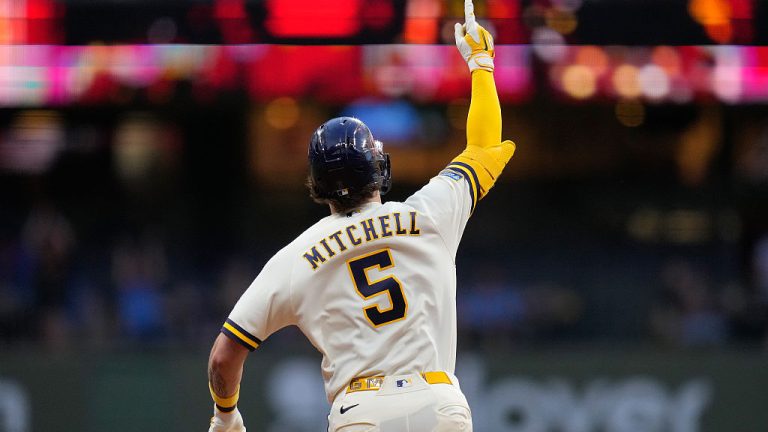
For years, we have been waiting for a big enough sample size to draw a reasonable conclusion on who Garrett Mitchell is as a player.
The often-injured Mitchell has struggled to stay on the field throughout his career for the Milwaukee Brewers. Uber-talented with an athletic skillset, Mitchell was always an intriguing profile given his blend of speed, defense, and power.
But having parts of five seasons constantly broken up by injury has made it difficult to assess the kind of player he can be at the big-league level. Through the first two months of the 2026 MLB season, fans are finally starting to get a glimpse of what Mitchell can provide on a daily basis.
While he’s far from a finished product with plenty of room for improvement, he is at least proving that he has what it takes to be a valuable contributor for the Brewers in 2026. While it may have taken a while to get to this point, it’s becoming clear what Mitchell can bring to the table for Milwaukee.
Stats were taken prior to play on May 28.
Who Is Garrett Mitchell?
Two things can be true at once: Garett Mitchell is a frustratingly streaky player who strikes out a ton, and he is an electrifying athlete who can provide a jolt of life when Milwaukee’s offense needs a spark. Both of those things have been on full display already this season.
Mitchell has played 46 games this year, already his second-most in a single season throughout his five-year career. Across 167 plate appearances, Mitchell is slashing .236/.349/.379 for a .738 OPS and 110 wRC+. He has 13 extra-base hits — including nine doubles, three homers, and a triple — to go along with 28 runs driven in (fourth on the team) and six stolen bases (third on the team).
While those numbers on the surface look respectable, it hasn’t necessarily been smooth sailing to get there.
Accepting the Flaws
The elephant in the room is Mitchell’s astronomical strikeout rate. He leads MLB in that category at a whopping 37.1%. His whiff rate of 37.9% is the fourth-highest mark in MLB, and his in-zone contact rate of 71.4% is the fourth-lowest in the sport (min. 150 PA).
As a result of such significant bat-to-ball flaws, Mitchell has been susceptible to extreme volatility at the plate.
| Opening Day – April 21 | April 22 – May 13 | May 14 – Present | |
| Games | 20 | 17 | 9 |
| Batting Average | .273 | .140 | .357 |
| On-Base Percentage | .437 | .231 | .400 |
| Slugging Percentage | .436 | .174 | .679 |
| OPS | .873 | .406 | 1.079 |
| wRC+ | 154 | 21 | 203 |
| wOBA | .392 | .198 | .464 |
| Strikeout Percentage | 37.5% | 38.5% | 33.3% |
Mitchell was one of Milwaukee’s top hitters out of the gate, posting a 154 wRC+ and .873 OPS in his first 20 games of the season. Still, a 37.5% strikeout rate and .519 BABIP suggested that regression was bound to come.
In his following 17 games, Mitchell’s batting average dropped by over 130 points, his wRC+ fell to just 21, and his OPS was cut in half. His punchout rate remained sky-high at 38.5%, while his BABIP dropped to .242 over that stretch.
But as the Brewers’ offense has heated up as of late, so has Mitchell. Across his latest nine games, he sports a wRC+ over 200, an OPS north of 1.000, and he’s been a pivotal run producer for the Brewers. Despite the strikeout rate still sitting north of 33% over that stretch, he’s been able to make up for it by doing damage on the baseball.
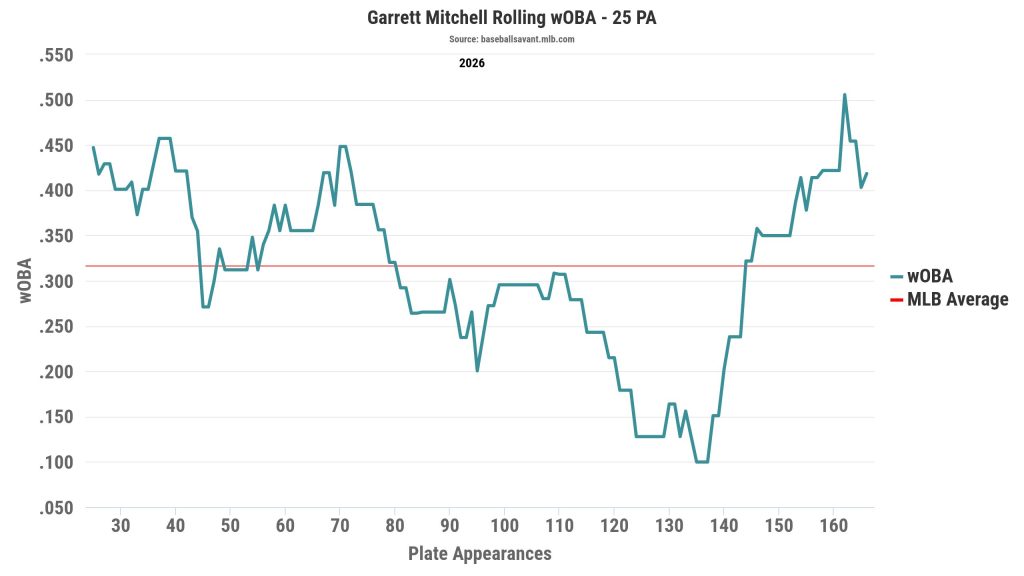
Now, I acknowledge that breaking up his 46-game sample into even smaller chunks is not the most ideal exercise. However, it really does help capture his volatility as a hitter.
Seeing such extreme peaks and valleys is typical for a player who strikes out at the rate that Michell does. But while the lows can be quite low, he’s shown flashes of the type of player he can be when he is in a rhythm at the plate.
It’s those flashes that give fans a glimpse of the complete package he could be if he were ever to cut down on the swing-and-miss.
Acknowledging the Strengths
While Mitchell doesn’t make contact often, he does two other things very well to help mitigate the whiff concerns: he walks at one of the highest rates in MLB, and he hits the ball exceptionally hard when he does connect with the ball.
Where Mitchell struggles in the bat-to-ball department he makes up for with an exceptional feel for the strike zone. His chase rate of 19.4% is in the top four percent of MLB. His selectiveness at the plate, highlighted by a 41.3% swing rate, allows him to pick and choose his spots to attack.
Mitchell is seeing the eighth-most pitchers per plate appearance this season at 4.3, which is a key element in his approach. Getting ahead in counts is absolutely critical for Mitchell to succeed at the plate.
In counts where Mitchell is ahead this season, he is slashing .381/.612/.667 for a 1.279 OPS. In even counts, his OPS drops to just .537, and in counts where the pitcher is ahead, Mitchell is batting just .111 with a .293 OPS.
Throughout his MLB career, he sports a 1.138 OPS when ahead in the count, a .737 OPS when in an even count, and just a .380 OPS in counts where the pitcher has the advantage. The production drop off is astronomical when Mitchell is on his heels in an at-bat.
Selectiveness is a key component of his game, as is hitting the ball hard. For a player who whiffs as much as Mitchell does, quality of contact is key when he does put the bat on the ball. So far this season, he’s excelled in that department.
Fueled by a 97th-percentile bat speed of 76.9 mph, Mitchell has a hard-hit rate of 50.6% that is in the top eight percent of MLB and an average exit velocity of 92.3 mph that is in the top 10 percent of MLB. With a max exit velocity of 115.5 mph, his maximum power output is up as well as his quality of contact on a per-swing bases, making the swing-and-miss much more palatable.
One thing that stands out in Mitchell’s batted-ball profile is his attack angle, or the vertical direction that the sweet spot of the bat is traveling at the moment it hits the baseball. While his attack direction is one of the highest opposite-field marks in MLB, he has done an excellent job at maintaining an ideal attack angle on his swings this season.
Mitchell’s ideal attack angle percentage — the percentage of swings that fall within the five and 20 degree attack angle range — sits at a whopping 63.2%, which is the 11th-highest mark in all of MLB.
Swings between these attack angles are much more likely to result in line drives and extra bases. So, in short, Mitchell is getting tons of value out of his competitive swings, a key factor in his offensive success.
Room for Improvement
That said, Mitchell does struggle to elevate the baseball at times, as his 53.8% ground-ball rate is one of the higher marks in baseball. It’s not the biggest of concerns for a player like Mitchell who is a burner on the basepaths with a 98th-percentile sprint speed, but it does limit how much game power he can tap into.
This is an issue that plagued him dating back to his days as a prospect. While it helps that he hits the ball hard, a high ground-ball rate — combined with a high strikeout rate — does leave a player susceptible to offensive droughts.
Sometimes well-hit balls find the holes, and sometimes they don’t. Mitchell’s mighty ground-ball rate can help explain the extreme fluctuations he sees in BABIP throughout the season, which often coincides with his overall production.
I am less confident that Mitchell sees a sharp increase in contact rate as the season progresses, but I am much more confident that he can get his ground-ball rate under control. An improvement in that department should lead to more consistency at the plate.
What’s more, Mitchell’s struggles against heaters have been well-documented to this point in his career. It’s not breaking news, but this is a shortcoming of Mitchell’s that will make it challenging to see prolonged stretches of success.
Against four-seamers this season, Mitchell is batting .208 with a 34.5% whiff rate, which is tied for the 10th-highest whiff rate against four-seamers in MLB. When looking at how that whiff rate is broken out by parts of the strike zone, it’s evident that opposing pitchers have a clear plan of attack against Mitchell.
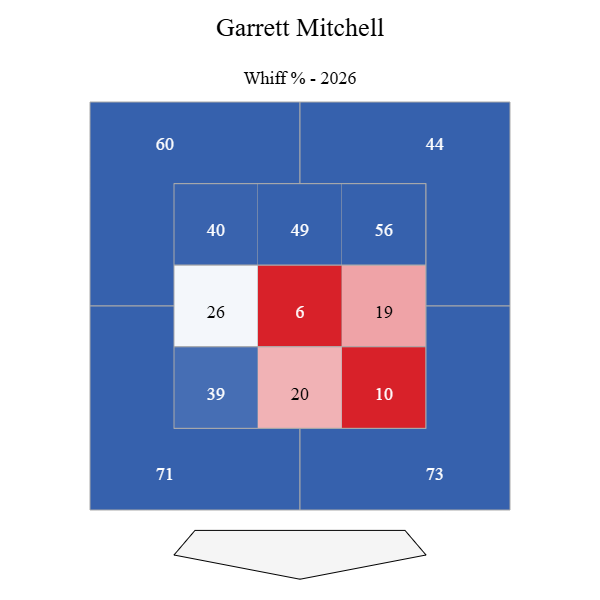
Of course, fastballs are the most common pitch type thrown at the top of the zone, specifically four-seamers. Pitchers have the scouting report on Mitchell, and they’re attacking his weakness. His 40% strikeout rate against four-seamers is the second-highest in MLB, only behind Rafael Devers.
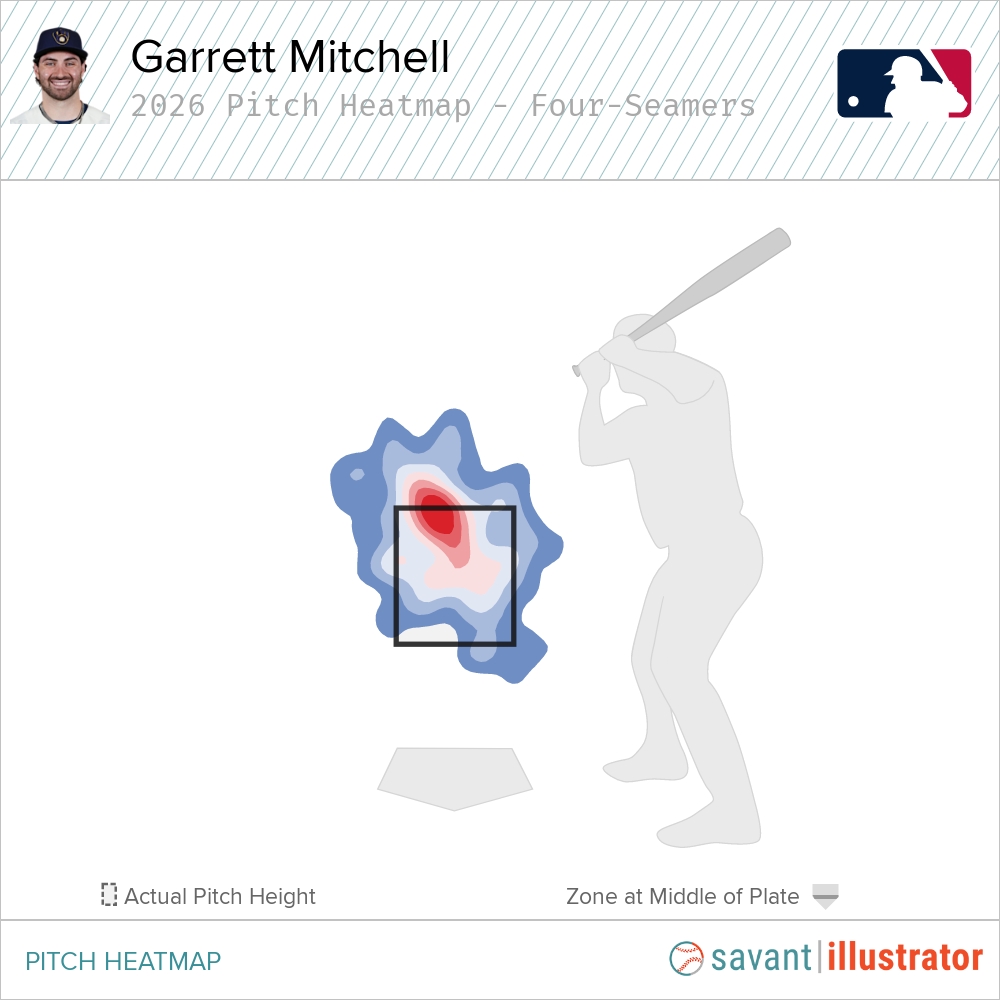
Unsurprisingly, Mitchell is seeing four-seamers more than any other pitch type at 33%. But the problem is not just that he struggles against high heaters, but those issues bleed into other parts of his game. Mainly, if Mitchell is thinking fastball in the back of his head, it leaves him susceptible to off-speed tailing away or low spin, and that’s exactly what we are seeing at the moment.
As a result of his struggles against four-seam fastballs, Mitchell has also struggled to pick up spin. Against sliders, Mitchell is whiffing 58.6% of the time, the fourth-highest mark in MLB against sliders. Though he’s mitigated the damage against curveballs, he’s batting just .118 against sliders this season.
It’s the same story against changeups, where he sports a 55.2% whiff rate while batting just .167 against the pitch type. Against the four most common pitch types against him — four-seams, sinkers, changeups, and sliders — which make up over 68% of the pitches he sees, he has a combined -5 run value against those pitches, according to Baseball Savant.
Against all other pitch types he’s faced, he has a combined +4 run value. So, it hasn’t been all bad, and he’s actually done most of his damage against sinkers and cutters this season.
Point being, when Mitchell is not getting beat at the top of the zone, it allows him to put together much more comfortable at-bats, putting him in the driver’s seat and allowing him to get ahead in counts.
When he’s struggling to catch up to the heater, it opens up a wide range of possibilities for opposing pitchers and gives them several avenues to beat Mitchell at the plate.
This is where more getting reps against major-league arms should help iron out some of these wrinkles in his game. After all, these struggles likely tie back to his aforementioned time off the field and how that’s impeded him from developing in a way. The hope is that as he gains more consistent at-bats, he can make the necessary adjustments.
Hot streaks and cold spells will likely forever be a part of Mitchell’s offensive game, but if he can either reduce the number of up-and-down stretches, or extend his hot streaks while shortening his slumps, it would go a long way into making him a more polished and complete player.
Final Thoughts
As the sample size grows, fans are getting a clearer picture of what Garrett Mitchell can bring to the table for the Brewers.
His value as a runner was never in question, as he continues to be an elite baserunner on a team that prioritizes speed and smart baserunning. Despite what the arm value metric might read on Baseball Savant, he still boasts elite arm strength and provides above-average defense at a premier position in center field. And he has enough pop in his bat to be a spark plug for the Brewers’ offense when they need a big swing.
Mitchell provides value in so many different ways, and he is still far from a polished product. It might not feel like it because he has been in the Show for five seasons, but this is a player who has just under 190 career MLB games played under his belt.
Making good swing decisions is something that clearly comes very naturally for Mitchell, and that’s something he will continue to lean on as he develops as an MLB hitter. There will be ebbs and flows, which is something Brewers fans will need to get comfortable with in 2026, but the flashes we’ve seen from Mitchell makes it easy to dream on what the total package could look like.
Become a Member of Just Baseball
Subscribe and upgrade to go ad-free!
* Save 25% by subscribing annually.

Written by
Joey Peterson is a graduate of the University of Wisconsin-Madison and an editor for Just Baseball. He covers the Milwaukee Brewers, along with general MLB topics…