
Bethune-Cookman Baseball Is Becoming Impossible To Ignore
Jonathan Hernandez delivered packages for Amazon during COVID and kept a list of players he wanted to recruit. Now he's turning a Daytona Beach HBCU into one of college baseball's most compelling programs.
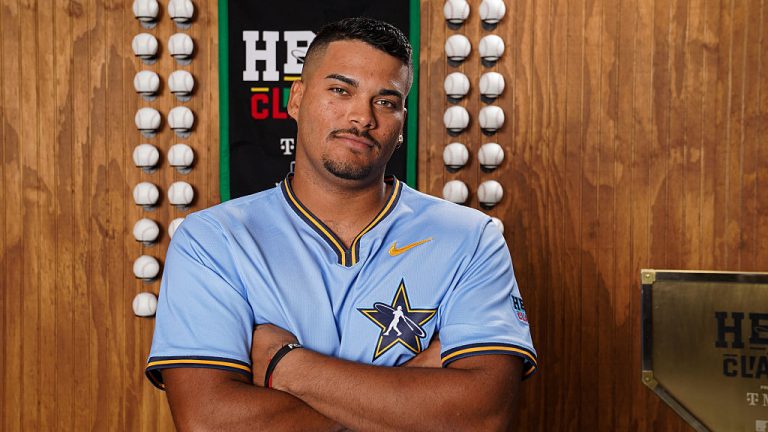
Seven years ago, Jonathan Hernandez was coaching baseball at a junior college in Miami, a program he helped build nearly from scratch, wedged between a Burlington Coat Factory and an LA Fitness.
He had never been to Daytona Beach in any meaningful way. He barely knew anything about Bethune-Cookman.
Then, one October night in 2017, his phone rang at 10 p.m. Jason Beverlin, the Wildcats’ longtime head coach, had just taken a job with the Toronto Blue Jays. The position was open.
“I called Coach Melendez like, get me in front of whoever we got to get to,” Hernandez recalled. “This is somewhere I want to be.”
He got the job. He’s been building ever since. And what he’s built is starting to turn heads far outside Daytona Beach.
A Program With a Past and a Coach Determined To Honor It
Bethune-Cookman baseball isn’t some overnight success story. This program has been around for a long time and has the history to show for it. The Wildcats have made roughly 17 NCAA Tournament appearances and produced six MLB players over the years.
During their peak stretch in the 2000s, they rattled off conference championships at a pace that most mid-major programs could only dream about, somewhere in the neighborhood of ten or eleven straight titles at one point.
But the program had dipped by the time Hernandez arrived in 2018, and he was walking into a situation that needed real work. He knew it. He was also walking into something bigger than just a baseball program.
The vision of the program was to get it back to national prominence, as Coach Melendez and Coach Beverlin had for a while, because it was down for a couple of years. And again, I’m just blessed with the opportunity to lead this program.
– Coach Jonathan Hernandez
Hernandez is deliberate about connecting his players to that history. The program was chasing its 20th conference championship in 2026, a number he made sure his guys knew about from day one.
In a sport where players come and go through the portal faster than ever, tying a roster to something larger than itself is a genuine coaching challenge. Hernandez makes it a point to meet it head-on.
We don’t shy away from it. We talk about the legacy of the program. We talk about the rich history that we do have. And we’re just trying to add ourselves into the history books here.
– Hernandez
The Unconventional Path That Shaped Everything
To understand how Hernandez coaches, you have to understand where he came from, because the route he took to get here isn’t the standard one.
He didn’t come up through the D-I assistant pipeline. He coached high school ball, worked his way from freshman team all the way to varsity head coach, then spent five years running a junior college program in Miami.
At that level, the head coach is everything: recruiter, academic advisor, financial aid counselor, equipment manager, and fall camp coordinator all rolled into one person. There is no support staff. There is no department to pass things off to.
When you coach junior college, you’re wearing so many hats,” Hernandez said. “That when I got here to Bethune, I had resources. We have an academic department, we have financial aid people. So I had to know it from A to Z, top to bottom.”
That background shaped something else, too: patience. It’s a word Hernandez returns to more than once when talking about building this program. He also learned something specific about time on the field that he carried directly into his D-I approach.
“Coming from junior college, it’s the wild, wild west,” he explained. “Being able to attain 20 hours a week where the work is in quality, not in quantity. We don’t have to be here for four hours as long as we get the work that we need.”
The First Year and the Amazon Van
Hernandez’s first season as head coach in 2018 went 17-38. That is a brutal number by any measure. He is honest about how hard it was.
“There were a lot of long nights. Times where I even questioned, am I good enough to be able to lead a Division I program?” he said. “Those seniors had three head coaches in four years.”
He redirected his focus: make sure those seniors graduated, recruit the next class, and trust the process. The program brought in a 58th-ranked recruiting class nationally. Then COVID hit and erased two seasons. Then, during the opt-out year of 2021, Hernandez was furloughed for eight months.
He went to work delivering packages for Amazon.
“Not that I took the position for granted because I didn’t,” he said. “But it definitely gave me a different perspective of the job and what it entails.”
When he came back, he saw something others might have missed. The NCAA’s extra eligibility year and the roster chaos that followed created a window for programs with flexibility.
Bethune-Cookman had a blank canvas and scholarship money to offer. Hernandez erased the entire recruiting board he’d been building and pivoted entirely to junior college players to stabilize the program fast.
That decision still defines the roster today, roughly 80 percent junior college, 10 percent transfer portal, 10 percent high school. It isn’t accidental. It’s a system.
The Recruiting Pitch: Toughness, Not Just Talent
Florida is one of the most competitive states in the country for college baseball recruiting. Twelve other Division I programs operate within its borders. Miami, Florida State, Florida, UCF, and Stetson are all pulling from the same talent pool.
Bethune-Cookman doesn’t have the same facilities, the same budget, or the same brand recognition. Hernandez doesn’t try to win that fight. He picks a different one.
“There has to be a toughness factor to it,” he said. “We wanna bring guys in that have faced some type of adversity in their lives and they’ve been able to overcome it. Because if they’re able to overcome adversity in life, then we’re gonna be bouncing around from a city field to a minor league stadium, on the road for two, three weeks, and they’re ready for that.”
The pitch has a specific edge to it that Hernandez leans into deliberately: we want you here, but we don’t need you.
We want you here because we want to show that you have the ability to compete against the gauntlet of a schedule that we play, and then give them a reason why they missed out on you.
– Hernandez
It’s a pitch built on chip-on-shoulder energy. And given what some of these players have gone on to do in Daytona Beach, it’s hard to argue with the results. The program has averaged two to four players drafted per year in recent seasons, giving the recruiting pitch something real to stand on.
The Walk-Off Moment That Changed Everything
The 2025 SWAC Tournament at historic Rickwood Field in Birmingham was the moment the program announced itself to the broader college baseball world. Andrey Martinez hit a walk-off home run to win the SWAC Championship. The place erupted.
Hernandez, standing in the middle of all of it, heard one voice above everything else.
“My son Jake ran into my arms,” he said, pausing. “I get chills talking about it. I broke down emotionally because as a parent, we miss out on a lot of our own kids: school recitals, plays, conferences, academic awards. Because we’re investing so much in other people’s kids. And that was one where, now I understand why you work so hard.”
The Wildcats went to the Tallahassee Regional that summer. They played in front of thousands of fans at Florida State’s Doak Campbell-adjacent complex and competed hard. Two years removed from the furlough and the Amazon deliveries, Jonathan Hernandez was standing on an NCAA Tournament field with his team.
This isn’t a shock to us here within our program with all the attention that we’re getting because of the recent success that we’ve had.
– Hernandez
The 2026 Season: A Program Record and a Stunner at Rickwood
Bethune-Cookman came back in 2026 locked in. Rather than losing the returning core to the transfer portal, the fear heading into the offseason, Hernandez held exit meetings with his players one by one, bracing for departures.
“It was one by one. We’re staying, we’re coming back. We’re staying, we’re coming back,” he recalled. “We actually had to take a 15, 20 minute break in between guys because we were just in shock.”
What followed was a season that should be remembered as one of the best in program history, regardless of how it ended.
The 2026 Wildcats set a program record for wins, finished 37-18 overall and 23-7 in SWAC play, won back-to-back regular season titles, and dominated the conference’s postseason award voting with ten individual honors.
Jose Fernandez was named SWAC Player of the Year. Edwin Sanchez, who went 11-1 with a 2.69 ERA and was perfect in conference play at 8-0, earned SWAC Pitcher of the Year. Hernandez himself was named SWAC Coach of the Year for the second straight season.
And then, in April, Bethune-Cookman beat ranked LSU on the road. Then beat No. 7 Florida in Gainesville six days later. Back-to-back road wins against top-25 SEC programs in one week. It was the first time the program had beaten two ranked opponents in the same season since 2009.
Whenever LSU or Florida punched us, we punched right back. We didn’t lay down. We’re gonna just come at you and we’re gonna try and win every inning and that’s what it’s about.
– Hernandez
The Wildcats entered the SWAC Tournament at Rickwood Field as the No. 1 seed and the obvious favorite to win the conference’s automatic NCAA bid.
Then Arkansas-Pine Bluff, the No. 8 seed, beat them twice. A 6-4 upset in the opening round. Then a 13-8 comeback win to eliminate them after B-CU had built a five-run lead. The season ended earlier than anyone in Daytona Beach wanted.
It stings. It should. A program-record win total and a historic week against the SEC, and it ends with two losses to the tournament’s lowest seed. That’s the nature of tournament baseball, and it doesn’t diminish what was built this year, but it doesn’t soften the exit, either.
What This Means for HBCU Baseball and Why It’s Bigger Than Wins
Bethune-Cookman operates with a small school’s budget. The campus in Daytona Beach has fewer than 3,000 students.
Everyone on campus knows who the baseball players are. Hernandez takes that seriously. The team shows up to football games, basketball games, volleyball matches, and track practice. They are part of the school, not just residents of it.
“We can’t afford the box,” Hernandez said directly. “So we do things differently, maybe unconventional, but it leads us to the results that we want.”
When Bethune-Cookman wins, really wins, against LSU, against Florida, in front of thousands of fans at Rickwood, the impact stretches beyond the program. Hernandez is clear about that.
When one HBCU succeeds outside of playing other HBCUs, we all come together. Those wins for us are a win for the entire HBCU landscape, to be able to give hope to other teams and opportunities.
– Hernandez
He has talked openly in the program about Omaha. Not as a fantasy, but as a destination. He refuses to let the narrative take hold that HBCU programs can’t compete at the highest level of college baseball. His players hear it every day.
“I’ll never let the narrative break in that HBCUs cannot compete on a national level,” he said. “Our guys understand that. We talk about it openly.”
The Unfinished Business
The 2026 tournament exit is a chapter. It isn’t the story.
Jonathan Hernandez has turned a program that went 17-38 in his first season, while he was questioning whether he was good enough for this level, into back-to-back SWAC regular season champions with a pair of wins over ranked SEC programs on their own fields.
He did it by recruiting tough junior college kids, playing the hardest schedule he could find, and building a culture that doesn’t collapse when things go wrong.
“You get more out of your losses than you do your wins,” he said. “And we’re gonna, as long as I’m here, continue to play a tough non-conference schedule.”
Winning a regional. Getting to a super regional. Showing up at Omaha. Those aren’t just motivational phrases in Daytona Beach. They’re the actual goal, stated plainly and built toward daily.
The 2026 season didn’t end the way Hernandez or his players hoped. But the program that played LSU on the road and won, that walked off for a SWAC championship, that produced a first-team All-SWAC shortstop and a perfect-record conference ace, that program isn’t going anywhere. It’s just getting started.
Somewhere between a Burlington Coat Factory and an LA Fitness in Miami, this was all in motion. The man who delivered Amazon packages during a pandemic is turning an HBCU baseball program into something the rest of the country is going to have to start taking seriously.
Become a Member of Just Baseball
Subscribe and upgrade to go ad-free!
* Save 25% by subscribing annually.

Written by
Jared Perkins is a College Baseball and MLB Draft Director for Just Baseball. He's a Host and Co-Founder of The College Baseball Show.