
The Reds Have Lost Their Best Closing Option at the Worst Time
The Reds are still holding on to playoff aspirations, but losing Graham Ashcraft, who's stuff would play nicely as the team's closer, is a big blow.
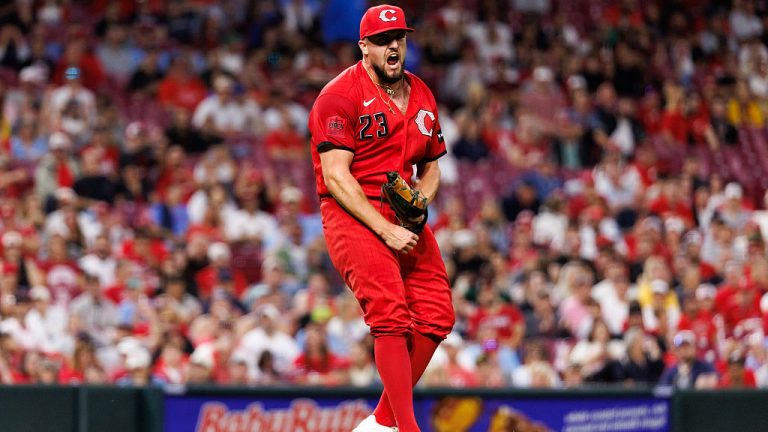
Since making the transition from the starting rotation to the bullpen prior to the 2025 MLB season, Graham Ashcraft has become one of the Cincinnati Reds‘ best relief options. The 28-year-old drastically altered his career trajectory with the switch and has continued his dominance through the first part of the current season.
Through 27 innings pitched, Ashcraft has held his ERA to 3.33, and opponents have struggled to the tune of just a .183 average in 109 plate appearances. The right-hander isn’t overperforming either, having managed a 3.46 xFIP and limiting xBAA to .197 (89th percentile).
With his degree of success and consistent reliability, having appeared in just under half of the Reds’ games, it seemed Ashcraft was ready to handle a larger role in Cincinnati’s bullpen.
That was, until he landed on the 60-day injured list with a UCL sprain. The news came in a sudden and unexpected manner, and will be a massive blow to Cincinnati’s playoff hunt.
Here’s why Ashcraft would have excelled in the squad’s closing role, and how his injury impacts the Reds’ bullpen:
Arsenal
Ashcraft is one of the more unorthodox arms in the game, attacking opponents with just two pitches: a cutter and a slider. Both have been relied on almost identically by the right-hander (51.3% and 48.7%, respectively).
The slider is the better of the two offerings, garnering a .160 xWOBA against so far this season, as well as causing opponents to swing-and-miss over 45% of the time.
With 8.0 inches of induced horizontal break, Ashcraft’s slider moves 5.3 inches more than comparable pitches (other pitches of the same pitch type, within +/- 2 MPH and +/- 0.5 feet of extension/release). He also induces -0.5 inches of vertical break on the pitch, which helps give the pitch depth.
Plus, it comes in at 90.6 MPH. Hitting Ashcraft’s slider is no small task.
Ashcraft’s other offering has fared less impressively so far this year. Opposing hitters have hit .308, managed a .424 xWOBA, and swung and missed just 19.4% of the time against the cutter, a result of an average movement profile.
That begs the question: why not throw another pitch?
In his time as a starter, Ashcraft had a more traditional repertoire; he relied on the slider and cutter, but also a sinker, changeup, and the occasional four-seam fastball. Simply put, none of the other pitches really worked.
Well then, what’s so special about the cutter that causes Ashcraft to throw it 50% of the time?
Ashcraft’s slider mirrors his cutter, with more bite but less velocity out of the hand. From a hitter’s perspective, the pitches look nearly identical until the slider breaks late. The tunnel Ashcraft has created has left the two indistinguishable until the very last moment and has been essential to his recent success.
A comparable pitcher, albeit more extreme, is Tommy Kahnle and his changeup. Against Kahnle, hitters essentially know what pitch is coming, but the pitch tunneling is so deceptive that squaring the ball up isn’t any easier.
Why A Shift to Closer Made Sense (Pre-Injury)
Recently, the Reds’ current closer, Tony Santillan, has struggled significantly, recording three blown saves and two saves. His season ERA has climbed north of 5.00, and a 4.63 xFIP doesn’t inspire much confidence that any of these results could be luck-based.
On the other hand, Ashcraft has been relatively consistent and dominant to start the year in Cincinnati’s bullpen.
Ashcraft’s already punched out 32 batters, the most by any Reds’ reliever so far in 2026. He strikes opponents out at a 29.4% clip (89th percentile), and induces ground balls on 54.1% of balls put in play (91st percentile). Plus, given his reliance on just two pitch types, he’s not a pitcher who should face many batters in an appearance.
He may not have a typical closer profile, but with such desirable strike out and ground ball outcomes, it’s hard to turn a blind eye to his success. Ashcraft closing out games in Cincinnati just made sense.
Impact
To start the year, Cincinnati’s bullpen has struggled to a 4.99 ERA, fourth-highest in the majors. Outside of left-hander Sam Moll and, previously, Ashcraft, the rest of the squad’s relieving core is struggling immensely or over-performing their underlying metrics by a wide margin.
Now, with the blow dealt from Ashcraft’s injury, the Reds will need reinforcement quickly.
Luckily, plenty of relief pitchers on expiring contracts are expected to become available for trade prior to this year’s deadline. Most notably, the Reds could pursue acquiring pitchers like Ryan Helsley (Orioles), Pete Fairbanks (Marlins), A.J. Minter (Mets), or Antonio Senzatela (Rockies).
Each of the aforementioned options won’t be a cheap acquisition, but in a year where the National League playoff picture is this open, Cincinnati’s front office can’t be afraid to make a splash.
After all, they just lost their best closing option in Graham Ashcraft.
Become a Member of Just Baseball
Subscribe and upgrade to go ad-free!
* Save 25% by subscribing annually.

Written by
Mason Linken first began writing about baseball after founding FBC Reports, and contributing to SABR's book "Henry Aaron". At Just Baseball, Mason is responsible for covering…