
MLB Draft Notebook: Florida State vs Wake Forest
Let's dive into which draft prospects shined during the recent weekend showdown between Florida State and Wake Forest.
Pitchability and finesse are something that’s becoming a bit rare in today’s game, especially with the rise in velocity the past few seasons. It’s not quite a lost art, but it’s not as prevalent.
Admittedly, this has made Florida State’s rotation a bit of a novelty; they won’t overpower you, but they’ll find success with deep pitch mixes and command. That was the case against a potent Wake Forest team that is fresh off a fifteen-game winning streak, as Florida State’s starters allowed just one run across 19.2 innings, striking out 32 and walking just six.
It was pure domination from first pitch on Friday, and that was the biggest story of the weekend. Wake Forest struggled to adjust to the kitchen sinks thrown their way, and while the approach was much better on Sunday, it was too little, too late.
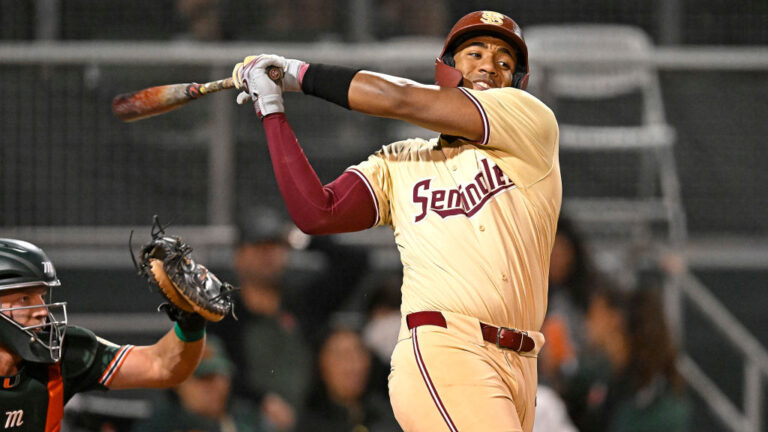
Offensively, Florida State had quite a few bats that impressed (hope you notice that this piece will be Florida State-heavy). Myles Bailey, Brayden Dowd, and Eli Putnam were the biggest performers on the weekend, but the entire lineup produced in some fashion. Wake Forest will have a bat featured in this piece, though it may not be one most would expect. Let’s dive in.
LHP Wes Mendes, Florida State
Final Line: 7 IP, 2 H, 0 ER, 2 BB, 11 K (59 Strikes/100 Pitches)
Mendes has been fantastic through the early part of the season, allowing just five runs total (two earned) and posting a 30:7 K:BB ratio across his first four starts. However, Friday was his best outing of the season, and a case can be made for it being the best start of his collegiate career.
“I felt like I got better as the outing went on, and I felt like I had all five pitches in play”, Mendes said on Saturday. His praise for Micah Posey, Florida State’s pitching coach, was on full display throughout our conversation. “Posey does a great job of scouting these guys, [Wake Forest’s] tendencies, and does a great job calling pitches.”
I’ll expand upon Mendes’ arsenal upgrades in a second, but I wanted to express my thoughts on his fastball, which was excellent in setting up his secondaries. It’s always been a solid foundation starter for his profile: sitting in the low-90s with solid shape and good extension.
Admittedly, his velocity was slightly down from previous outings, topping out at 94 MPH and holding 90-93 MPH throughout, but the colder weather more than likely played a role in that. Mendes was able to place the fastball in and out of the zone consistently, and with over 6.5 feet of extension and considerable hop, he was able to find success in missing bats.
The change-up is his bread and butter, a potentially plus pitch with fantastic velocity separation and command. Against a righty-heavy lineup, it was his most used secondary, garnering seven whiffs on ten swings (70% whiff rate) thanks to exceptional depth and fading life.
Mendes’ expanded his arsenal at Driveline this past winter, as the addition of his mid-80s cutter has helped mold his game in 2026. “It’s been great for me; it just gets weak contact. Honestly, it’s gotten some swing-and-miss lately, which I wasn’t necessarily expecting it to”, Mendes said. “I can use it in advantage counts.” It’s got firm shape and was able to generate four whiffs in the middle of the zone.
He’s also tinkered with his low-80s slider, too. At Driveline, Mendes was able to manipulate the shape and get more of a “death ball” shape, in his words. Mendes tries to get “around negative five vert, five horizontal” on the pitch, which he was able to consistently in the outing. It played best below the zone, and gave him a harder vertical option from the curveball, which sat in the mid-70s with significant depth and feel to land consistently.
It’s hard to hate the pitchability he has, and the results have started to come together. He’s established himself as a true Day 1 arm, and I believe he’s a second rounder at this stage of the cycle.
LHP Trey Beard, Florida State
Final Line: 6.2 IP, 1 H, 0 ER, 1 BB, 14 K (61 Strikes/90 Pitches)
In his Beard’s first true taste of ACC baseball, he delivered with a career outing. He took a no-hit bid into the sixth inning, and at the end of his day, Beard struck out a career-high 14 batters. Link Jarrett did not hide his praise for the deceptive southpaw after the game.
“I’ve seen some good left-handers, I just haven’t seen somebody that comfortable [with] left-on-left change-ups, in any count, against anybody,” Jarrett said. “It was unique.”
Unique is the best way to describe Beard. He’s always been an anomaly of sorts throughout his collegiate career, as his outlier release and body contortion make him an atypical pitching prospect. Despite this, Beard hammers the strike zone, sequences very well, and is unafraid to keep hitters guessing.
Beard pitched predominantly with his change-up, throwing it 40% of the time in his outing. It’s a doozy of a pitch, as it comes out of the tunnel with his fastball and slams on the brakes, deploying the parachute halfway to home plate and fading heavily. He had no issue moving it to both sides of the plate, either. It’s a truly diabolical pitch with excellent velocity separation and high-level confidence to throw. It’s truly a plus pitch, maybe better depending on who you ask.
A nice development on the fastball was the slight uptick in velocity, as Beard held 90-93 MPH throughout the outing and sat on the higher end of that range, averaging 92 MPH. It’s an incredibly steep pitch with little extension given his stride, but Beard did an excellent job of setting his secondaries up with the fastball. It serves a purpose, and he knows how to use it.
Beard rounds out his arsenal with two different breaking balls, an upper-70s curveball with significant depth and a mid-80s bullet slider that plays off the angle he creates. The curveball has solid teeth and plays well, plus he can steal strikes routinely with it. He does the same with the slider, which he introduced in the third inning and went to often in the latter half of his outing.
Coach Jarrett had mentioned that Beard is still on a pitch count, as he’s still ramping up after enduring an illness to start the season. That said, the shackles should be eased off within the next week or so. Like Mendes, Beard has put himself in Day 1 territory, and I walked away from his outing with a third-round grade on his profile.
OF Brayden Dowd, Florida State
Final Line: 4-11, 2 HR, 1 2B, 4 RBI, 1 SB, 1 BB, 4 K
Traveling across the country from USC last summer, Dowd got behind the A-Ball to start the season due to a small injury, but he has put together a complete performance since returning.
While he’s a bit undersized at five-foot-ten, 185-pounds, Dowd is a scrappy outfielder who has seen his tools jump up the ladder every season. Dowd stays compact and direct to the baseball, and his swing adjustments year to year have allowed him to tap into more power. The exit velocities won’t jump off the page at you, but it’s consistently hard contact.
He’ll attack both gaps often, though he’s shown feel to pull the baseball over the right field fence. He did that this past weekend, with one home run to right field and another that snuck out to the opposite field gap.
The biggest part of Dowd’s offensive game will be his bat-to-ball skills and approach. Dowd tends to be selective, feasting on fastballs left in the zone. He does not chase heaters out of the zone, and he’s only whiffed twice on velocity all season, none of which came this past weekend. I’ve talked about my scouting pillars in the past, and success against the fastball is one of them. Dowd’s affinity for heaters fits that pillar to a tee.
Against secondary offerings, Dowd’s swing path tends to go over the top of spin, but it’s a manageable situation. He was a tad bit aggressive when seeing spin this past weekend, whiffing five times across his three-game sample, though he did show adjustments at times and did damage to offerings left over the plate. It’s a strong hit tool overall, which pairs with fringe-average pop.
He’s a strong asset in center with his speed and route-running ability. He has played all three outfield positions, a testament to his versatility, and should get reps in any spot at the next level. He makes very good reads off the bat, and his closing speed allows him to gobble up baseballs in the gap. The arm strength is there, too.
Assuming Dowd continues to perform at this level, he will push himself into Day 1 territory, I think he’s already there, but more in the third round than anything. He’s a true sparkplug type with defensive versatility.
1B Myles Bailey, Florida State
Final Line: 2-10, 2 HR, 4 RBI, 4 BB, 4 K
Big man hits baseball far, big man hits baseball hard. That’s the easiest way I can describe Bailey, who has the most power of any bat in the collegiate ranks.
Bailey made his presence felt almost instantly on Friday, when he got a cutter on the outer half from Blake Morningstar and proceeded to deposit it over the warehouse in LCF. He would follow up with a moonshot on Sunday off a hanging slider from Duncan Marsten, nearly leaving the ballpark via Shorefair Drive. Both home runs left the bat at 109.5 MPH and 105.4 MPH, respectively. It’s true 80-grade juice to every inch of the stadium.
Obviously, Bailey’s huge frame and strength help him attain this kind of power, but another aspect that stood out to me was his hip/shoulder separation and leverage. He creates quite a bit of stretch down the box, and his hips explode open with violent force. This allows the barrel to fly through the zone like a rocket ship, and it’s like Bailey is swinging Bamm Bamm’s club from the Flintstones.
The one thing I would like to see changed is Bailey’s contact rates. In 2025, Bailey struggled to consistently make contact, posting a sub-60% contact rate, though I’ll give credit where credit is due, he performed a lot better down the stretch in this department. He’s doing a better job of handling fastballs, especially in the zone, but he struggles to adjust and the bat-to-ball skills have only improved marginally outside of this.
Yes, the power being his carrying tool should alleviate these concerns, but for me, I would like to see the contact rate get closer to 70% as the season goes on. He does get on base at a high clip, though strikeouts will always be a part of his game.
Despite his size, Bailey is rather mobile around the bag at first base and should provide some value professionally at the position. He did play third base as a prep, but he’s outgrown the idea of going back there at this moment. However, the bat is going to drive the profile here, and if the hit tool can take another step forward, there will be more confidence among scouts.
RHP Chris Levonas, Wake Forest
Final Line: 6 IP, 2 H, 1 ER, 2 BB, 10 K (57 Strikes/94 Pitches)
After turning down significant money from the Milwaukee Brewers in the 2024 draft, Levonas saw his stuff drop back slightly from what it was during his senior spring. In 2026, he’s back to that aforementioned form, and he’s lining himself up for a huge payday in 2027.
Levonas is an incredibly mobile, fluid mover down the bump with outstanding athleticism and a super-quick right arm that is downright electric. It’s a true high-octane arm that has found his strengths again with a revamped approach to attacking hitters.
Levonas has dropped his fastball usage by ~10% in 2026, but the velocity has jumped from a 94.1 MPH average in 2025 to over 97 MPH in 2026. He sat 95-98 MPH throughout most of the outing on Saturday, touching 100 MPH three times during the early innings.
I’ll give credit to Taylor Crews, who appropriately pointed out a mistake I made in the tweet that will show up below. While Levonas did has some dead-zone fastball readings, a majority of his heaters got cut/ride shape, which pairs with above-average extension.
The real storylines of Levonas’ outing belonged to his breaking balls, which are both obscenely good pitches. He threw his upper-80s slider the most, garnering eleven whiffs on the day thanks to high spin rates, huge bite, and large sweeping action.
He’d firm the shape up at times into a low-90s cutter. His low-80s curveball is just as dynamic, getting over ten inches of depth with similar sweeping characteristics and spin rates. He can kill spin on a powerful low-90s cambio that acts like a two-seam.
Given his outstanding athleticism, deep arsenal, and strikes, Levonas has the toolset to survive as a starting pitcher at the next level. What we’ve seen in 2026 is a true mid-rotation or better starter outcome.
RHP Evan Jones, Wake Forest
Final Line: 2.1 IP, 1 H, 1 ER, 1 BB, 5 K (26 Strikes/44 Pitches)
Last year in New Jersey, Evan Jones was a lanky pitcher with an arsenal that was led by a low-90s fastball. He had suitors in the draft, though he ultimately found himself on campus. It’s safe to say people will regret letting him walk, as Jones has become one of the best young arms in the country.
Like Levonas, Jones is an incredibly fluid mover down the mound with outstanding athleticism and a low slot that creates tough angles for hitters at the plate. A slider-heavy arm at the present, there’s a good reason as to why: it’s a true double-plus offering.
Sitting in the mid-80s, Jones throws a massive sweeper from a sub-five-foot release height, which generated over fifteen inches of horizontal movement on Saturday. It registered eight whiffs on fourteen swings, which equates to a 57% whiff rate. On the year, it sits at 70%. It’s diabolically good.
He throws two different fastballs, a heavy sinker and a four-seam with significant carry for his arm slot. Both pitches now sit in the upper-90s, and Jones has hit 99 MPH on numerous occasions in-game. The sinker gets over fifteen inches of running action, boring in on the hands of right-handed bats, while the four-seam will get upwards of sixteen inches of carry, though he does raise his slot to throw this pitch. That said, it’s a VAA-nightmare for batters at the plate, as he can get to -3.00 VAA on the top rail with the pitch.
Jones will tinker with a cutter and change-up, but they lag behind the fastballs and sweeper. It’s still early, but he looks the part of a top of the class arm in 2028.
RHP Troy Dressler, Wake Forest
Final Line: 4 IP, 0 H, 1 ER, 1 BB, 8 K (41 Strikes/55 Pitches)
The most impressive thing that stuck out to me was Dressler’s flexibility on the bump. As someone who has taken yoga classes for nearly two years, I am still jealous of the positions that Dressler can put his body into on the bump.
My jealousy aside, Dressler’s outing on Sunday was downright electric. Operating with an extreme drop-and-drive operation, Dressler throws from an over-the-top release that is incredibly deceptive, as the release height hovers just shy of six feet off the turf. He gets astonishing extension numbers on the pitches, too. It’s an arsenal deep with unique traits.
Dressler’s heater is an extreme cut/ride shape with tons of backspin and cut late in its life, eating above the letters with resounding success. He held 93-96 MPH across four shutout innings of relief, and he touched 97 MPH at his peak. Not many guys will be able to touch this pitch thanks to his angles and traits.
The weirdest pitch in this article, Dressler’s curveball is a hammer in the low-to-mid-80s that plays off the angle he generates. He doesn’t have outlandish spin rates, but it’s consistently hard bite with depth that hitters struggle to catch up to.
One thing I noticed in the data was the “backwards” movement the curveball got at times. What I mean by that is the pitch got armside movement, when a huge majority of breaking balls from right-handed arms get gloveside movement. It’s a rare trait, as guys like Dauri Moreta and Tatsumi Imai are two examples that come to mind, as well as former Wake Forest arm Haiden Leffew.
Dressler rounds out his arsenal with an upper-80s splitter that kills a ton of spin and dives to the dirt quickly. He showed off a few sub-1,000 RPM pitches and got a whiff on every swing he generated from the pitch. He threw a cutter, as well.
His uniqueness and traits are enough to put a “high follow” label on him for the 2027 class.
OF Javar Williams, Wake Forest
Final Line: 5-12, 2 HR, 4 RBI, 4 K
In a weekend that was offensively sparse for Wake Forest, leadoff man Javar Williams was an outlier with his performances.
What was more of a “tweener” profile in 2025 has turned into a legitimate top-of-the-order table-setter in 2026. Coach Tom Walter had mentioned that he felt Williams got away from his “backside habit” during the first two games of the series, but that changed on Sunday. He hit two backside home runs against Bryson Moore and Cade O’Leary, with both leaving the bat at 98 MPH. When his arms get extended, he can create damage, though power will not be a huge part of his game.
The hit tool has improved since last spring, too. He has slashed his fastball whiff rate in half, now sitting below 10% on the season and he did not whiff on a heater all weekend. He was very aggressive against velocity, whereas he would take spin and watch strike three. He’ll need to find a medium ground in this regard, but the ability to attack velocity has gotten better.
His speed will play on the basepaths and in the outfield, where he gets outstanding jumps on the ball and will display excellent range. To date, Williams has 17 stolen bases on the season, and that’s a number that should continue to rise as the year goes on. He’s got Day 2 upside in this year’s class, as he is a draft-eligible junior.
Become a Member of Just Baseball
Subscribe and upgrade to go ad-free!
* Save 25% by subscribing annually.

Written by