
Who Will Be the Fifth Starter for the Red Sox?
Five pitchers are making their cases for the final spot in Boston's starting rotation this spring.
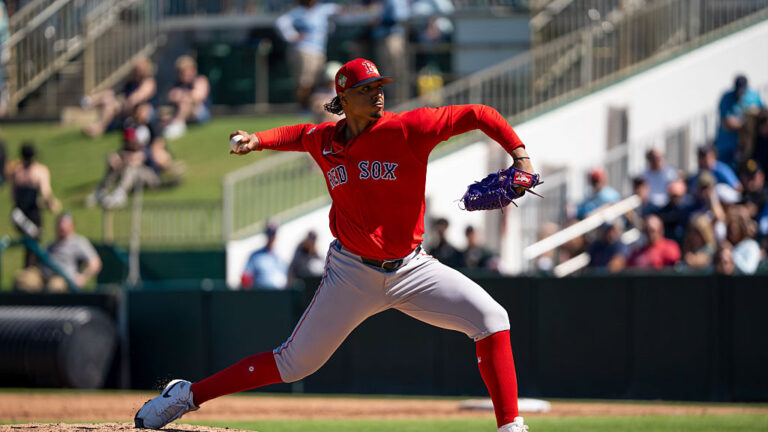
An offseason spent overhauling the starting pitching corps has resulted in an MLB rotation that appears nearly set in stone.
Garrett Crochet was already colorfully declared the Opening Day starter, while veteran additions Sonny Gray and Ranger Suárez will likely get the ball in the second and third contests in Cincinnati. And while Brayan Bello was the subject of trade rumors this winter, he will enter the season as an overqualified fourth starter.
Health permitting, those four pitchers will start the first four games of the season. The last rotation spot, however, is where things get interesting.
Five pitchers have arguments to get the ball in the season’s fifth game, and MassLive’s Chris Cotillo reported that each hurler is under legitimate consideration for the role: Johan Oviedo, Connelly Early, Kutter Crawford, Payton Tolle, and Patrick Sandoval.
Here is the case for and against each of them.
Johan Oviedo, RHP
Why he could win it: The Red Sox paid a hefty price to acquire Johan Oviedo from the Pittsburgh Pirates this winter, giving up former consensus top-100 prospect Jhostynxon Garcia and promising pitching prospect Jesus Travieso for his services.
The soon-to-be 28-year-old possesses many of the traits the Red Sox look for in their pitchers, namely his 6-foot-6 frame, 97th percentile extension, and ability to generate weak contact.
Though his 3.77 ERA in his nine-start return from Tommy John surgery may have been boosted by an unsustainable .208 BABIP, it was an encouraging sign that Oviedo’s stuff was back to its pre-Tommy John form, headlined by a fastball that averaged 95.5 mph and induced whiffs at a 31% clip.
Why he may not: As good as Oviedo looks when he’s on, his control issues have held him back throughout his career. Though his 13.5% walk rate last season can partially be chalked up to Tommy John rust, it’s not too far off from his career rate of 11.0%.
There are clearly some changes the Red Sox feel they can make to help Oviedo take his game to the next level, and with a minor-league option remaining, it’s not unreasonable to think they will start him in Triple-A if he struggles to implement them in spring training.
Connelly Early, LHP
Why he could win it: Perhaps no player in the Red Sox organization boosted their long-term outlook last season more than Connelly Early.
Beginning the year as a fairly anonymous Double-A pitcher, Early rode improved fastball velocity and sharper command all the way to a dominant September call-up and the start in Game 3 of the Wild Card round.
While Early is unlikely to maintain the 5.1% walk percentage he had during his four-game MLB debut, his intriguing five-pitch mix and impressive pitchability have made him a consensus top-60 pitching prospect entering the 2026 season, and the FanGraphs Depth Charts projections (3.80 ERA, 3.77 FIP) indicate that he could more than hold his own at the major league level.
Early made a strong case for a spot in the rotation in his spring debut on Monday, tossing two scoreless innings against the Rays and once again displaying increased fastball velocity.
Why he may not: Early would probably start the season in a lot of other teams’ rotations, but the Red Sox’s surplus of rotation depth allows them to slow-play his development.
The lefty was called up to the big leagues more due to necessity than performance last year, earning the nod only after Walker Buehler was released and Richard Fitts and Dustin May went down with injuries.
Early has only pitched 28.2 career innings at Triple-A, far less than guys like Bello (58.2) and Kutter Crawford (72.2) had before their MLB debuts.
Even if he is one of the five best starting pitchers in the organization, the Red Sox could take advantage of his minor league options and give him a little more seasoning at Triple-A until an opportunity presents itself in the majors.
Kutter Crawford, RHP
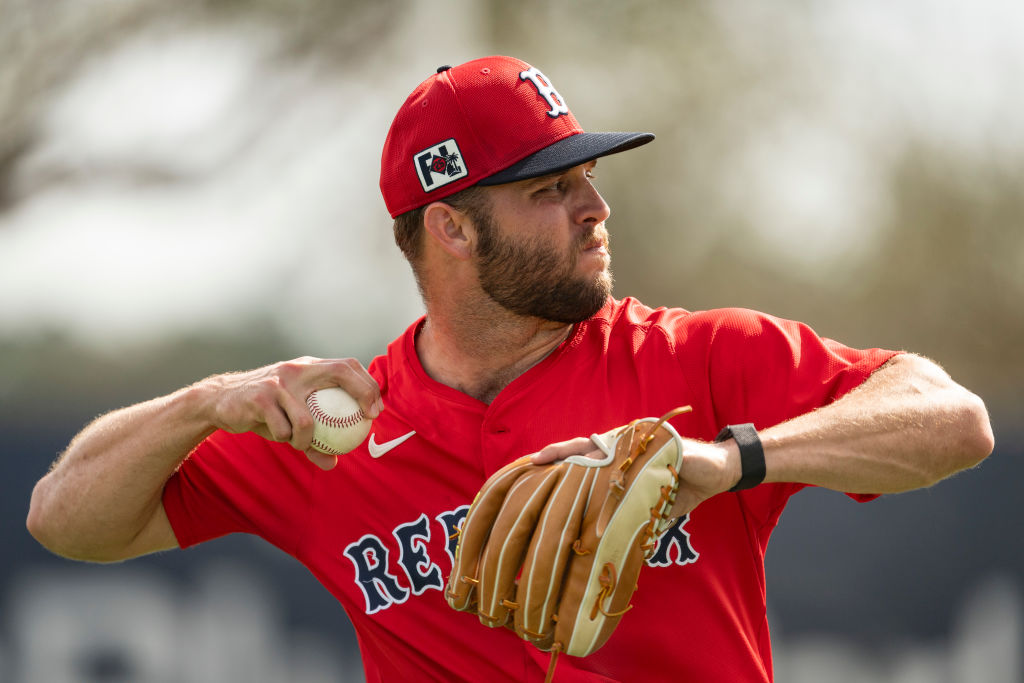
Kutter Crawford #50 of the Boston Red Sox throws during a Spring Training workout at JetBlue Park at Fenway South in Fort Myers, Florida on February 13, 2025. (Photo by Maddie Malhotra/Boston Red Sox/Getty Images)
Why he could win it: In a 2025 season in which the Red Sox cycled through 11 different starting pitchers for the fourth and fifth spots in their rotation, they really could have used the dependability that Kutter Crawford gave them in 2024.
No, he wasn’t spectacular, but Crawford turned in 33 league-averageish starts, striking out 175 batters against just 51 walks. There’s also reason to believe that his season could have been even better, as his 3.83 expected ERA was over a half-run better than his actual ERA of 4.36.
From 2023-2024, Crawford gave the Red Sox 313 innings at a 102 ERA+ clip. He has proven that he can be a steady and dependable member of their rotation, which is more than any of the other pitchers competing for a rotation spot can say.
Why he may not: In terms of pure upside, Crawford probably has the lowest ceiling of the five candidates for the rotation.
Though he routinely turns in above-average strikeout and walk rates, Crawford has been unable to solve the home run bugaboo.
The combination of a sky-high fly ball rate, unfriendly home ballpark, and unremarkable fastball that he loves to throw up in the zone led to him allowing 51 home runs between 2023 and 2024.
That was the 12th-highest total in baseball during that span, despite the fact that Crawford threw fewer innings than all but two of the pitchers ahead of him.
With all the pitching talent the Red Sox have compiled in the last two years, being just a league-average starter won’t be good enough for Crawford to hold down a rotation spot. Therefore, it’s worth exploring whether a move to the bullpen would help maximize his abilities.
His 3.35 ERA as a reliever stands in stark contrast to his 4.69 ERA as a starter, an understandable difference given that opponents have slashed .290/.351/.492 when seeing Crawford for the third time.
A back-end starter is objectively more valuable than a middle reliever, but with the Red Sox having a plethora of starting pitchers and some question marks about the bridge to Garrett Whitlock and Aroldis Chapman, it may make most sense for all parties for Crawford to take over the multi-inning relief role that Whitlock outgrew last season.
Before the Red Sox can make a final decision about Crawford’s role, however, they will need to make sure he is 100% healthy. Not only did he miss all of last season with back and wrist issues, but he is already behind all the other starting pitchers after battling the flu in the first week of spring.
MassLive’s Chris Cotillo reported that the Red Sox could place Crawford on the injured list to begin the season, which would allow them to kick the can down the road and give them more time to figure out how he can best contribute to the MLB team.
Payton Tolle, LHP
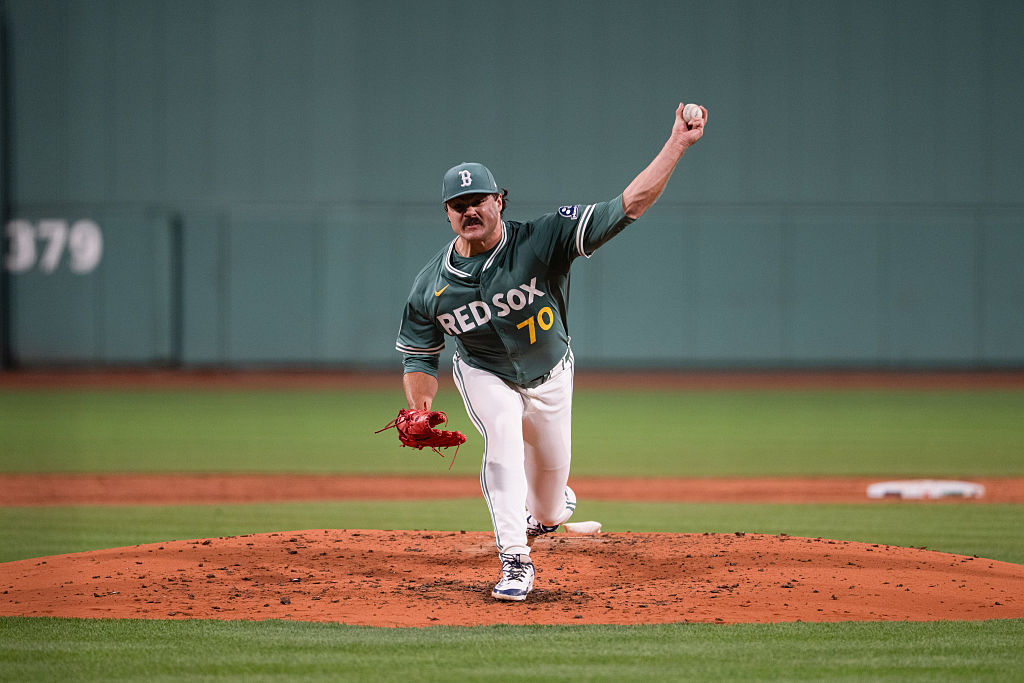
Why he could win it: It doesn’t take a scouting background to see why Payton Tolle is a consensus top-30 prospect entering the season.
His fastball is a true outlier pitch, averaging 96.7 mph and feeling even harder due to his 99th percentile 7-foot-5-inch extension. It’s a 70-grade pitch, and it quickly proved way too much for minor league hitters to handle.
It took 91.2 innings for Tolle to climb from High-A Greenville to the majors, a span in which the big lefty struck out 133 batters and walked just 23.
While many pitchers struggled towards the end of their first minor league season, Tolle seemed to get better as the season went along, hitting triple-digits for the first time during his September call-up and refining his slider and cutter into potential plus offerings.
Tolle’s ceiling is the highest of any Red Sox pitching prospect in recent memory, and it will be difficult to send him back to the minors if he comes out shoving in spring training.
Why he may not: As good as Tolle’s fastball is, his brief MLB stint showed why you need more than one pitch to succeed at the big league level.
Without any command of his secondary pitches, Tolle saw his opponents sit on his fastball and punish mistakes. After a dominant debut against the lowly Pittsburgh Pirates, Tolle was lit up by both the Arizona Diamondbacks and Sacramento Athletics and was sent to the bullpen in favor of Early and Kyle Harrison.
There’s little doubt that Tolle could be a dominant late-inning reliever right out of the gate, but there is still more refinement needed if he is going to reach his ceiling as a top-of-the-rotation starter.
Improving his changeup should be the first item on his to-do list. Tolle showed an inconsistent feel for the pitch through his minor league career and threw it just 7% of the time in the big leagues.
Developing a pitch that moves away from right-handed hitters would help both his slider and cutter play up and give him the ability to present different looks as he works multiple times through the order. He displayed a new sinker in his spring training debut, but a changeup would profile more as a swing-and-miss offering.
With how much the Red Sox pushed Tolle in his first full year in the organization, a little more seasoning in Worcester, a place where he threw just 15 innings last year, will only help his long-term development.
Patrick Sandoval, LHP
Why he could win it: Of the five pitchers competing for the fifth spot in Boston’s rotation, no pitcher has had a better MLB season than Patrick Sandoval‘s 2022 campaign with the Angels.
The then-25-year-old posted a 2.91 ERA, a mark that would have ranked ninth in MLB if he had enough innings to qualify, and struck out over a batter an inning,
Unfortunately, that breakout campaign was immediately followed by steps back in the next two seasons and Tommy John surgery in June of 2024.
Yet, despite knowing that he would miss most, if not all, of the 2025 season, the Red Sox still inked Sandoval to a back-loaded two-year,$18.5 million contract, a clear sign that they believed the lefty could contribute to the MLB rotation when healthy.
Also working in Sandoval’s favor is that he is the only one of the five to not have a minor league option. The Red Sox will either need to put him on the major league roster, find a trade partner, or wave the white flag on his $12.5 million salary.
Why he may not: If he does not make the rotation, Sandoval is a candidate to be the second lefty in the Red Sox bullpen. A trade is also a distinct possibility.
While there are still some interesting free agent starting pitchers left on the market, including Lucas Giolito and Zack Littell, none possess the upside of a healthy Sandoval.
And while Sandoval is somewhat of a risk, having not pitched in nearly two calendar years, his $12.5 million salary is far from a catastrophe, especially if the Red Sox are willing to pay down some salary in exchange for a better prospect return
For the Red Sox, trading Sandoval could allow them to slip back under the second luxury tax threshold and give them more flexibility ahead of the deadline.
Sandoval will first need to prove he is close to his pre-TJ form, but a team like the Braves, who will be without Hurston Waldrep and Spencer Schwellenbach for the foreseeable future, could make a lot of sense.
Become a Member of Just Baseball
Subscribe and upgrade to go ad-free!
* Save 25% by subscribing annually.

Written by
Daniel Fox is a contributing writer for Just Baseball. He has previously written for Pitcher List, BoSoxInjection, and in the Cape Cod Baseball League. He is…