
What’s Next for the Braves After Re-Signing Ha-Seong Kim?
After shoring up the shortstop position with the re-signing of Ha-Seong Kim, what's next this offseason for the Atlanta Braves?
 | |
| | 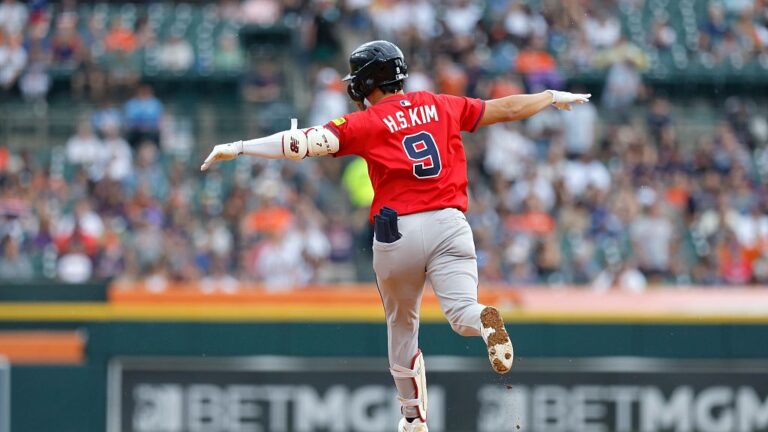
As we inch deeper into the winter months, the Atlanta Braves continued their aggressive offseason by re-signing shortstop Ha-Seong Kim to a one-year, $20 million deal last week.
Kim, now age 30, originally became a free agent last offseason after spending the first four seasons of his MLB career with the San Diego Padres. Before arriving in the majors, Kim starred in the KBO, posting a career 133 home runs to go along with an .866 OPS across seven seasons.
During his four years in San Diego, Kim established himself as an extremely valuable contributor. He slashed .242/.326/.380 with a .706 OPS while accumulating 15.3 bWAR. His breakout came in 2023, when he posted 5.4 bWAR, won a Gold Glove, and finished 14th in the National League MVP vote.
Kim’s 2024 season was interrupted after shoulder surgery ended it early. The following offseason, he declined his mutual option for 2025 and entered free agency. Following a market that was lower on him than expected, he signed a two-year, $29 million deal with the Tampa Bay Rays that included an opt out after the first season.
Unfortunately, injuries again became a factor in 2025. Kim appeared in just 24 games for Tampa Bay, hitting .214 with a .612 OPS. In a surprising move, the Rays placed him on waivers, and the Braves claimed him on September 1.
Kim immediately stepped into the starting shortstop role in Atlanta the following day. Over 24 games with the Braves, he showed signs of recovery by slashing .253/.316/.368 with a .684 OPS as he worked his way back to full strength. At season’s end, Kim declined his $16 million player option and once again entered free agency.
Braves general manager Alex Anthopoulos had expressed interest in Kim prior to his signing with Tampa Bay, but the fit just did not seem right at the time. He reiterated that desire following last season, and that interest proved mutual as Kim re -signed with Atlanta on December 15.
Why The Calculated Gamble Makes Sense
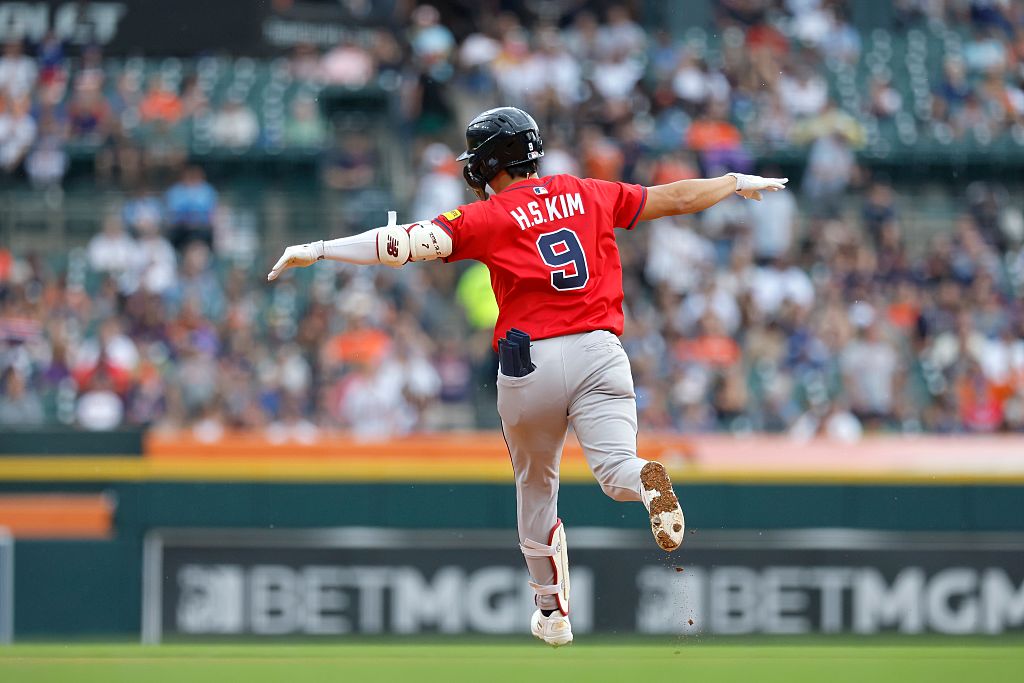
At first glance, the deal between Ha-Seong Kim and the Braves checks several boxes.
For Atlanta, it solidifies the shortstop position for 2026 and allows Mauricio Dubón to be deployed more freely in a utility role. For Kim, it represents an immediate $4 million increase over the salary he would have earned by exercising his player option.
Both sides achieved what they needed, which made this reunion feel likely all offseason. Even so, the one-year structure is somewhat surprising. Many expected a multi-year agreement, especially given Atlanta’s long-term planning tendencies and Kim’s age.
With the offense now largely set for 2026, the bigger questions surrounding shortstop have simply been pushed back to 2027. Both Kim and Dubón are set to become free agents after the season, leaving Atlanta with future decisions still looming.
Following the signing, Anthopoulos was asked in his latest media availability whether the deal would have happened had Kim not spent September with the team. He acknowledged that having Kim in house made a meaningful difference.
That short stint allowed the organization to evaluate him not just as a player, but as a fit within the clubhouse. After Kim declined his option, Anthopoulos made it clear that Atlanta wanted him back, and that feeling was shared with Kim as well.
Anthopoulos even compared the situation to one Braves fans know well:
“I think we’ve been successful with guys like this. I view this similar, they’re different players one guy won an MVP in Josh Donaldson, but I view this similar to Josh Donaldson. He had been banged up. He had spent two years in a row on the IL…I have a lot of confidence in the medical staff here and so on. Kim has had two years in a row where he’s missed time.”
While the back of Kim’s baseball card does not carry the same weight as Donaldson’s did entering his Atlanta stint, the comparison is logical. Donaldson signed a one-year, $23 million deal with the Braves and responded with a monster 2019 season, posting a .900 OPS and 37 home runs. That performance led him to signing a four-year, $92 million deal with Minnesota.
Kim appears to be aiming for a similar rebound. After two injury-plagued seasons, his market is not where he likely believes it should be. It had been confirmed that he received multiple multi-year offers, including a four-year, $48 million offer from the Athletics to play second base, but Kim eyes to stick at shortstop and earn a bigger payday.
Entering 2026 fully healthy, he has an opportunity to re-establish his value while playing a premium defensive position on a contending team. Surrounded by one of baseball’s strongest lineups and supported by what should be a strong rotation, the stage is set for a potential bounce back year.
If Kim is able to bounce back, look for Atlanta to attempt to retain his services with an in-season extension.
Can Atlanta Keep Adding?
With a projected payroll now just north of $250 million, the Braves sit approximately $6 million over the Competitive Balance Tax threshold. After resetting last season, that subjects them to the first-year tax of 20% penalty.
Anthopoulos has consistently stated his desire to remain below the third tax tier, which begins $40 million over the threshold at $284 million. When factoring in the roughly $10 million the organization typically sets aside to reserve for in-season flexibility, Atlanta is left with roughly $24 million to work with.
The offense now appears largely settled. With the additions of Kim, Mike Yastrzemski, and Dubón, lineup flexibility has become one of Atlanta’s strengths. Watching how Walt Weiss deploys that depth over the course of the season will be intriguing storyline to follow.
Outside of a minor move or an unexpected trade, the current group is likely the Braves offense for 2026. That leaves the pitching staff as the clearest area for further improvement.
Pitching Staff Upgrades
The last two seasons have shown how fragile starting rotation depth can be. In 2025, all five Opening Day starters spent significant time on the injured list. Spencer Strider began the year sidelined after missing much of 2024 and struggled to regain consistency after returning.
Looking ahead, there is reason for optimism.
Chris Sale is healthy and positioned to return to Cy Young form. Spencer Schwellenbach is back after a fractured right elbow. Strider will be a full year removed from internal brace surgery. Hurston Waldrep will look to build on the progress he showed late in the season. Reynaldo López and Grant Holmes have received positive reviews as they continue their recoveries.
Bryce Elder remains an option, while prospects like Didier Fuentes and JR Ritchie (Just Baseball’s No. 94 overall prospect) could push for opportunities as well.
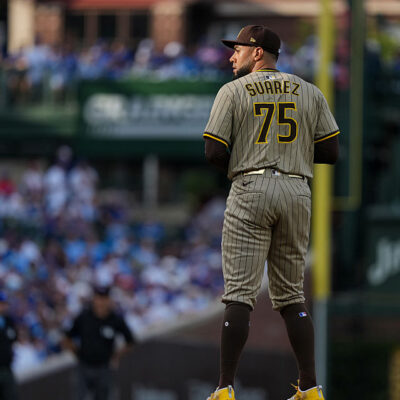
The bullpen has also taken a significant step forward. After re-signing Raisel Iglesias to a one year, $16 million deal, Atlanta followed it up by signing Robert Suarez to a three year, $45 million contract. That $61 million duo combined for 69 saves last season, and when paired with Dylan Lee’s steady production, the back end of games looks far more secure this season.
Still, questions remain. Joe Jiménez is rehabbing from the knee injury that cost him all of 2025. Arms like Aaron Bummer, Joel Payamps, Joey Wentz, Ian Hamilton, Danny Young, José Suarez, Dylan Dodd, Hayden Harris, James Karinchak, and Daysbel Hernández offer options, but not guarantees.
Health cannot be assumed, and Anthopoulos has made it clear that adding pitching remains a priority. He has emphasized the value of carrying extra arms into camp on that same media availability:
“We’re okay if we overbook, if you want to use that term. Probably don’t want to overbook to the tune of four or five guys, but maybe two or three and things will work themselves out by the time you get to the end of camp.”
Balancing starter and bullpen depth will be a challenge. Several pitchers such as Grant Holmes, Bryce Elder, Jose Suarez, and Joey Wentz have experience in both roles but are out of minor-league options. This provides flexibility but also complicates roster construction.
Even so, that flexibility will not prevent Atlanta from making additional upgrades if the right opportunity arises.
Predicting Anthopoulos is an impossible game. After a passive offseason last year that preceded a disappointing campaign, the aggressive approach this winter has been an exciting change.
With a couple of months still remaining before pitchers and catchers report to Spring Training and roughly $24 million available, the Braves may not be finished shaping their 2026 roster. This anticipation continues to build for Atlanta fans.
Written by
Taylor is a baseball enthusiast and a writer for Just Baseball. An Atlanta native, he shares his love for the Braves, card collecting, and scouting the…