
Braves Sign Robert Suarez To A Three-Year, $45 Million Deal
With Robert Suarez joining Raisel Iglesias, the Atlanta Braves now boast a dominant bullpen duo heading into the 2026 season.
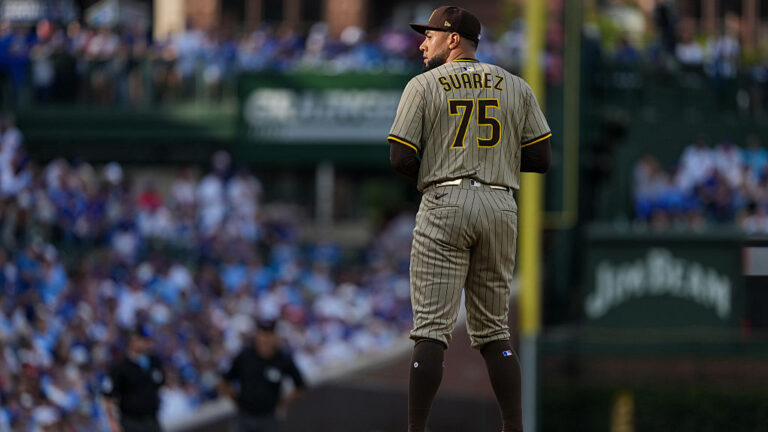
After a relatively quiet start to the offseason, Alex Anthopoulos and the Atlanta Braves have finally begun making meaningful upgrades to the roster. On Thursday, the Braves agreed to a three-year, $45 million contract with veteran reliever Robert Suarez. He has been one of the most consistent late-inning arms in baseball over the past four seasons.
At age 34, Suarez is coming off arguably the best season of his MLB career. He posted a 2.97 ERA, 0.904 WHIP, and 40 saves while earning his second straight trip to the All-Star Game.
For Atlanta, this is a significant addition. Pairing Suarez with Raisel Iglesias gives the Braves a duo that combined for 69 saves last year. More importantly, it signals that ownership is willing to spend to upgrade the current roster.
Who Is Robert Suarez?
Suarez’s path to MLB was anything but conventional. Born in Venezuela, he began his professional career in 2015 with Saraperos de Saltillo of the Mexican League. A year later, he signed with the Fukuoka SoftBank Hawks of Nippon Professional Baseball in Japan.
He spent six total seasons (missing one due to Tommy John surgery) and established himself as one of Japan’s premier relievers. Suarez recorded a 2.81 ERA, 1.16 WHIP, 209 strikeouts, and 68 saves over 191 appearances.
These numbers caught the attention of the San Diego Padres, who signed him to a one-year deal with a player option for the 2022 season.
Suarez rewarded them immediately, posting a 2.27 ERA, 1.05 WHIP, and 11.5 K/9 across 45 appearances. He then opted to decline his player option, leading the Padres to re-sign Suarez to a five year, $46 million deal.
In his four total seasons with the Padres, Suarez more than delivered pitching to a 2.91 ERA, 0.981 WHIP, 3.38 K/BB, and 77 total saves across 206 games.

At the conclusion of 2025 he exercised his opt-out clause again, choosing to test the open market yet again.
What Does He Bring?
The defining trait of Suarez’s game is his velocity.
In each of his four MLB seasons, he has ranked in at least the 97th percentile in fastball velocity.
In 2024, he ranked on the 99th percentile (99.0 mph) and last seasons in the 98th percentile (98.6 mph). Only flamethrowers Mason Miller, Jhoan Duran, Ryan Helsley, Hunter Greene, and Aroldis Chapman ranked higher than him.
As expected, Suarez grades extremely well across the Stuff+ models.
| Stuff+ | Stf+ FA | Stf+ SI | Stf+ FC | Stf+ CH | |
| 2022 | 112 | 119 | 113 | 101 | 100 |
| 2023 | 113 | 119 | 115 | 123 | 104 |
| 2024 | 116 | 119 | 113 | 88 | 107 |
| 2025 | 113 | 115 | 117 | 88 | 106 |
| Overall | 114 | 115 | 115 | 101 | 104 |
Last season, Suarez relied heavily on his fastball, throwing it 63.4% of the time. He maintained a .155 batting average against on the fastball with a 24.0% whiff rate.
His second most relied on pitch is a change-up, with an average velocity 8.1 mph slower than his fastball last season (90.5 mph). He threw it at a 23.9% clip, generating a 32.8% whiff rate.
The final pitch of his arsenal is a sinker. Throwing it 12.5% of the time last season, it maintains a similar velocity to his fastball and kept batters to just a .139 batting average.
He has never posted a WHIP higher than 1.05. His walk rate has improved every season, dropping from 11.0% to 5.9% last year. Combine that with his strikeout profile and All-Star production, and you get exactly the kind of late-inning flamethrower Atlanta has been missing.
How Does He Fit on the Braves?
With Iglesias already in place, the Braves now have the luxury of two legitimate options at closer. Early indications are that Iglesias will remain the primary closer in 2026, while Suarez will serve as the right-handed setup man.
I have been vocal about wanting flexibility on the offense side end, and that stays true on the pitching front as well. Having both Iglesias and Suarez gives Walt Weiss flexibility and comfort at the back end of the bullpen.
Beyond those two, the numbers paint an even more encouraging picture. Since the start of the 2022 season (min. 150 innings pitched among relievers) the Braves have four pitchers that rank in the top 25 in WHIP:
- Rasiel Iglesias ranks #6 (0.96)
- Robert Suarez ranks #8 (0.98)
- Dylan Lee ranks #22 (1.07)
- Joe Jiménez ranks #23 (1.07)
All four rank inside the top 50 in K:BB% and wOBA allowed as well.
This means the Braves enter the season with a potential three-headed monster in the late innings of games. And if Jiménez returns healthy, it becomes a legitimate four-deep unit capable of shortening games following one of the better starting rotations in baseball.
Given how much Atlanta’s bullpen struggled for stretches last season, Suarez’s addition is not just helpful. It’s massive.
Moving Forward
After the additions of Mike Yastrzemski and Suarez, the Braves sit roughly $10 million below the Competitive Balance Tax threshold of $244 million.
They have approximately $30 million of room before triggering the 12% surcharge for exceeding the CBT by $20M, and approximately $50 million until reaching the next surcharge tier Anthopoulos has indicated the team does not intend to surpass.
This is encouraging news for Braves fans. Despite already filling several major needs, Atlanta still has the financial flexibility to add even more. Another reliever, a starting pitcher, or an everyday shortstop all remain realistic options.
Regardless of what comes next, this offseason already feels like a refreshing pivot from the stagnation of the previous year. The Braves are acting aggressively, spending where necessary, and positioning themselves to rebound from a disappointing 2025 season.
With a talented core still intact and the bullpen significantly upgraded, Atlanta is trending toward returning to contention for another World Series in 2026.

Written by
Taylor is a baseball enthusiast and a writer for Just Baseball. An Atlanta native, he shares his love for the Braves, card collecting, and scouting the…