
What’s Next for Brett Baty: Super Utility Role, or New Trade Chip?
While Brett Baty's name is suddenly on the trade block, there are only a few players who the New York Mets should consider moving him for.
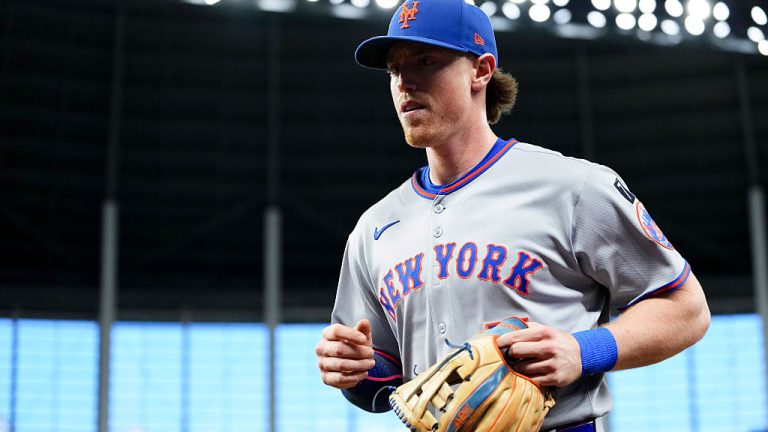
Yesterday, Brett Baty woke up as the starting third baseman for the New York Mets.
A position he has long been promised. Dating back to his first round selection in the draft back in 2019, to his time as a consensus top 100 prospect in baseball. When Baty first took the keys to third base in 2023, the expectation was that he would drive the car for a long time.
Instead, it has been a timeshare.
Baty’s struggles in 2023 and at the start of 2024 opened the door for Mark Vientos, who looked like a breakout star when he was hitting grand slams against the Dodgers in the NLCS. The tides turned in 2025, with Vientos struggling on both sides of the ball, while Baty thrived in a utility role.
By fWAR (2.3), Baty was the fifth-most valuable player on the Mets last season behind the short-lived “Fab Four” of Juan Soto, Francisco Lindor, Pete Alonso, and Brandon Nimmo.
An above-average defender at third and a surprisingly solid one at second, Baty earned playing time throughout the year with his glove and finished strong with his bat.
After the trade deadline, Baty went on to finish the season hitting .308/.370/.496, with seven home runs and a 146 wRC+ across his final 43 games played. He finished the year with a 111 wRC+ overall and a career-high 18 home runs.
Because of this performance, Baty was going to have the keys to finally be the Mets’ starting third baseman in 2026, with President of Baseball Operations David Stearns alluding to that all offseason long. Had Kyle Tucker been a New York Met, that would have probably been the case.
Instead, Tucker is a Dodger, Bo Bichette is a Met, and Brett Baty is in limbo.
The Mets Will Not Be Quick to Trade Baty
If there is one thing executives don’t do, it is show their cards.
Prime example, there is not a soul outside of Bo Bichette and his agent who thought he would be playing baseball at Citi Field this season.
Stearns made the best out of a bad situation, pivoting off plan A of Kyle Tucker to the next best free agent on the board.
Better yet, Bichette was all but signed, sealed, and delivered to the division rival Philadelphia Phillies on a seven-year, $200 million deal, only to have it trumped by a three-year, $126 million pact by the New York Mets. One that comes with opt-outs after each season and a full no-trade clause.
Even as a converted shortstop, it is unlikely that Bichette is going to play the hot corner as well as Baty, but he brings a right-handed middle-of-the-order bat that the Mets desperately needed.
Last year, Bo Bichette hit .381/.427/.626 with 189 wRC+ when hitting with runners in scoring position. Eleven of his 18 home runs came with runners on base.
This is the protection Juan Soto needed in the Mets lineup. You figure out where to put his glove later. And in this case, that is over at third base.
If Bichette signed the seven-year deal with the Mets, Baty might be more expendable, but there is no guarantee that Bichette will be in New York beyond the 2026 season. There is every chance that going into 2027, Baty is again the answer at third base. But what does he do until then?
What’s Brett Baty’s Role in 2026?
There was once a time in Brett Baty’s development where we weren’t sure if he was going to be a solid defender at his natural position of third base, much less be athletic enough to flex out to second and play solid defense in the big leagues up the middle.
Outside of a little time playing second in Triple-A at the end of 2024, Baty essentially learned second base in spring training and during the season last year and was able to post 3 DRS and -1 OAA.
At third base, he was even better (4 DRS, 2 OAA).
While he has actually never played an inning of first base professionally, Baty’s competition at the position in spring training is Jorge Polanco (who has one inning of MLB experience) and Mark Vientos (who hasn’t looked great at the position, both as a prospect and in limited action last year).
The best version of the Mets’ infield likely has Baty at first base, Marcus Semien at second, with Francisco Lindor and Bichette at short and third. This would allow Polanco to DH, but the Mets may still want to get Vientos’ bat in the lineup.
Giving Polanco days at first base with Vientos at DH is likely the Mets’ best lineup against left-handed pitching. It also forces Baty and Vientos back into an essential platoon again, which is not the worst thing in the world, but it does make it hard to get to know what these young players can be moving forward.
Where else on the field do the Mets have an opening if they want to play all three of Polanco, Vientos, and Baty on the same day? Oh yeah, no Tucker.
Left field is wide open for the Mets right now (assuming top prospect Carson Benge ends up in center). Baty has played exactly 30 games and 250 innings out in left field as a pro, but hasn’t touched the grass since playing one inning in an extra-inning game in May of 2023.
Baty is going to have to get comfortable at both first base and left field this spring, while still being the Mets’ backup option at third base and second. Marcus Semien is typically an everyday player, but maybe that has worked against him a bit at 35 years old.
The Mets can use Baty to get Semien off his feet, maybe maximizing his potential by being a bit more selective with his matchups. While Bichette will be asked to play every day at third, he also hasn’t eclipsed 150 games since 2022.
Ronny Mauricio represents some depth for the Mets on the 40-man roster that could make Baty a bit more expendable if a team is willing to trade something really good for him, but there are plenty of ways he can be used on the roster if not.
When the Mets traded Jeff McNeil, they lost a Swiss Army knife who has been very versatile for them over the years.
The fact that McNeil was able to pick up center field at 33 years old last year was pretty remarkable. Baty playing some left at 26 years old doesn’t seem nearly as far-fetched as that experiment was.
If the Mets end up in a situation this year where Brett Baty becomes their 10th-best player, that would be a remarkable revelation, because again, last year, he was their fifth-best.
Chances are that playing time will open up for Baty across the diamond, but his name will be in the lineup card more often than not. He might get shielded from left-handed pitching again, even when he doesn’t need to be, but that’s the burden of being on a good team.
At the same time, the Mets still need pitching, and they still have that massive hole to fill in the corner outfield spot, one that they are not likely to hand to Baty himself going into spring.
This is where we can’t rule out the fact that Baty is in play to get traded, because other teams will value him just as much as the Mets likely value keeping him. For me, there are really only two players that make sense as targets for the Mets in a Baty trade.
Two Trades the Mets Should Take for Brett Baty
All offseason, the New York Mets have been listening to trade offers to manage their glut of young infielders on the MLB roster. Between Mark Vientos, Ronny Mauricio, and Luisangel Acuña, teams could have had their pick of the litter, but Baty was seemingly off the table.
Now that Baty is potentially on the block, teams are going to call about him, as he could be the Opening Day third baseman on a lot of different contenders. Still pre-arb for one more season, Baty comes with four years of team control and is only 26 years old.
Getting a cost-controlled two-way third baseman is a commodity. One that may be preferred by some teams rather than taking the bet on a top 100 prospect that may still need time to develop before they can contribute.
The Mets are looking for a frontline starter, and they need an outfielder. If Baty can get them either, it could be a huge win-win. Here are some trade fits that could have some legs.
1. Milwaukee Brewers
The Trade: Brett Baty and Brandon Sproat for Freddy Peralta
The No. 1 trade target for the Mets right now should be Freddy Peralta. He’s the ace they need, and after spending $42 million per on Bo Bichette, Peralta’s $8 million will slot nicely into their payroll.
The Brewers want young starting pitching for Peralta, so any trade likely has to be headlined by Brandon Sproat or Jonah Tong.
Coming off a season where he was the most dominant starter in minor league baseball, the Mets may prefer to keep Tong, but Sproat is the more big league-ready anyway. The Brewers can immediately backfill Peralta with Sproat, getting full control of a viable big league starting pitcher.
While Sproat might not have quite the ceiling of Tong, and certainly not that of Nolan McLean, he is a former second-round pick and a consensus top 100 prospect who is going to get outs in the big leagues.
If the Mets didn’t have Baty on the block, the Brewers would be looking right back to that top 100 and try to poach another budding prospect. In our recent Freddy Peralta mock trades article, we had the Mets trading Sproat along with third base prospect Jacob Reimer.

The Mets may prefer to just trade prospects for Peralta, but the Brewers may want more immediate impact. Baty would slot right in as a potential platoon partner for Caleb Durin at third base.
The Brewers have been known to get more out of players’ swings, and would likely see Baty as having a profile they could get even more out of.
For the Mets, you get the ace you need right now, and you have some depth in the system still between Mauricio, Reimer, and even shortstop prospect Jett Williams. If the Bichette experiment works out at third, maybe you are trying to re-up with him anyway.
Trading Baty is a tough pill to swallow, but when you get the arm you need, it’s a price you have to be willing to pay.
2. Boston Red Sox
The Trade: Brett Baty and Jett Williams for Jarren Duran
This one is a bit more complicated because this is not trading for a rental; it is trading for a former All-Star outfielder with three years of control.
The Boston Red Sox have been receiving interest from opposing teams on Jarren Duran since the trade deadline, as the presence of Roman Anthony and Gold Glovers Wilyer Abreu and Ceddane Rafaela makes Duran expendable. In theory, that is.
Now that Alex Bregman is a Cub, the Red Sox are left with a vacancy at third base, but also in the middle of their lineup. Positionally, Brett Baty fits on the Red Sox roster a lot better in 2026 than Duran does, but does that mean these two are an even swap offensively?
Check their wRC+ in 2026, and it would tell you that is exactly what they are, with Duran posting an identical wRC+ to Baty at 111.
The mirror doesn’t stop there, as both players came on strong in the second half of the season. Look at their numbers from July 1st on:
| July 1st-End of 2025 | Slash Line | HR | XBH | wRC+ | fWAR |
| Jarren Duran | .261/.357/.485 | 10 | 35 | 130 | 2.4 |
| Brett Baty | .280/.345/.460 | 10 | 16 | 128 | 1.7 |
From July 1st to the end of the season, Duran and Baty each hit exactly 10 home runs, and ran very similar rates in terms of wRC+. With that said, I included extra-base hits in the chart because I wanted to illustrate how not all wRC+ marks are created equal.
Since Baty and Duran each hit 10 home runs, while running similar walk and strikeout rates, the calculation on wRC+ comes out very similar, but when you see the disparity in extra-base hits, you start to see some of the explosion that Duran could add to the Mets lineup.
Over the last two seasons, Duran trails only Corbin Carroll in total triples (31 to 27), and he has led the American League in both campaigns. In 2024, Duran led the majors with 48 doubles. His 89 over the last two seasons trails only Bobby Witt Jr.
Imagine adding Jarren Duran’s extra-base prowess to the top of a lineup that includes Francisco Lindor, Bo Bichette, and Juan Soto?
The Mets have a vacancy in both center and left field right now. Whoever looks better in the center between Duran and Benge takes one spot, the other grabs the corner, and you roll with a very complete team.
The Red Sox get a strong defensive third baseman to replace Bregman, and while they lose Duran, they get another left-handed bat to take his place with Baty.
Are Baty and Willson Contreras equivalent to what the Red Sox had last year with Bregman and Duran? Maybe not entirely, but they sure are a lot cheaper, and have the chance to be nearly as productive, while leaving more room for the rest of their young core to take over.
They are also getting a top 100 prospect in the deal, as the Mets can afford to trade Jett Williams from a loaded system that has a very similar prospect ranked just ahead of him in our top 100 in AJ Ewing.
Should the Mets Trade Brett Baty?
Completing this thought exercise was an interesting one for me, because I have covered Brett Baty dating back to when he was first drafted back in 2019 on my podcast, Locked On Mets.
Having seen the full maturation of Baty, I would hate to see the Mets move on from him right when he seems poised for a breakout. Baty’s defensive ability has made him a high-floor big leaguer who should be a valued piece of the Mets’ core for the entirety of his team control.
If retained, the Mets will get Baty’s age-26 through age-29 seasons, which should be the absolute prime of his career.
If he can build upon the adjustments he made last season, Baty has the potential to be one of the better all-around third basemen in baseball, capable of playing strong defense at the hot corner, and the potential to hit 25 home runs with everyday playing time.
Even if he doesn’t reach that best outcome, though, Baty has at least proven that he has the floor of being a solid utility-man who can handle two positions on the infield, with the chance to add even more to his tool-kit.
For contending teams, taking a shot on a former top prospect that can field two big league positions could be more appealing than getting a top 100 prospect who has not been tested at the highest level yet.
Jacob Reimer is sitting where Brett Baty was back in 2021, where he could still be years away from being a solid big leaguer, even though he finished last year in Double-A.
If the Brewers could pick between Reimer and Baty in a trade package with Brandon Sporat, they are going to want the guy they know can contribute right away, rather than hope they pick the right prospect who pans out fully in two to three years.
All of the reasons other teams want Baty are also reasons why the Mets should keep Baty. Good teams that want to win should not be trading good players away.
That is exactly why Nico Hoerner is likely to remain a Cub, even when the service time game might have told you that he would be traded when they got Bregman, because he is a rental and they have Matt Shaw. Instead, Shaw seems poised to take on a similar super utility role as Baty.
For me, the best course of action for the Mets is to keep Baty and use their loaded farm system to make the trades you need to win now. Juan Soto is only 27 once, and Lindor is only 32 once as well. Bo Bichette might only have one season in New York.
The Mets have already invested too much in this team not see it through, and Baty is a tougher player to replace on the field than he is in a trade package.
At the same time, there are only so many All-Star caliber performers in the game, and few fit the Mets’ needs better right now than Freddy Peralta and Jarren Duran.
Side note: I would have thrown Tarik Skubal in this mix, but the Tigers may not trade him, and they have a player signed to six-year pre-arb extension in Colt Keith that may be too similiar to Baty for him to be a fit in Detroit.
I would effort to acquire either, or even both Peralta and Duran, largely with prospects, as well as utilizing Mark Vientos, Ronny Mauricio, or Luisangel Acuña if any of those infielders were of interest.
But if the Mets are trying to land Duran and the Red Sox demand Baty in return, you can’t let that be the sticking point that costs you from fielding a strong defensive outfield and a more explosive lineup. The same goes for landing the ace you desperately need in Peralta.
Brett Baty is going to have a huge impact on the New York Mets in 2026. It is just a matter of whether that impact comes on the diamond or if it comes in the form of helping the Mets land another star.

Written by
Ryan Finkelstein has led editorial for Just Baseball since 2021 and officially became the Editor-in-Chief in 2025. He also hosts Locked On Mets, the No. 1…