
Top Landing Spots for Free Agent Randy Arozarena
Randy Arozarena hits free agency after the best season of his career. Will he return to Seattle, or is there a better fit elsewhere?

With few impact bats available in free agency, Randy Arozarena’s career year should make him one of the most coveted hitters available. Yet his strong results and the questions about how well they’ll hold up could make him one of the offseason’s more polarizing players.
In an otherwise disappointing year for Seattle’s offence, Arozarena put together an MVP-calibre season. His 151 wRC+ ranked third in MLB, and his 5.5 fWAR was the most of any player in this free agent class. Yes, even Tarik Skubal. He also posted his lowest strikeout rate and highest xwOBA over a full season.
That production builds on an established offensive track record. Arozarena owns a career 128 wRC+ and has recorded six consecutive seasons with at least 20 home runs and 20 stolen bases. Only Barry Bonds, Bobby Bonds, and Bobby Abreu have put together longer streaks.
His postseason résumé adds to the appeal. Arozarena has a .946 OPS across 45 career playoff games, highlighted by an MLB-record 10 home runs in the 2020 postseason.
Why Teams Might Hesitate
The question is how much of his 2026 production will carry forward. His shorter swing helped him make more contact, but his bat speed has dropped nearly 2 mph over the past two seasons. His hard-hit rate, the share of batted balls hit at least 95 mph, also fell from 50.6% to 43.5% last season.
Arozarena has consistently hit 20 or more home runs, but he’s long had a tendency to hit the ball on the ground. His 48.5% groundball rate in 2026 was well above the MLB average of 41.6%. With so much of his contact staying on the ground, declining bat speed and less frequent hard contact raise questions about whether he can sustain that power as he ages.
Those offensive concerns are compounded by his defensive limitations. Arozarena recorded −5 Outs Above Average in left field, and his limited arm strength offers little to offset those shortcomings. That could mean more time at designated hitter over the course of his next contract.
His stolen-base totals also overstate his overall baserunning contribution. Outs on the bases have offset much of the value of his steals, leaving him roughly neutral for his career by FanGraphs’ baserunning metric, BsR.
That makes Arozarena difficult to value. He’s an established, productive hitter coming off his best season, but he’s also entering his age-32 campaign. How much teams are willing to pay, and for how long, will depend on how confidently they project his bat to age.
Free Agent Profile
- Age in 2027 — 32
- 2026 stats — 154 G, .281/.381/.484, 26 HR, 79 RBI, 26 SB, 151 wRC+, 5.5 fWAR
- 2026 salary — $15.65 million
Contract Projection
- Projected Length: 4 – 6 years
- Projected AAV: $25 – 33 million
FanGraphs’ Steamer projects Arozarena to hit .252/.352/.431 with 22 home runs and a 120 wRC+ in 2027. That’s a step back from his career year in 2026 and closer to his career mark of 128. Even with that regression, a hitter who can get on base at a .352 clip and hit 20-plus home runs should command a significant contract in a market short on impact bats.
A four-year deal looks most likely and would take Arozarena through his age-35 season. A fifth year could be in play if multiple teams are bidding, while a sixth would take him through age 37. Given his defensive limitations and the possibility that he’ll need more time at DH as he ages, some teams may be willing to pay a higher AAV on a shorter deal. A club that wants to keep the annual cost down could offer an extra guaranteed year in exchange for a lower AAV.
Arozarena’s best fits are teams that can give him everyday at-bats in left field now and have the flexibility to use him at DH more often later in the deal.
Free Agent Landing Spots for Randy Arozarena
Seattle Mariners
The Mariners already know how Arozarena fits. Since joining Seattle at the 2024 trade deadline, he’s posted an .800 OPS in 368 games. Bringing him back would keep a proven bat in a lineup that struggled to score even with him in it.
A reunion would also give Seattle more time to develop its younger hitters. Michael Arroyo and Lazaro Montes offer immense offensive upside, but asking either to replace Arozarena’s production right away would be a lot to put on an inexperienced player.
The obstacle is how much Seattle can commit to one player. If the Mariners keep payroll near 2026 levels, they could have roughly $30–40 million to spend this offseason. Arozarena could take up most of that on his own, leaving less room to address other needs. A reunion makes the most sense if Seattle can keep one of its best hitters and still afford to improve the lineup around him.
Toronto Blue Jays
A year after reaching Game 7 of the World Series with a top-five offence, the Blue Jays scored the fewest runs in baseball this season. Vladimir Guerrero Jr. and George Springer underperformed, while injuries to Addison Barger and Anthony Santander exposed the need for another dependable hitter. Arozarena would give Toronto the power and on-base ability it lacked as it tries to get back into playoff contention.
There’s a clear path to everyday playing time. No Blue Jay started in more than 40 games in left field last season, and Springer’s free agency opens up potential at-bats at DH.
The longer-term fit is trickier. Santander is under contract through 2029, so signing Arozarena could leave Toronto with two expensive corner outfielders who need more time at DH as they age.
Philadelphia Phillies
Bryce Harper and Kyle Schwarber were the only Phillies hitters with a wRC+ above 110 last season, and the team’s cleanup spot produced a .645 OPS, 29th in MLB.
Left field was another weakness for Philadelphia. The Phillies got −0.8 fWAR from the position, the second-lowest mark in MLB, and primary left fielder Brandon Marsh struggled after the All-Star break, posting a 31 wRC+ and −1.3 fWAR in the second half. Arozarena would give the Phillies an everyday left fielder and a right-handed bat to slot behind Harper and Schwarber
The fit is less convincing defensively. Philadelphia’s outfield defence already ranked in the bottom 10, and Arozarena would do little to improve it. With Schwarber occupying the DH spot, the Phillies would have to count on Arozarena to play left field regularly, even in the later years of the deal.
Atlanta Braves
After Jurickson Profar’s suspension, Atlanta rotated Mauricio Dubón, Mike Yastrzemski, and Eli White through left field and finished 27th in OPS at the position in 2026. Arozarena would give the Braves an everyday left fielder and a substantial offensive upgrade.
Atlanta also needs a shortstop, but a thin free agent market at the position could make left field the better place to spend on offence. The tougher decision is how much to commit to Arozarena when the Braves also need starting pitching depth. Upgrading left field would make the lineup better right away, but a big contract would leave less room to reinforce the rotation.
Chicago Cubs
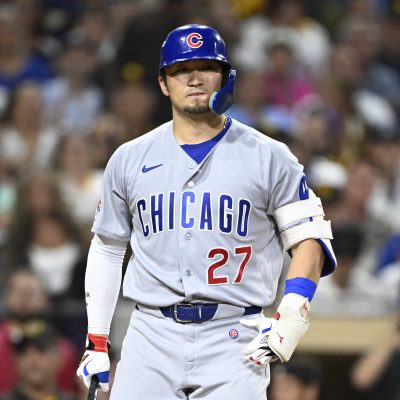
With Ian Happ and Seiya Suzuki both hitting free agency, the Cubs could lose both starting corner outfielders in the same offseason. Arozarena could take over in left and replace some of that lost offence, easing the pressure on Matt Shaw and Pedro Ramírez to step into larger roles right away.
Rebuilding the rotation may be the more pressing priority for Chicago. Matthew Boyd, Shota Imanaga, David Peterson, Kevin Gausman, Clay Holmes, and Colin Rea are all free agents, so the Cubs may want to address their starting pitching before making a major commitment to an outfielder. If they do spend big on a bat, they might prefer to re-sign Suzuki, whose right-handed power is already a known fit in their lineup.
Boston Red Sox
For all their outfield depth, the Red Sox finished 26th in OPS from left field in 2026. Their outfield options also lean heavily left-handed, with Roman Anthony, Jarren Duran, Wilyer Abreu, and Masataka Yoshida all batting from that side. Arozarena would give Boston another established right-handed hitter alongside Willson Contreras.
With Anthony likely to get most of the starts in left, Arozarena could spend most of his time at DH, though the two could share starts at both spots. When Arozarena plays left, Gold Glove center fielder Ceddanne Rafaela could help ease some of his defensive burden.
Arozarena would likely get regular at-bats ahead of Duran and Yoshida, but signing him would leave Boston with a crowded outfield and DH picture. Moving one of them could ease that logjam. The bigger question is whether the Red Sox want to make a major commitment to a player they’d use primarily at DH.
Become a Member of Just Baseball
Subscribe and upgrade to go ad-free!
* Save 25% by subscribing annually.

Written by
Will Houslander is from Toronto and studies at Ivey Business School. He covers all things MLB for Just Baseball and writes about the Toronto Blue Jays…