
Meet the Players: Inside Agentiq Sports Roster
In part one, we heard from Agentiq co-founder Zach Kurtz about why fans deserve more than a betting slip or a card in a sleeve. Now it’s time to meet the players.
Agentiq’s launch roster features five big-league talents from four organizations. Two are prospects, two are at the beginning stages of their big-league career, and one is an established MLB arm. Each has sold a slice of his future on-field earnings, and fans can buy in through a fixed number of units in a qualified offering.
Some names are knocking on the big-league door. Others are already there. Here’s who they are, and what’s on the table.
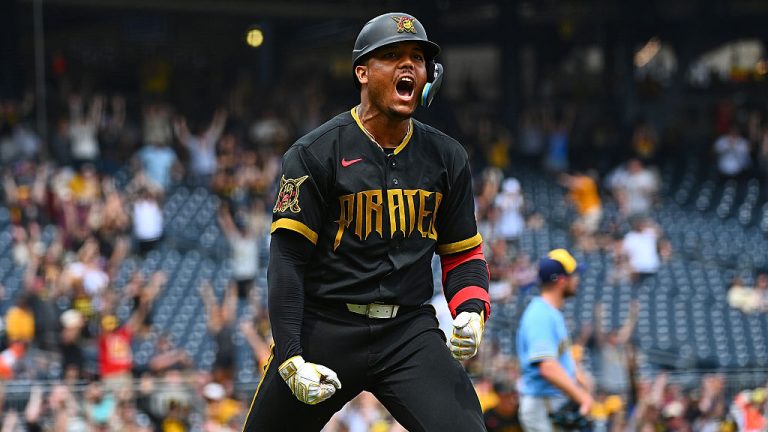
Esmerlyn Valdez, OF/1B, Pittsburgh Pirates
Player type: Riser · Price per unit: $28.21 · Units: 100,000 · Offering: $2.82M
If you like power, Valdez is your guy. The Pirates signed him out of the Dominican Republic in January 2021 for $130,000, and he has been mashing ever since.
In 2025, he hit .286/.376/.520 with 26 home runs and 86 RBI between High-A Greensboro and Double-A Altoona. That homer total led the Pirates’ system, and only two minor leaguers aged 21 or younger hit more. He was named South Atlantic League MVP and the organization’s Willie Stargell Slugger of the Year.
Then came the Arizona Fall League, where he led the circuit with eight home runs in 19 games. Pittsburgh added him to the 40-man roster that winter.
This season, Valdez earned his first call-up after a five-homers-in-five-games tear at Triple-A Indianapolis. He debuted on May 22nd, 2026, in Toronto, and two days later in the final game of the series, Valdez hit his first home run. He’d homer again in his next game, his first in front of a home crowd in Pittsburgh.
Across 72 games in his rookie campaign, Valdez hit 17 home runs and posted an .855 OPS, which led all NL rookies (minimum of 250 PAs).
His $2.82M offering is the largest on the roster, and his $28.21 unit price is the highest of the four younger players.
Ronny Cruz, SS/3B, Washington Nationals
Player type: Prospect · Price per unit: $12.90 · Units: 100,000 · Offering: $1.29M
Cruz may be the breakout story of the Nationals’ farm system this year. The Cubs drafted him in the third round in 2024 out of high school in Miami. Washington landed him at the 2025 deadline in the Michael Soroka trade.
The buzz started in spring training. Assistant GM Devin Pearson said Cruz was the name everybody kept raving about, praising his hard contact and plus range at shortstop. Cruz even hit a two-run homer off the Astros in Grapefruit League play.
Then he backed it up. Cruz opened 2026 at Single-A Fredericksburg, hitting .333/.460/.627 with three homers and a league-leading 15 steals in 14 games. That earned the 19-year-old a quick promotion to High-A Wilmington.
He entered the year as the Nationals’ No. 25 prospect according to MLB Pipeline, but now finds himself ranked in their top 10 after stealing 52 bases and hitting 15 home runs in his first full season of professional baseball. His 100,000 units are priced at $12.90 each.
Carlos Virahonda, C, Arizona Diamondbacks
Player type: Prospect · Price per unit: $5.10 · Units: 50,000 · Offering: $255K
Virahonda has the lowest unit price on the roster. He also might have had the best 2026 of anyone on it.
The 20-year-old Venezuelan catcher signed with Arizona in January 2023. He came into this year known mostly for his glove and his plus arm behind the plate. Then the bat showed up: his previous career high was four home runs, and he blew past that in 2026.
Across Single-A Visalia, High-A Hillsboro and Double-A Amarillo, he hit 20 doubles and 19 home runs, drove in a system-leading 94 runs, and posted an .870 OPS in 102 games. He reached Double-A at just 20 years old.
He homered in each of the first two games of the Texas League Championship Series as Amarillo won the title. Last week, the Diamondbacks named him their Minor League Player of the Year.
Hunter Dobbins, RHP, St. Louis Cardinals
Player type: Riser · Price per unit: $10.85 · Units: 30,000 · Offering: $326K
Dobbins is the only “riser” on the roster: past the prospect stage, but still establishing himself in the majors.
The Texas native broke in with Boston in 2025, going 4-1 with a 4.13 ERA across 13 appearances (11 starts). His rookie year ended in July when he tore the ACL in his right knee while covering first base. Last winter, the Red Sox sent him to St. Louis as part of the Willson Contreras trade.
He opened 2026 on the injured list, and ended up splitting the season between Triple-A and the big leagues. In Triple-A, Dobbins pitched to a 4.16 ERA in 13 starts. In the big leagues, he fared even better, posting a 3.67 ERA in 11 games (8 starts) across 54 innings pitched.
For fans, Dobbins is a bet on a pitcher who has already shown he can have success in a big league rotation. Unfortunately, Dobbins underwent Tommy John surgery last month, which will have him sidelined for the 2027 season.
Justin Martinez, RHP, Arizona Diamondbacks
Player type: Established · Price per unit: $35.30 · Units: 10,000 · Offering: $353K
Martinez is the roster’s lone established big-leaguer, and he throws really, really hard.
His 2024 breakout made him one of the best young relievers in the game: a 2.48 ERA, 29.5% strikeout rate and 58.9% ground-ball rate over 72 2/3 innings. Arizona rewarded him with a five-year, $18 million extension in March 2025. Then a UCL sprain led to Tommy John surgery that June, wiping out most of two seasons.
His return late this season was worth the wait. Martinez threw an immaculate inning against the Rangers, striking out Wyatt Langford, Evan Carter and Jake Burger on nine pitches. He also uncorked a 103.8 mph pitch, the fastest in Diamondbacks history.
The structure of his offering reflects his track record. He has the fewest units on the roster (10,000) and the highest price per unit ($35.30). With that said, Martinez has already signed a five-year, $18 million contract with the Arizona Diamondbacks, which includes club options for $7 million in 2030 and $9 million in 2031.
Reading the Numbers
Prices run from $5.10 to $35.30 per unit, and offering sizes from $255K to $2.82M. As Kurtz explained in part one, each price comes from Agentiq’s projections of a player’s career earnings, discounted to today.
| Player | Team | Type | Unit price | Units | Offering | Breakeven | Projected* |
|---|---|---|---|---|---|---|---|
| Justin Martinez | Diamondbacks | Established | $35.30 | 10,000 | $353K | $35.3M | $62.8M |
| Esmerlyn Valdez | Pirates | Prospect | $28.21 | 100,000 | $2.82M | $28.2M | $67.3M |
| Ronny Cruz | Nationals | Prospect | $12.90 | 100,000 | $1.29M | $12.9M | $21.9M |
| Hunter Dobbins | Cardinals | Riser | $10.85 | 30,000 | $326K | $10.9M | $34.7M |
| Carlos Virahonda | Diamondbacks | Prospect | $5.10 | 50,000 | $255K | $5.1M | $8.3M |
*Projected earnings are based on Agentiq’s internal data science model as our best estimate, but they are not guaranteed.
The established player carries the highest price but the fewest units. The prospects come with more units and, in Virahonda’s case, a much lower entry point, along with a longer road before any big-league paychecks arrive.
Before You Invest
Every player above shows what makes this model exciting and what makes it risky. Valdez and Cruz have to keep climbing. Dobbins and Martinez have already shown how fast an injury can change a career.
Agentiq’s units are securities offered under Regulation A, and the company is clear about the risks:
- You could lose your entire investment.
- Units are illiquid, and there’s no guarantee a secondary market will develop.
- Each player is a separate series. Buying into one player gives you no stake in the others or in Agentiq itself.
- Non-accredited investors generally can’t invest more than 10% of the greater of their annual income or net worth.
This is the second installment of a four-part series on Agentiq


Written by
Ryan Finkelstein has led editorial for Just Baseball since 2021 and officially became the Editor-in-Chief in 2025. He also hosts Locked On Mets, the No. 1…