
Did the Marlins Pick the Right Time to Trade Ryan Weathers?
A deep dive into the Ryan Weathers trade for both the Miami Marlins and the New York Yankees, with a breakdown of the prospect return.
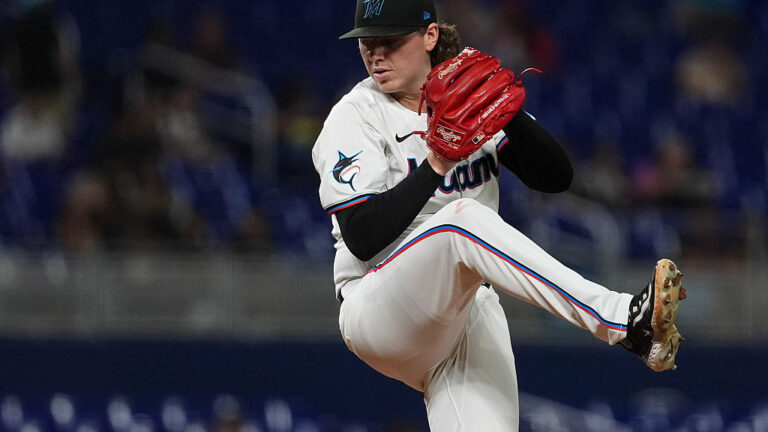
The Yankees and Marlins agreed to a deal that sent 26-year-old left-hander Ryan Weathers to the Bronx in exchange for four prospects just a week after shipping Edward Cabrera out to the Cubs for a trio of prospects.
Moving Cabrera in the name of shedding volatility made sense. The talented 27-year-old has hit the IL 13 times in his pro career, including as recently as September of last season with a right elbow sprain.
Weathers has, unfortunately, had some concerning ailments over the last year as well.
After a really encouraging Spring Training where his fastball looked better than ever, he hit the IL with a mild left flexor strain, taking six weeks to recover before making his first start of the regular season in mid-May.
Five starts later, Weathers returned to the IL, but this time with a more serious lat strain that kept him out nearly the remainder of the season. The good news is, Weathers returned to make three more MLB starts in September, where his average velocity was within a tick of where he was before the injury.
The idea of not wanting to roster two pitchers who carry what is reasonably perceived as a significant injury risk makes sense, especially with the Marlins’ pitching surplus. But I think that justifies the Cabrera trade, not necessarily both.
Cabrera was coming off a breakout season where he pitched to a 3.53 ERA across 137 2/3 innings pitched. While there is still more upside with Cabrera, it is fair to categorize that trade as selling high on the best season we have seen for the 27-year-old so far.
With Weathers coming off a season where he only made eight starts, it is hard to call this anything but selling low on a high-ceiling arm.
Why the Marlins Made the Trade
This has been a theme with Peter Bendix and the Marlins front office, though. Jesus Luzardo was moved after a 2024 season where he battled both elbow inflammation and a lumbar stress reaction that limited him to 12 starts.
The return was somewhat similar to that of the Edward Cabrera trade, a clear headline prospect that lacked a second piece that really packed a punch.
In all three of those deals, it could be argued that the Marlins netted 70 cents on the dollar rather than rolling the dice on a healthy first half and moving those players at the deadline.
While Luzardo ended up turning in a healthy 2025, there was an understandable reason for the Marlins to not want to risk an injury that could wipeout one of their most valuable trade assets to replenish the farm system with position player prospects.
For the same reason, the Marlins were looking to move the aforementioned three arms; other teams may have been wary to give up significant pieces for a player who may not be available for them, hence the 70 cents on the dollar.
That said, pitching is so expensive on the open market, and “healthier” controllable arms require such a hefty return that certain teams may prefer to give up a little bit less in exchange for more risk.
It’s a lot easier to want to roll the dice on a healthy season from one of those three pitchers from my desk than Bendix’s, and I’d imagine if the Marlins’ top two prospects weren’t two of the best left-handed pitching prospects in the game, maybe they’re more likely to hold onto one of their big league arms.
Robby Snelling (Just Baseball’s No. 30 prospect) should be up by May, and Thomas White (Just Baseball’s No. 18 prospect) shouldn’t be too far behind if he can cut down the walk rate a bit.
Still, neither has thrown a big league pitch, and if the Marlins were gunning for giving their team the highest ceiling in 2026, you at least hold onto one of Cabrera or Weathers.
While think there is excitement around how the team performed in 2025, a 79-win season was never going to disrupt the Marlins new process.
A process focused on creating waves of talent throughout the organization so that the team can compete despite likely always sitting towards the bottom of the league in terms of payroll.
For the teams that operate that way–like the Rays and Brewers–the margin for error is razor-thin.
You have to create your own assets, and you can’t squander whatever assets you do have. There’s a lot of reason to believe that the Marlins’ return from the Yankees was one that came with a ringing endorsement on the model side (more on the return later).
Conversely, Cubs, Yankees, and Phillies can afford to whiff on a trade like this a bit more, especially when the injury concerns allow them to hold onto their blue-chip prospects while allowing them to allocate funds towards an Alex Bregman, Cody Bellinger, and Bo Bichette.
Given their injury history, neither Cabrera nor Weathers has undergone Tommy John surgery to this point, and if either were to in 2026, the Marlins would likely be in a spot where they would be attempting to salvage pennies on the dollar for either, depending on the timing.
But it doesn’t even have to be that catastrophic; another flexor issue, lat strain, etc., could be enough to scare teams off for good, while eating into coveted team control.
Why This Trade Was a No-Brainer for the Yankees
Now that I’m through the hard part, trading for Weathers was a slam dunk for the Yankees. I really do believe Weathers was on the cusp of a breakout season in 2025 before being derailed by injuries.
His fastball was a tick harder with an inch more of induced vertical break and three less horizontal, his changeup had more depth than ever, generating more than 14 inches of vertical separation, and he tightened up his sweeper to a harder and sharper offering.
Also, for a Yankees team that is a Cody Bellinger return away from a higher payroll than last year, bringing in Weathers at his $1.35 million price tag with three years of control potentially answers a need without compromising their ability to push for Bellinger or another bat they may be interested in.
I will get more into the package as I wrap up with the Marlins angle, but for a team that is perpetually in win-now mode, moving four prospects who are not near helping the big league team in 2026 is easily palatable.
If things do go awry health-wise with Weathers, the Yankees can rest on the fact that they retained their top-end talent with more of a quantity approach to the package.
Outfielder Dillon Lewis likely stung the most, as he was slated to rank in the 6-8 range in our Yankees top prospect update, but as long as the Yankees are not parting with their last two first round shortstops in George Lombard and Dax Kilby as well as their top pitching prospects, the risk reward proposition of a potential middle-rotation arm for less than twice the league minimum is a shot Brian Cashman was likely happy to take.
Even in a limited sample last season, I have plenty of confidence that a healthy Weathers is a middle-rotation arm, given the aforementioned arsenal leap and his ability to pound the zone. He will help form potentially as exciting a left-handed trio as there is in baseball, joining Max Fried and Carlos Rodon.
Gerrit Cole is also expected to return in the first half of the season if all things continue smoothly, which, paired with the emergence of Cam Schlittler, could make the Yankees one of the most volatile but potentially nasty rotations in baseball.
The Return
None of the four players moved to the Marlins requires a 40-man roster spot, something most team models value highly.
The headlining pair is Dillon Lewis and Brendan Jones, both of whom are not Rule 5 eligible until after the 2027 season, with carrying traits. Infielders Dylan Jasso and Juan Matheus had solid 2025 seasons, but offer less upside and will be Rule 5 eligible following the 2026 season.
Lewis definitely has the highest ceiling of the group. He has the ability to stick in center field despite his 6-foot-3, 220-pound frame, thanks to his plus wheels.
Lewis’s actions are a bit stiff, but that only appears to be an impediment when it comes to finishing highlight reel-type plays on occasion. He has a second gear that he can really kick into in the outfield that allows him to cover a lot of ground and a plus arm to complement.
The Marlins’ pursuit of speed and players with high exit velocities has been obvious over the last couple of years, and Lewis checks both boxes. His 90th percentile exit velocity exactly matched that of the headline piece in the Cabrera trade, Owen Caissie at 108 MPH in 2025.
Of course, Caissie did that at the Triple-A level compared to Lewis at Low-A and High-A, but it at least illustrates the kind of impact Lewis was capable of in an age 21/22 season. There’s some swing and miss liability, but the contact rates were palatable at 80% zone contact and 72% overall.
Though he’s still a bit raw in the box with a swing that can lack some adjustability, it was an impressive enough pro debut for Lewis to completely shift the perspective on him both within the Yankees organization and around the league.
The 2024 13th-rounder made the leap from a 14-41 Queens City team of the Atlantic Sun League to posting a 121 wRC+ with 13 homers and 13 bags in 76 High-A games to wind down the season. Lewis is a superb scouting success by the Yankees and immediately offers the best blend of power and speed in the Marlins organization.
While the hit tool is still the biggest question, Lewis’ easy plus raw power, speed, and at least respectable contact rates give him a good shot to at least fill a big league role with a lot of upside to dream on.
Standing at 5-foot-9, 180 pounds, Brendan Jones does not quite offer as much upside, but the left-handed hitting outfielder provides a high-floor skill set. He is an easy plus runner who will stick in centerfield and swiped 51 bags on 60 tries in 2025.
While the bat to ball is closer to average than above average, the plate discipline is above average, with respectable numbers left on left.
Squeezing out the most of his tools is the theme, and the power is a prime example. His average exit velocity of 86 MPH would be towards the bottom 5% of qualified Major League hitters, but he has a knack for pulling the ball in the air, which helped him sneak out 11 homers and 40 extra base hits in 126 games.
For a player of Jones’ archetype, slightly better contact rates than 77% overall and 84% in zone would make it easier to project an everyday centerfielder, though you don’t have to squint too hard to see a potential fourth outfielder.
The defense and speed will carry Jones to an active roster, and his gritty, hard-nosed game with the ability to sneak out 10 or so homers.
Jasso and Matheus look more like infield depth, both posting 115 wRC+’s on the season, Jasso at Double-A and Matheus split between Low-A and High-A. Matheus offers a little more to dream on as a switch-hitter who can play all over the infield, though he likely projects best at second base.
Matheus only improved with his feel to hit as his age 21 season trucked onwards, running a zone-contact rate of nearly 90% over his final 300 plate appearances of the season, paired with an 83% contact rate and chase rate hardly above 20%.
As a result, he walked nearly as much as he struck out in that span.
There’s not a ton of raw impact, but he has a good feel for finding the barrel, evidenced by an average exit velocity of 89 MPH compared to a 90th percentile exit velocity of just 102.5 MPH. Matheus offers above-average wheels as well, swiping 40 bags on 51 tries in 2025.
There’s a valid concern that Matheus noisy operation could create more challenges at the upper levels, however he kicked into another gear offensively as he was promoted to High-A to close out the year, posting a 135 wRC+ over his final 28 games.
Jasso is a corner infielder who does not post elite exit velocities, but has a strong EV floor, boasting an average exit velocity of 91 MPH in 2025 and Hard Hit rate of 48%. That said, it will still be an uphill battle for Jasso to provide the slug necessary to carry his corner infield profile that comes with average-at-best defense at the hot corner.
His struggles against velocity are a clear-cut area of improvement as Jasso presumably gears up for Triple-A in 2026.
At the end of the day, the likely determining factor of whether the deal from the Marlins’ end of things is going to be how close to his dynamic ceiling Dillon Lewis can reach.
Regardless, there’s no doubting that the Marlins have cultivated one of baseball’s deepest farm systems.
For the Yankees, they address their rotation with an upside piece while flexing their scouting and player development muscles to create their own assets.
Lewis and Jones were picked in the 13th and 12th rounds, respectively, a year and a half ago, while Jasso signed as an undrafted free agent in 2023. As for Matheus, signed for $10,000 as an international free agent in 2022.

Written by
Aram Leighton is the Co-Founder and Executive Editor for Just Baseball. A Syracuse University grad, Aram is one of the hosts of the Just Baseball Show…