
Isaac Collins Still Deserves More Love in the NL Rookie of the Year Race
Despite his impressive numbers, Isaac Collins still isn't getting the love that he deserves in the 2025 NL Rookie of the Year race.
 | |
| | 
The Rookie of the Year race is always one of my favorite awards to follow each year.
In 2024, the baseball world was gifted with one of the most epic Rookie of the Year battles to date, with Paul Skenes taking home the hardware over Jackson Merrill in the National League.
This season, Nick Kurtz has put together a generational rookie season of his own and is the runaway favorite to win the award in the American League.
The National League, however, is still very much up for grabs. With just under three weeks left to play in the regular season, all eyes will be on a handful of candidates vying for the hardware. But one name out of Milwaukee deserves more love in the race.
Who Are the Top Candidates?
Backstop Drake Baldwin has been one of the favorites for this award since the season began, and for good reason. He looks like the next best thing at the catcher position for the Atlanta Braves, and his odds currently sit at +130.
Hurler Cade Horton of the Chicago Cubs, who is now the odds-on favorite to win the award at -115, has been the best pitcher in MLB since the All-Star break and has seen his odds shift quite dramatically over the past handful of weeks as a result of his stellar play.
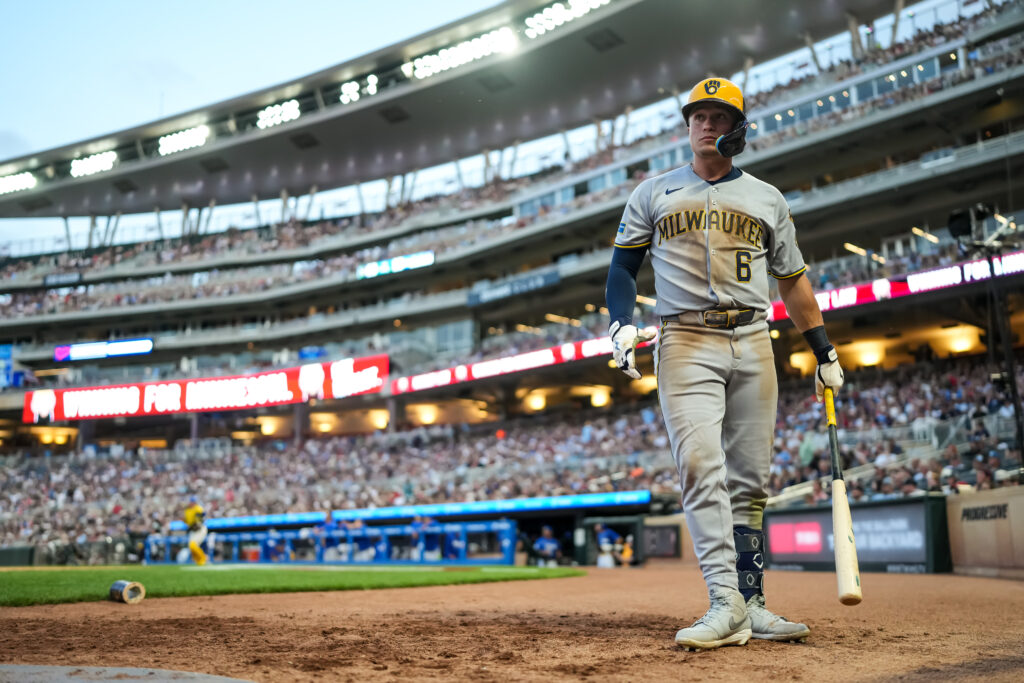
But one name that is falling by the wayside, despite putting up some of the best rookie numbers this season, is outfielder Isaac Collins of the Milwaukee Brewers.
Collins, whose odds to win 2025 NL Rookie of the Year currently sit at +550, has arguably the strongest argument of all to win this year’s award. And yet, there is a sizable gap in the betting odds between Collins and the two names ahead of him.
I’m not here to say that neither Baldwin nor Horton aren’t deserving of the honor, because they certainly are. A very strong case can be made for each of those two players to win the award.
But Collins is somehow still underrated in the betting market for no valid reason. I am here to give him his flowers and make the case for why he should walk away as this year’s NL Rookie of the Year.
Stats were taken prior to play on September 9.
The Case for Isaac Collins To Win NL Rookie of the Year
Who Has Been the Better Hitter in the National League?
Let’s start with the two position players. When looking at what Collins and Baldwin have done this season, the comparison between these two rookie campaigns is pretty fascinating.
Both have been exceptional this season, but they’ve done it in very different ways and in very different roles with their respective ball clubs. At the end of the day, though, their season-long metrics stack up quite closely to each other:
| Metric | Isaac Collins (403 PA) | Drake Baldwin (374 PA) |
|---|---|---|
| fWAR | 2.8 | 2.5 |
| BA | .275 | .276 |
| OBP | .373 | .348 |
| SLG | .433 | .448 |
| OPS | .805 | .796 |
| wOBA | .354 | .348 |
| wRC+ | 128 | 122 |
| ISO | .158 | .172 |
| XBH | 33 | 28 |
| HR | 9 | 15 |
| RBI | 54 | 64 |
| R | 53 | 45 |
| SB | 16 | 0 |
As you can see by the table above, we’re splitting hairs when it comes to comparing these two players.
Collins leads all NL rookies in fWAR at 2.8, while Baldwin is right behind him in second place at 2.5. Collins has played in 12 more games and has 29 more plate appearances than Baldwin, but that workload difference is also something to take into consideration for each résumé when all is said and done.
Their batting averages are nearly identical, but Collins gets on base at a much higher clip thanks to a 12.4% walk rate compared to Baldwin’s mark of 9.1%. Collins’ OBP (.373) is second among NL rookies while Baldwin ranks fourth in that category (.348).
Collins’ ability to get on base at such a high clip is one of his strongest arguments for this award. Voters will have to weight the importance of that against Baldwin’s power-hitting ability, as that’s where Baldwin has the clear edge over Collins.
Baldwin is second among NL rookies in slugging percentage at .448, which is 15 points higher than Collins’ mark. In turn, his Isolated Power (ISO) is 14 points higher than Collins, and he has 15 homers on the year (second among NL rookies) compared to Collins’ nine homers (T-5th).
The long ball is often king when it comes to player debates, and his power-hitting prowess is why Baldwin leads NL rookies with 64 RBIs, 10 more than Collins. That being said, while he may trail Baldwin in homers and overall quality of contact metrics, Collins has also demonstrated an ability to hit for power this season.
Despite the gap in homers, Collins actually has more extra-base hits than Baldwin. Collins has 21 doubles and three triples compared to Baldwin’s 13 doubles and zero triples.
Baldwin is the far superior home run slugger, nobody is debating that. But Collins manages to rack up his extra-base hits in a much different way, using his speed and baserunning skills to his advantage. That is an element to his offensive game that is nonexistent for Baldwin.
Collins’ 16 stolen bases are tied for the most among NL rookies, while Baldwin has zero on the year. It feels as if the value of that element of speed and baserunning is getting lost in the shuffle in this Rookie of the Year race because Baldwin has the louder bat.
In reality, when looking at the overall big picture of what a player brings to the table, Collins’ baserunning should be considered a huge advantage over Baldwin in this debate, especially when every other category is as close as it is.
In terms of defensive value, it’s nearly impossible to compare the performance of a left fielder to the performance of a catcher. However, it is worth noting that Collins leads left fielders in MLB with +6 OAA.
Baseball Savant has Collins in the 65th percentile in Fielding Run Value while Baldwin is in the 57th percentile. But given how difficult it is to quantify defensive value, especially between these two positions, this is one element of the discussion that needs to be taken with a grain of salt in my opinion.
Overall, Collins has the advantage over Baldwin in OPS, wRC+, and wOBA. Sure, Baldwin has the advantage in run production and homers, but does his 15 point advantage in slugging percentage outweigh Collins besting him in many of the overall offensive metrics?
Perhaps to some voters, yes — that extra slugging ability, combined with the added workload of playing catcher, will be the deciding factor. But to me, the gap between these two players isn’t as large as the betting odds suggest.
Collins has been the better baserunner and the better all-around hitter for the best team in baseball. While team performance shouldn’t mean much in an individual award race, it could be the tiebreaker when things are this tight.
Collins Vs. Horton
Comparing a left fielder to a catcher is difficult in its own right. Comparing the value of a left fielder to the performance of a starting pitcher is a whole different beast. But we’re going to give it a try, just as the voters will come season’s end.
Simply put, Horton has been one of the best pitchers in MLB since the All-Star break. He has the lowest ERA in the second half at a sparking 0.77 (min. 40 IP), and no other qualified pitcher has an ERA below 1.00. Since the Midsummer Classic, batters are hitting just .149 against him, and he has a WHIP of just 0.81 over that stretch.
Those numbers are sensational and deserve to be highlighted as such, and his production for the Cubs these past few weeks is a big reason why he is currently the odds-on favorite.
However, that shouldn’t take away from Collins’ production since the All-Star break either. He has a 145 wRC+ since the All-Star break to go with an .875 OPS and 1.5 fWAR. Albeit his numbers aren’t nearly as jaw-dropping as Horton’s sub-1.00 ERA, but it’s not as if Collins’ production has completely cratered in the second half.
Moreover, while what Horton has done over his last few starts is tremendous, he did pitch to a 4.45 ERA in nearly the same sample size prior to the All-Star break (56.2 IP in the first half versus 47.0 IP in the second half). Horton still has an impressive 2.78 ERA on the season, but it’s felt like a tale of two halves for the Cubs hurler.
Collins on the other hand still had a 116 wRC+ and 113 OPS+ in the first half of the season before taking off in recent months. It may not be as flashy, but that type of season-long consistency should be rewarded when determining who should be Rookie of the Year.
Collins will have over 130 games played this season (he’s at 120 with 16 games left to play), while Horton will likely be around 125-130 innings pitched on the year. How will voters weight those two workloads? That remains yet to be seen.
Final Thoughts
I’ll admit that, heading into Opening Day, there wasn’t a world in which I thought Collins would be in this position by the end of the 2025 season.
It’s not that I didn’t believe that he could be a valuable piece for the Brewers, but his opening odds to win the 2025 Rookie of the Year Award were off the board for a reason. Heck, his odds weren’t even listed for the award by BetMGM until June.
Collins is 28 years old and was fifth in the outfield pecking order behind Jackson Chourio, Garrett Mitchell, Sal Frelick, and Christian Yelich. What’s more, his spot on the roster really only opened up because of the injury that Blake Perkins suffered in spring training. If Perkins never got hurt, would Collins have even made the Opening Day roster? Perhaps not.
Baldwin and Horton, on the other hand, had the prospect pedigree that at least put them on the map heading into Opening Day.
Heading into the year, Baldwin, 24, was the No. 17 overall prospect in baseball, according to Just Baseball, and the third-best catching prospect behind Dalton Rushing and Samuel Basallo. Horton, 23, went into 2025 as Just Baseball’s No. 45 ranked prospect and was the the Cubs’ top pitching prospect. Baldwin’s opening odds for NL ROY were +5000, while Horton’s were +8000.
At the end of the day, whether it’s right or wrong, there is a good chance that is hurting Collins’ case while it is helping both Baldwin’s and Horton’s arguments to win the award.
But take all the external factors out of the equation. Strip away the prospect status heading into the season, disregard the age of the players in question, and just look at the production on the field. How many rookies have been better than Collins this season in the National League? The answer is not many.
He may not walk away with the hardware when all is said and done, but it’s time Isaac Collins gets the praise he deserves in this award race.
Written by
Joey Peterson is a graduate of the University of Wisconsin-Madison and an editor for Just Baseball. Joey covers the Milwaukee Brewers, along with general MLB topics…