
Is Something Wrong Under the Hood for Trevor Rogers?
As the Orioles look to flip the script on their 2026 season, getting Trevor Rogers back on track is key for Baltimore's postseason hopes.
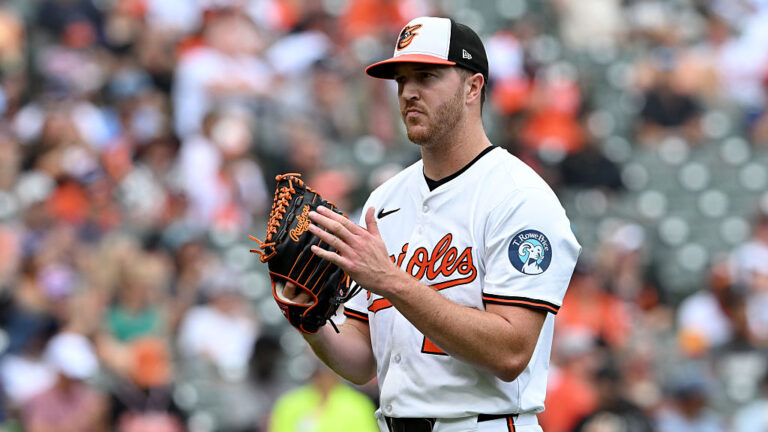
As the MLB calendar prepares to flip to June, the Baltimore Orioles‘ window of getting back into playoff contention is getting slimer.
While there are many issues plauging the team right now, the sorest thumb is the starting rotation. The group that entered the season as the team’s biggest wild card has turned into a joker.
At the head of this lackluster group is Trevor Rogers. The lefty, who finished top 10 in AL Cy Young voting in 2025, has mightily struggled in a 2026 season where he was expected to lead the rotation.
After a 2025 season that had fans feeling like the team had their ace, 2026 has been a hard crash back to reality for the former Miami Marlin. While some regression was probable, the kind of performances Rogers has had suggest that something has changed between 2025 and 2026.
So, what has changed over the offseason for the lefty? Are these things that can be fixed? Was 2025 just a fluke? Let’s try to find answers for some of these puzzling questions.
Stats were taken prior to play on May 27.
The Fastball Is King
A key part of Rogers’ resurgence in 2025 was the southpaw finding his fastball. With his changeup being his go-to secondary pitch, having a fastball that can play at the top of the zone is critical to his success.
Following his runner-up NL Rookie of the Year season in 2021, Rogers struggled with his health, leading to his fastball not being as sharp as it needed to be. As a result, Rogers got hit around hard, becoming a shell of his 2021 self.
Despite missing the start of 2025 due to injury, Rogers was able to consistently stay on the bump. This allowed him to throw his fastball the hardest he had in years.
In 2026, his average fastball velocity is actually the same as it was a season ago, but the run value on the pitch has dropped from 16 in 2025 to -1 in 2026.
In Rogers’ two most successful big-league seasons — 2021 and 2025 — his four-seamer sported a run value of 14 and 16, respectively. Across his other five seasons, the pitch never surpassed +1 in run value. It’s what drives his success, and the results just haven’t been there to start the season.
But if the velocity isn’t down on the pitch, what could be contributing to an opponent .258 batting average and .468 slugging percentage?
When looking into his fastball performance, his hard-hit percentage (36.5%) and expected batting average (.229) do not reflect what you would expect to see from someone who is 14th percentile for fastball run value.
To me, the statistic that stood out the most from last season has to be its putaway percentage. In 2025, Rogers had a 23.3% putaway percentage on the four-seam. The threat of his changeup caught lots of hitters mixed up on their timing, leading to Rogers being able to get outs with his heater.
In 2026, that metric stands at 10.6%, a near 13-point drop. While the metrics show that his fastball is not getting torched, losing a pitch that was so effective is putting more pressure on his secondary pitches.

Struggling With Secondaries
Without his fastball getting outs like it did in 2025, Rogers’ secondary pitches are under more pressure to get outs. So far, they are not getting the job done.
Rogers’ second-most thrown pitch is his changeup at 24%. In 2025, Rogers mustered a .202 batting average and .272 slugging percentage on that offspeed pitch, good enough for a 7 run value. This year’s changeup has been atrocious comparatively, with hitters batting .339 against the pitch with a .464 slugging percentage.
For the 28-year-old, 407 changeups in 2025 resulted in 23 hits, five of which were for extra-bases. In 2026, 189 changeups has resulted in 19 hits with four of them being for extra-bases.
As his second-most used pitch, it is safe to say that Rogers is not getting the results he emulated in 2025.
The southpaw is also having similar issues with his cutter, his fourth-most used pitch. Last season, 191 cutters resulted in an opponent batting average of .065 and a slugging percentage of .161. He hasn’t seen the same success in 2026, as 93 cutters have resulted in an opponent average of .400 with an .800 slugging percentage.
Rogers also had a 19% putaway percentage with his cutter in 2025. This season, that has dropped to zero percent.
So, with hitters having more success off his fastball, his secondary pitches are even more important to finding success. However, those pitches are getting hit even harder, putting the lefty in a difficult spot when it comes to attacking at-bats.
How Does Rogers Get Back on Track?
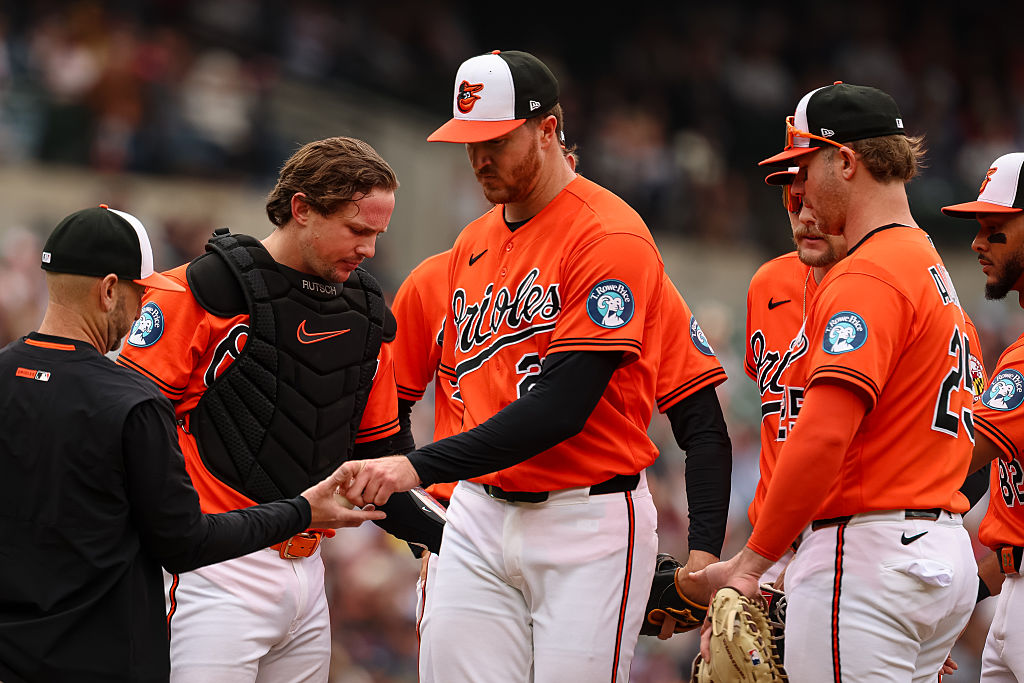
There is no questioning that when Rogers is on he can be a top arm in the American League. Even replicating 80% of his 2025 season would get the Orioles back on track to competing for playoff contention.
That being said, significant improvements need to be made to even consider Rogers being back to his former self.
It starts with getting hitters out when Rogers gets to two strikes. In two-strike counts, hitters are slashing .297/.377/.418. Compare that to a .120/.165/.184 slash line in 2025.
Rogers’ has evidently struggled to get hitters out with his go-to pitches, which, in turn, is helping hitters reach base even with two strikes. Finding his “out pitch” is critical to regaining his dominance on the mound.
At the same time, it is also not fair to put all of the blame on Rogers himself, as the Orioles’ fielding has cost the lefty at times.
While Rogers is tagged with a 6.96 ERA, a 4.53 FIP indicates that the fielders behind him are not helping out the skidding arm. The Orioles, as a team, have a .984 fielding percentage, tied for fifth-worst mark in the league. Their 31 errors are tied for the sixth most.
With Rogers depending on inducing weaker contact with his changeup, sinker, and cutter, having a defense that can handle the batted balls is a massive variable in whether or not Rogers succeeds. So far, Orioles defenders are not holding up their end of the bargain.
As the Orioles head into June looking to flip the switch from their dismal start, getting production out of the rotation will be paramount if the team wants to dig out of this own hole. At the head of the rotation, Rogers and Kyle Bradish have to become the duo that can consistently go out and give their ball club quality starts.
In his four most recent starts, Bradish has a 2.24 ERA with three of them being quality starts. It is time to see of Rogers can flip that same switch.
Become a Member of Just Baseball
Subscribe and upgrade to go ad-free!
* Save 25% by subscribing annually.

Written by
Tommy is an avid fan of baseball, especially in the Charm City. Tommy covers the Orioles for Just Baseball with the dream of working full time…