
Hao-Yu Lee Has Been a Difference Maker for the Detroit Tigers
The Tigers need another infielder to step up and become part of their future. After a slow start, Hao-Yu Lee has forced his way into that conversation.
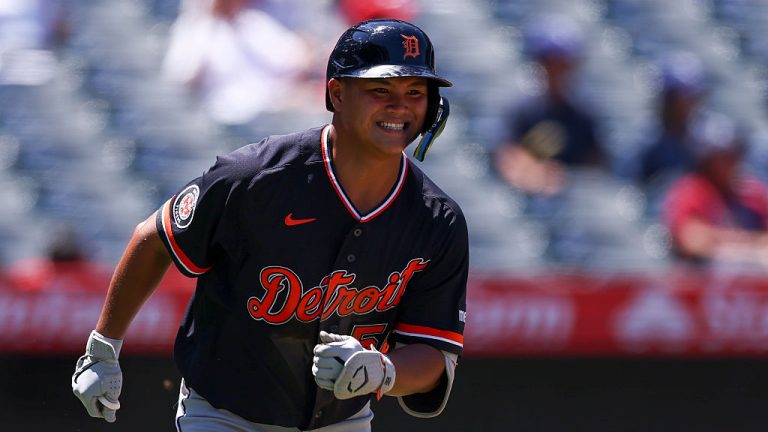
Kevin McGonigle has been the talk of the Detroit Tigers since he debuted earlier this season. He hit the ground running, providing an answer at the top of the lineup, and is currently the favorite for American League Rookie of the Year. However, McGonigle is not the only rookie making noise in Detroit.
Infielder Hao-Yu Lee, who was acquired at the 2023 trade deadline in exchange for Michael Lorenzen, has settled in and quickly become a reliable bat for a Tigers lineup that desperately needs one. Lee was originally added to the roster in mid-April due to injuries but struggled out of the gate, posting a .579 OPS through his first 32 games before being demoted.
He returned to the Tigers’ lineup a couple of weeks later and has steadily improved. Since June 1, Lee has slashed .337/.364/.548 with five home runs, seven doubles, and a 153 wRC+. During a stretch in which Gleyber Torres and Javier Báez were injured and Kerry Carpenter was in a nasty slump, Lee has stepped up and filled a significant void in the Tigers’ lineup.
Will the improvements continue? Is he truly more than a short-side platoon bat? Time will tell, but what we’ve seen over the past month and a half cannot go unnoticed.
Stats were taken prior to play on July 29.
Hao-Yu Lee’s Success and the Next Steps
Lee’s first stint in the majors looked overwhelming. It did not matter what pitchers were throwing him or where they were throwing it, Lee was going to swing. His chase rate was high, leading to a 29% strikeout rate and, ultimately, a demotion back to the minors.
Since his return, Lee has looked like a more confident player in the box. Sure, you’d like to see him lay off more pitches outside the zone and make more contact, but the strides we’ve seen from the 23-year-old rookie are impressive, even if they’re not perfect. A profile that once leaned more toward a short-side platoon bat than an everyday player is starting to look like a piece that can fill the bottom third of the lineup right away, with room for more.
His confidence is starting to come through. Last week in Anaheim, the Tigers were down to their final out in the ninth with Lee at the plate. A shot off the wall in deep right-center drove in two runs, giving the Tigers a lead they ultimately turned into a win. He let out a roar of emotion at second base with a level of enthusiasm we had not seen from him before.
A few days later, Lee got a hold of a hanging changeup from Michael Wacha and pulled it out for his sixth home run of the season. He paused in the box, slowly strutted as he watched the ball fly, then added a subtle bat flip before rounding the bases with a bit of moxie we had only recently been introduced to.
You can tell he’s starting to feel like he belongs.
While we don’t know what type of player Lee will become, I think we have an idea of what he could be. He’ll make contact at an above-average rate, spray the ball to all fields, and hit enough home runs to keep pitchers honest, but not enough to be in the Derby. A baseline of at least an above-average platoon bat against lefties feels like a safe floor, with a higher ceiling well within reach.
The good news is he’s not hitting the ball on the ground too often, sitting at a 36.8% ground-ball rate, close to his roughly 40% mark in the minors. Fly balls and line drives are going to be his game, and spraying the ball to all fields has been a staple throughout his minor league career.
He’s started to pull the ball a little more, which could lead to more power, even if I don’t think that is, or should be, a primary focus of Lee’s game. The quality of contact is good enough to play to all fields, and we’ve especially seen that recently.
Of the 30 batted balls he’s hit at 100 mph or harder this season, 20 have come since June 1. If you’ve been watching, it feels like at least once a game Lee stings a ball that catches your eye. He’s adjusting to major league pitching by reading the ball better, recognizing pitches, and triggering earlier, leading to better results.
That has also led to some aggressiveness. The occasional big hack at a pitch outside the zone has become more common than you’d hope. Swinging at pitches he can’t do much damage with is a learning curve he’s still working through.
He’s also shown a cold zone at the top of the strike zone. That’s where Lee has his lowest batting average and slugging percentage, along with his highest strikeout rates. Sample size is part of the equation, but it’s worth watching throughout the year to see how he adjusts and develops on the fly.
If Lee continues to make adjustments and perform at a high level, he could be an answer to one of the Tigers’ biggest questions heading into 2027.
How Lee Fits into the Future
The Tigers look like a different team when Gleyber Torres is healthy and in the lineup. Filling the two-hole and providing a right-handed bat that makes plenty of contact between two lefties has helped A.J. Hinch balance the lineup and move runners over ahead of his power bats.
Torres is on an expiring deal and could be moved at this year’s deadline, leaving a big hole at second base — a position Lee has played for most of his career. While I think Torres is a much better hitter and offers more complete at-bats than Lee, there’s a possibility Lee could take over his role next season.
For starters, Lee is probably a comparable defender to Torres. Neither has graded out well by the defensive metrics, and both have limited range, but neither is unplayable at the position. The Tigers have shown they’re willing to sacrifice defense at times in favor of offense.
If Lee wants to fill Torres’ shoes, he’ll have to continue hitting at a high level, especially against righties. That’s the big question. Will Lee hit enough against right-handed pitching to be an everyday option? Right now, he is, but I do wonder whether he’ll be able to keep it up. Filling the two-hole might be a big ask, but even if Lee finds himself in the bottom third of the lineup, his ability to hit righties will still be the biggest determinant of his playing time.
Let’s say he doesn’t hit righties well enough to be an everyday player but still puts up good numbers against lefties. There’s a role in 2027 for that profile. Detroit has shown the value of a short-side platoon every year, finding at-bats for Andy Ibáñez and Jahmai Jones as starters against southpaws. Heck, Jones didn’t even play the field.
There’s a world where Lee is Colt Keith’s platoon partner, no matter where Keith plays. Or Lee can serve as the designated hitter, pushing Kerry Carpenter to the bench when a lefty is on the mound. His defense doesn’t have to be perfect to carve out a role, as the Tigers have shown time and time again with previous players.
Final Thoughts
Of course, all of this could be a moot point if Lee does not hit. If his aggressiveness cannot be tamed to the point where he forces pitchers back into the zone, he could be nothing more than a depth option shuttling between Detroit and Toledo.
But what we have seen over the past two months is more than just hope. It’s more than a small sample size fueled by enough luck to inflate the numbers. Well-struck balls being driven to all fields and a boost in power are more indicative of future success than I expected to see this season. The Tigers need another infielder to step up and become part of their future, and Lee has cemented his name in that conversation.
Become a Member of Just Baseball
Subscribe and upgrade to go ad-free!
* Save 25% by subscribing annually.

Written by