
Examining the Braves’ Push for a Top-Five Payroll
Atlanta's front office claims a willingness to spend this winter, raising expectations even further after a down 2025 season.
 | |
| | 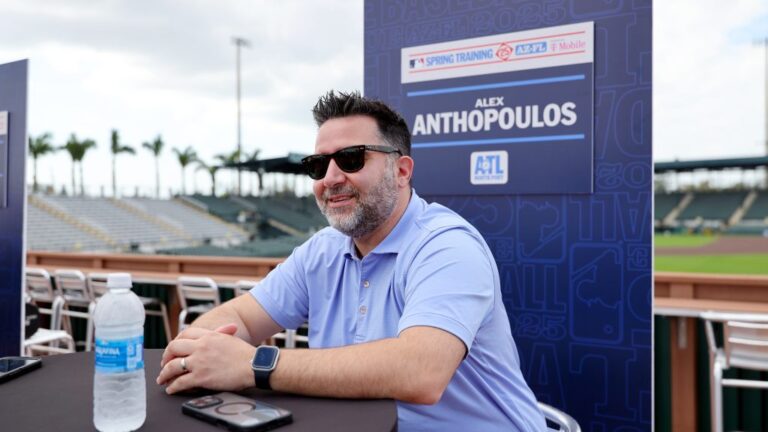
We’ve officially entered the most pivotal offseason of the Alex Anthopoulos era. It’s clear the Atlanta Braves’ front office understands exactly how much pressure is on them.
After two straight seasons of underperformance and a lack of impact transactions last winter, it’s reasonable for fans to wonder whether this winter will actually be different.
Braves fans get the unique opportunity to gain insights into the organization’s financial picture, with Atlanta being the only publicly traded franchise in the league. During the team’s Q3 earnings call, chairman Terry McGuirk made comments that instantly raised expectations.
Despite on-field struggles, the Braves saw year-over-year growth in Q3. As the topic turned towards player salary and payroll ambitions, McGuirk’s response was very blunt:
“We’ve always professed to try and be a leader in player compensation from the team standpoint. I’ve stated in the past that our goals are to be a top five salary team. We’re currently a top 10 and haven’t been out of that in quite some time, out of that range. I think aiming back to the top five is a place that I want to get to.”
He also acknowledged declining second-half attendance and made it clear the franchise cannot afford another disappointing season. For a fanbase that has called for an aggressive offseason for the past few years, this was a tangible sign the front office might actually follow through.
But words only go so far. Braves fans have heard this story before, with disappointing results that followed. So the real question remains: Will McGuirk and Anthopoulos actually spend at the level they’ve publicly signaled?
Understanding the Luxury Tax Landscape
To understand what Atlanta can realistically do, you have to understand the CBA’s tax system. By only spending roughly $220 million last season, the Braves successfully reset their luxury tax status after exceeding the CBT threshold the past two seasons.

In the current system, teams that exceed the threshold must pay a 20% tax the first year they do so, followed by a 30% tax in their second consecutive year, and a 50% tax thereafter. Teams can reset this tax by dipping under the threshold, as Atlanta did last season.
On top of that, there is an additional surcharge added depending on the amount by which a team exceeds this threshold. For teams that go over by $20-40 million, there is a 12% surcharge added. If a team exceeds the threshold by $40-60 million, a 42.5% surcharge is added. Anything further, and a whopping 60% surcharge is added.
Additionally, franchises that exceed the CBT threshold by $40 million or more see their highest non-top-six draft picks drop by 10 spots in the next MLB draft.
This is why resetting the luxury tax was so meaningful, whether Anthopolous did so on purpose or not. For most teams, these penalties add up, and most owners can realistically only take on so many financial hits.
Anthopolous has publicly stated that his club is willing to exceed the tax, as they had in the previous two seasons before 2025, as long as it avoids draft penalties. In an interview with local radio 680 The Fan, Anthopolous stated:
“We comfortably went over two years in a row. It was just money out the door. We didn’t lose draft picks, we didn’t move down in the draft. You have to go so far over and over so many tiers for it to be an issue.”
If Atlanta is ever going to push hard into the upper-tier of team payrolls, 2026 is the time to do it.
How Much Can the Braves Spend?
The offseason is ever-changing. Transactions are made on a daily basis.
As it stands at the time of this writing, the Atlanta Braves have $202,800,000 on the books in actual tax payroll. This includes both major and minor league contracts, player benefits, and the pre-arbitration bonus pool. Add in a projected $8,670,000 for projected arbitration and pre-arbitration, and this leaves Atlanta’s current luxury tax payroll at $211,470,000.

Payroll has steadily increased each of the last four seasons, as the league average has risen from $150 million to over $176 million.
When projecting what it will take to finish inside the top five in payroll, recent trends show that the fifth highest payroll has risen by an average of $10 million annually over the last four seasons. Using this, I project the mark to be at $265 million for 2026.
Being that the 2026 CBT threshold is set at $244 million, the Braves have roughly $32,530,000 remaining until they eclipse that mark. Atlanta would then have up to $52,530,000 to spend until reaching the first surcharge penalty of 12%, resulting in a payroll of around $264,000,000.
In my opinion, once a team crosses the CBT line, it makes little sense to stop right there. If the only consequence is a financial one, as Anthopolous has stated, you may as well be willing to continue to spend up.
With that in mind, the Braves would have up to $72,530,000 in space until they reached the next tier, which would result in draft pick penalties. This would result in a payroll of around $284,000,000.
Regardless of whether the target number is around $260 million or closer to $280 million, the Braves clearly have the ability to land in top-five payroll territory if they so choose to. It’s time to act on this promise.
Who Would They Spend It On?
The Braves have already made several moves this offseason.
Of note, Atlanta re-signed Raisel Iglesias and Joel Payamps, while signing Chadwick Tromp and Elieser Hernández to minor league contracts.
On the trade front, Atlanta sent cash to Colorado in exchange for relief pitcher Ryan Rolison. The biggest splash so far has been a 1-for-1 swap with the Houston Astros, sending Nick Allen in exchange for utility man Mauricio Dubón.
Before the offseason really got going, the Braves tendered contracts to Dylan Lee, Jose Suarez, Joey Wentz, Eli White, Vidal Brujan, and the newly acquired Dubón.
Even so, multiple meaningful holes still remain. My ideal hierarchy of needs has slightly shifted after these additions, but by and large remains true. The way Atlanta allocates its remaining spending power will determine whether this winter will be considered aggressive or just merely sufficient.
I will be operating under the projection that Atlanta will close with a payroll of $264 million, leaving $52,530,000 to spend.
Shortstop
Target: 40% ($21.0M)
Ha-Seong Kim remains the most realistic and best-fitting option at shortstop. His offensive numbers in Atlanta weren’t eye-popping (a .684 OPS and 91 wRC+) but both sides have expressed interest in a reunion.
After opting out of a $16 million salary for 2026, Kim is expected to command somewhere around $10–16 million annually. However, considering the market and the importance of the position, I would be comfortable with an offer in the $20–22 million range.
Mauricio Dubón gives Atlanta a bit of leverage because he can be the starting shortstop if needed. Anthopoulos made it clear in his post-trade comments that Dubón’s role will depend on what else the club does this winter:
“His role will be determined on what else we do this winter, and also this spring.”
Last season, Dubón spent time at every infield and outfield position outside of catcher. Ideally, he is a super utility player for Atlanta, giving new manager Walt Weiss a Swiss Army knife to deploy around the diamond three to five times a week.
This only reinforces the need to be aggressive at this position. The problem is that in such a bare market, the only similar alternative is Bo Bichette, who is expected to make anywhere from $22-28 million annually.
Other free agent options include Willi Castro, Luis Rengifo, and Isiah Kiner-Falefa. Unless the trade market offers different options, Kim is the cleanest answer to Atlanta’s problem.
Bullpen
Target: 20% ($10.5M)
While the bullpen already includes Raisel Iglesias, Dylan Lee, Joel Payamps, Joe Jiménez, and several depth options, Anthopoulos has made it clear that the team still needs multiple additions.
“We need a lot of relievers. Our plan is not to just get one reliever and be done. We’re going to need to do more.”
Given the recent financial commitment to Iglesias, the Braves may be better served targeting other options outside of the premium names of Robert Suarez and Edwin Díaz.
Pete Fairbanks makes for an intriguing option after the Tampa Bay Rays declined his $11 million option. With our prediction for Fairbanks landing between $8-14 million annually, this would provide Atlanta a more affordable, yet still top-of-the-line option to pair with Iglesias in the back end of the bullpen.
Other cheaper potential fits I would consider include Kyle Finnegan, Emilio Pagán, Kenley Jansen, Dustin May, Shawn Armstrong, Dauri Moreta, or bringing back Pierce Johnson and/or Tyler Kinley.
Given the money they already have tied into the bullpen, it may be more beneficial to target cheap options who have one or more elite pitches. This would allow newly acquired pitching coach Jeremy Hefner to further develop these cheap arms into a [hopefully] elite bullpen.
Starting Pitcher
Target: 20% ($10.5M)
The Atlanta Braves boast one of the stronger rotations in baseball that includes Chris Sale, Spencer Schwellenbach, and Spencer Strider.
Hurston Waldrep has seemingly secured his spot in the rotation after a breakout rookie campaign. Reynaldo López is set to return after missing basically all of 2025. Bryce Elder is available as an innings eater, and Just Baseball’s No. 94 prospect JR Ritchie is nearing his debut.
But if the past two seasons have taught us anything, it is that starting rotation depth can disappear quickly.
Bringing in one of the high-end free agent starters, such as Ranger Suárez, Michael King, and Framber Valdez, would almost guarantee one of the best rotations in baseball. However, I don’t believe that would be the most ideal allocation of assets.
That’s why Chris Bassitt stands out. The veteran pitcher has made at least 30 starts each of the last four seasons. He’s durable, consistent, and capable of keeping his team in every game he pitches. Even though our predictions put him in the $12-18 million annual salary range, I believe his age and market dynamics could make $8-10 million feasible.
Veterans like Tyler Mahle or Merrill Kelly would also make sense in this same price tier.
This isn’t the spot for the Braves to overspend, but it is a position where the Braves must not be caught thin again. In today’s MLB, a team can never have too many pitchers.
Outfield/DH
Target: 15% ($7.9M)
If the Braves do add Kim, Dubón’s versatility, and guys like Eli White and Nacho Alvarez Jr. capable of playing multiple positions as well, would allow the team to create DH rest days for Ronald Acuña Jr. and Jurickson Profar. This would maintain defensive stability and flexibility. Having this reduces the need for a splash addition at DH who can also play in the outfield.
Instead, the Braves could look towards a couple of buy-low candidates who are open to taking a lesser role on a contending team.
Adolis García is a flashy name that was recently non-tendered after having two down seasons in Texas. Linking García and hitting coach Tim Hyers back together could provide the upside off the bench Atlanta needs.
Mike Tauchman, JJ Bleday, and Lane Thomas are also intriguing buy-low candidates that have the capabilities to boost the Braves’ roster.
A slightly more expensive, yet still attainable, option is Ryan O’Hearn. After a career year in 2025 that included an All-Star appearance, the 32-year-old veteran is looking for his next team. He has experience at first base and corner outfield, giving Atlanta the chance to maintain the defensive flexibility needed. We have him projected to earn around $10-15 million in annual salary.
If the Braves do not secure an upgrade at shortstop, such as Kim, an even larger upgrade in this bucket will be needed. Taking the salary I designated for shortstop and applying it here would allow Atlanta to go after nearly anyone it desires.
Offseason Outlook
Even though Atlanta isn’t the same kind of media market that New York or Los Angeles is, it remains one of the largest and most profitable markets in baseball. Thanks to a lack of teams in the Southeast and TBS in the 1990s, Braves Country stretches well beyond regional boundaries.
The Braves brought in substantial revenue even during a down season. Ownership has directly acknowledged the need to spend and increase payroll this winter, especially after resetting the luxury tax. There is no reason they should not be aggressive in the offseason.
I genuinely believe that both Alex Anthopolous and Terry McGuirk’s goal is to have a top-five payroll this season. Not only is their reputation on the line, but possibly their jobs if things go sideways for a third straight season.
But words and belief only go so far. The resources are available, and there is financial flexibility to take advantage of. Fans, shareholders, and ownership are all aligned. Now it’s time for the Braves to act like the contender they insist they are.
Written by
Taylor is a baseball enthusiast and a writer for Just Baseball. An Atlanta native, he shares his love for the Braves, card collecting, and scouting the…