
The Detroit Tigers’ Defense Is Becoming Their Achilles’ Heel
There's no question that the Tigers' defense is a problem. The real question is, just how much of a problem is it?
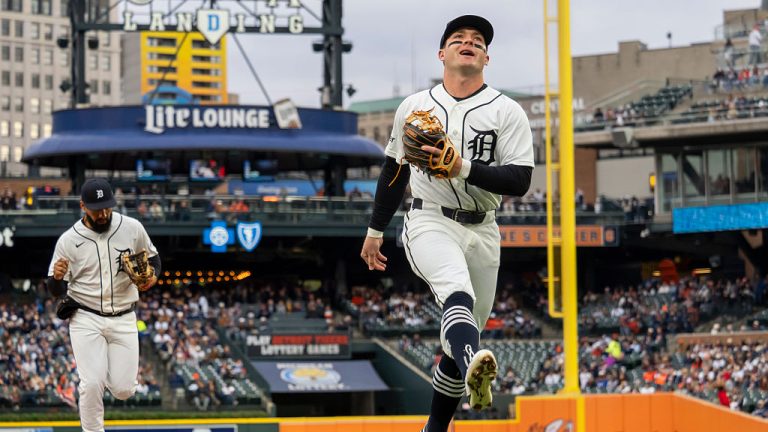
The Detroit Tigers entered the season as the favorites to finish atop the AL Central. Offseason additions Framber Valdez, Justin Verlander, and Kenley Jansen, along with the returning Gleyber Torres and Kyle Finnegan, led to optimism, but this team still had legitimate questions.
Would no offensive additions hurt the lineup? Was the bullpen deep enough to sustain a season? Were there too many lefty bats?
But, the question that might not have been enough of a focus was whether Detroit’s defense would be playoff-caliber.
Oftentimes, you are not able to build a roster of full players who contribute in a multitude of ways. You have to pick areas where you are willing to sacrifice, and the Tigers have elected to favor offense over defense. While that decision is not uncommon and often a preferred avenue for managers and teams, the Tigers are feeling the effects early this season.
How Bad Is Detroit’s Defense?
If you watch the games regularly, you probably have a grasp on how poorly the Tigers’ defense has been to start the season. Lazy, unfocused errors and errant throws have not only led to baserunners, but runs multiple times this season.
But, we can’t always see from a television a player’s first step, route, or range, which results in plays they should have made not always registering as a negative in our minds. A single up the middle out of the reach of a player might be chalked up as nothing more than a single, when in reality, a player’s reaction, or lack thereof, was the biggest factor in not recording an out.
Today, we are going to use two metrics that are familiar to some and foreign to others.
Outs Above Average (OAA) is defined as the cumulative effect of all individual plays a fielder has been credited or debited with, making it a range-based metric of fielding skill that accounts for the number of plays made and the difficulty of them. Essentially, how many plays did this fielder make compared to how many they should have made?
We will also use Defensive Runs Saved (DRS), which quantifies a player’s entire defensive performance by attempting to measure how many runs a defender saved. It takes into account errors, range, outfield arm and double-play ability.
While I will admit these metrics can feel wonky and clunky at times, especially early in the season, they do help clarify what our eyes cannot see from a broadcast.
Through May 1, the Tigers were tied for 25th in defensive runs saved with -3 and dead last in OAA with -15. Yes, those are both negative numbers. The overall numbers are not being tanked by one or two atrocious players, but instead as a sub-par effort mostly across the board.
| Player | DRS | OAA |
|---|---|---|
| Gleyber Torres | 5 | 2 |
| Colt Keith | 0 | 1 |
| Zach McKinstry | -2 | 1 |
| Riley Greene | 0 | 0 |
| Wenceel Perez | 0 | -1 |
| Matt Vierling | -4 | -1 |
| Javier Báez | -2 | -2 |
| Spencer Torkelson | -6 | -3 |
| Kerry Carpenter | -3 | -4 |
| Kevin McGonigle | 3 | -4 |
| Dillon Dingler | 1 | n/a |
The above table shows you how each player has performed by both metrics. The biggest surprise is actually at the top of the list with Torres, who has finished each of the past three seasons as a -4 or worse in both metrics. Unfortunately, this is more of a sample size issue than an indicator that Torres is suddenly a great defender, and regression is likely.
We all know that Carpenter is a poor defender, so his numbers should not be a surprise. I’m sure the surprise to many will actually be Javier Báez, a former Gold Glove winner, who is rated as a negative, but that trend has been going on for some time.
Báez’s defense at short has taken a step back over the past few seasons. In 2024, he had a -4 DRS and -1 OAA at short. In 2025, it was -1 DRS and 0 OAA. In fact, he’s graded out as a better defender in center, a position he was introduced to last season, which has bumped his overall defensive numbers.
This might feel wrong because you still see the athletic ability and the diving stop, perfect footwork, and dart to first to nail a runner. However, his range has declined, which leads to Báez reaching fewer balls and, in turn, making fewer plays.
While the addition of Kevin McGonigle has been fantastic for the team’s offense, his defense has been a work in progress. The majority of people thought McGonigle would not stay at short long-term and a move to second or third would be best in the future. However, for 2026, short was his best avenue for playing time.
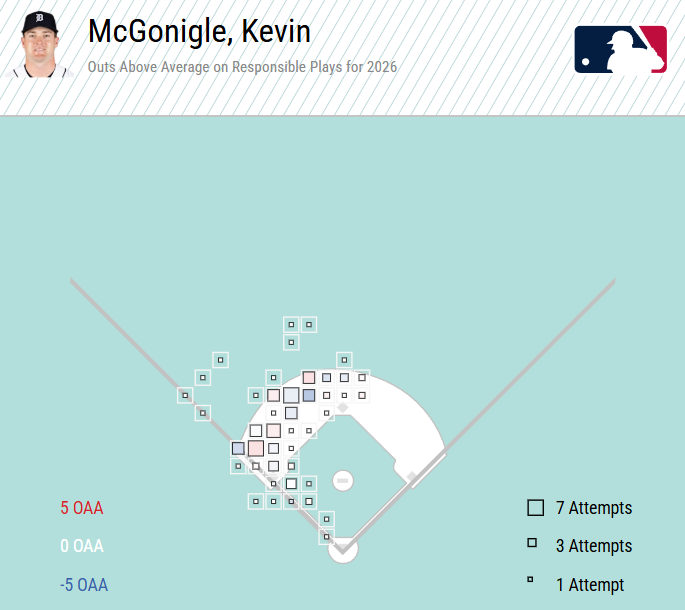
This graphic is a heat map of where McGonigle has been above average (red shade) and below average (blue shade) at both short and third. At short, moving towards his glove side has been a challenge, which is not completely unusual, as the footwork requires a motion of shifting your entire body for the throw to first, giving yourself another thing to think about when fielding the ball.
Although McGonigle has graded out poorly, he is athletic enough to improve with time on task. I doubt he reaches the point of being a plus defender at either short or third, but average is within reach. But, that doesn’t solve the issue for 2026.
Sure, Torres is grading out well right now, but do you trust that to hold over the course of a season? Neither do I. The Tigers’ infield does not have a player that I, or the metrics, think will be considered a plus defender. This is a problem when you have a pitcher like Framber Valdez who induces a lot of groundballs, exposing the issues in the infield.
The start of the season has been rough in the field. Luckily, the Tigers have several months to turn these numbers around, but can they?
Can the Tigers’ Defense Improve?
Anytime you work with a relatively small sample, it raises the question of whether this is sustainable. Are we seeing outliers or a continuation of a trend? Once you have the answer, the next question is, do we need to look for improvements or hold tight and let water find its level?
Unfortunately, I do not think the Tigers’ defense is simply a victim of a small sample telling a lie. Instead, it is a trend that will be difficult to break.
| Player | 2026 DRS / OAA | 2025 DRS / OAA |
|---|---|---|
| Gleyber Torres | 5 / 2 | -4 / -5 |
| Colt Keith | 0 / 1 | -1 / -3 |
| Zach McKinstry | -2 / 1 | -4 / 0 |
| Riley Greene | 0 / 0 | -2 / 1 |
| Wenceel Perez | 0 /-1 | -1 / 2 |
| Matt Vierling | -4 / -1 | -1 / 0 |
| Javier Báez | -2 / -2 | 2 / 6** |
| Spencer Torkelson | -6 / -3 | 0 / -2 |
| Kerry Carpenter | -3 / -4 | 0 / -3 |
| Kevin McGonigle | 3 / -4 | n/a |
| Dillon Dingler | 1 / n/a | 6 / n/a |
** 2025 Báez: +2 DRS in CF, +1 3B, -1 SS | +3 OAA in CF, +2 3B, +1 2B, 0 SS
Seeing how each player’s numbers compare to last season shows that there are no outliers outside of Torres and Báez. Yes, there will be movement in these numbers over the course of a season, but the picture all of this data paints is that the Tigers do not have a course correction coming simply due to an increasing sample. As they are constructed, this is a bad defensive team.
Could they improve from within the organization? Well, maybe, but the options are slim. Getting Parking Meadows back would be a welcome addition, especially with Báez now injured, and would greatly improve the outfield defense in center. Meadows had a -1 DRS / +4 OAA in 58 games last season. (Note: OAA is a better indicator than DRS for outfielders specifically.)
The next option to improve the defense would be top prospect Max Clark. We do not have the numbers to back this claim up, but I have watched a lot of Clark, and his jump, along with his tracking ability and speed, would make for a significant improvement either in center or right field. However, his bat might not quite be ready in the eyes of the organization.
The other fielders on the 40-man roster who could contribute are Trei Cruz (UTL, injured), Thayron Liranzo (C/1B) and Eduardo Valencia (C/1B). None of these players is considered a plus defender.
The Tigers also have some depth on their active roster with Hao-Yu Lee, but he’s a below-average defender himself. And before you ask, Max Anderson is also…a bad defender.
Detroit is in a position where an avenue to improve the defense will have to come from outside the organization. It is unlikely that any significant trade will happen for the next month or longer. Essentially, the Tigers will have to play the cards they’ve dealt themselves for the time being.
Final Thoughts
The front office should not be surprised by what we have seen in the field. The team they elected to construct had this red flag from day one, and we are now seeing the problem play out in real time. If they decide to make a move to improve their defense, it will have to come at the cost of someone they deem an everyday player. Not parting with that player, but giving up his playing time.
The only path to everyday improvement would be to promote or acquire an outfielder who can fill right field and move Carpenter to the DH role. If they want to improve the infield, Carpenter would have to stay in right with an infielder moving to DH, which feels less likely based on what we have seen in the past.
Bottom line, the Tigers’ defense is a problem, and the fix is not easy. Getting a bench player who has a good glove – like recent minor league signing Paul DeJong – would be a start, but not the type of move that could improve the team’s defense as a whole. At this point, cross your fingers and hope for the best.
Become a Member of Just Baseball
Subscribe and upgrade to go ad-free!
* Save 25% by subscribing annually.

Written by