
Daulton Varsho’s Free-Agent Payday is Taking a Major Hit
After looking like he was headed for a major payday, Varsho has taken a glaring step back in his walk year, complicating his free-agent outlook.
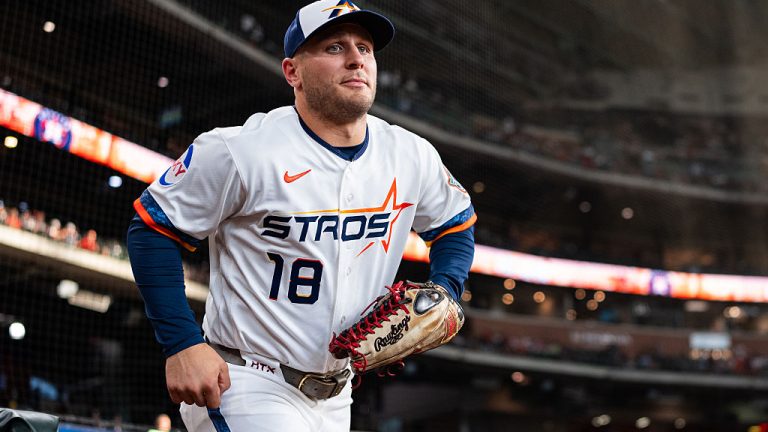
Amidst the chatter of Freddy Peralta tanking a potential nine-figure free-agency check, Daulton Varsho‘s similar walk-season struggles have remained relatively quiet.
Over the past four seasons, Varsho was a league-average hitter with defensive prowess so elite that he averaged 5.0 rWAR/162 games. For a position that puts defense at such a premium, Varsho’s free-agent value was set to make him a very wealthy man.
Then came his 2026 production. In Toronto, Varsho looked outmatched at the plate. Houston hoped to rewrite his season with a trade at the deadline, but Varsho has only looked weaker since entering the race for an AL West crown.
While you can hardly call Varsho’s 91st-percentile OAA a struggle, this does mark the second straight year of regression in Varsho’s defensive value. His sprint speed has also dropped to a league-average mark, which has impacted his ability to track down balls. While his incredible range often canceled out his weaker arm in years past, that is less likely to continue if Varsho keeps regressing as he enters his 30s.
Should teams in need of a center fielder be concerned about Varsho’s regression on both sides of the ball? Let’s dive into his rise and fall.
Stats were taken prior to play on September 3rd.
Varsho’s Rise to Stardom
Varsho’s MLB path and ascent is a strange one. He committed to UW-Milwaukee, a low-major school in the Horizon League. He excelled in his sophomore and junior seasons, becoming a second-round draft pick and later, a consensus top-100 prospect.
At the time, Varsho was only playing catcher, with the Diamondbacks transitioning him into a hybrid catcher/center fielder role in Double-A.
Despite the position being new to Varsho at the pro level, he took to it quickly. Varsho’s speed and range allowed him to become one of the league’s best defensive center fielders.
With defensive concerns now in the rearview, the key to Varsho staying on the field was his bat. In a shortened 2020 season, Varsho made the leap from Double-A to the majors and struggled. But once he had some time in Triple-A, he returned with an above-average bat as a superutility player in 2021.
Following a trade to Toronto, Varsho’s best offensive performance came in 2025. He played just 71 games but comfortably posted career highs in slugging percentage, OPS, and OPS+.
Varsho’s Previously Anticipated Payday
If Varsho kept pace with his 2025 season numbers over a full 162 in 2026, then he was in line for a major paycheck. The closest example is someone like Lorenzo Cain, who posted similar numbers with an OPS 20-30% better than league average alongside excellent defense.
The problem with Varsho is that he didn’t post consistent offensive numbers over a season-long sample size. Or at least, he hadn’t since 2022.
Cain earned a five-year deal from the Brewers worth $80 million. But this was eight years ago, and the price tag for free agents has risen since then. Varsho certainly had a chance at a similar contract if he produced elite results in 2026. It seems, however, that opportunity has largely passed him by.
Varsho’s Current Projection
Players with Varsho’s track record who have a bad contract year usually accept a “prove-it deal.” This can be a qualifying offer that he accepts or a short-term deal, often one season, meant to prove that his prior year was a fluke and regain value.
I think that a qualifying offer would likely be too high a value for Varsho this offseason. Instead, he will likely sign a one-year deal in the range of $10-15 million should his struggles continue.
If he retained the pace of an injury-riddled campaign in 2025, then Varsho could have been on his way to a deal worth 4-5 years and over $100 million. At this point, it’s nearly impossible to think that sort of offer could still come to fruition.
That being said, Varsho’s move from the Blue Jays to the Houston Astros has given him a better chance at the playoffs. While Toronto is still in the mix for the final Wild Card spot, Houston currently stands atop its division by two games over the Rangers. If Varsho can manage to become a postseason hero, either with his bat or his glove, his recognition could rise, and so could the potential that teams see in him this offseason.
There are many players over the years who have earned far greater contracts after becoming a postseason hero. Varsho will hope to continue this trend with the Astros.
Similar Free Agency Comparisons
Varsho has a rare combination of tools and season-over-season results that make him hard to find a direct comparison to. While there are plenty of glove-first center fielders who have seen success in recent MLB seasons, their bats tend to vary widely in production from season to season.
This is, in many ways, the same issue that Varsho possesses. The exception is that Varsho has consistently seen similar levels of offensive production, with one glaring bad season: 2026.
It’s also worth considering how defense-first center fielders have been valued over time. Despite having more value than many other outfielders on a WAR basis, Varsho is 30 years old with signs of defensive and speed regression. Teams are less likely to gamble on the value of defense and speed with long-term contracts, often dishing out the big money to players whose tools are less dependent on athleticism as they age.
As a result, many of the examples below are players who received short deals when they first appeared on the free-agent market.
While some of these outfielders may have seen their success or struggles at different times, here are some players who projected similarly to Daulton Varsho’s current expectations entering free agency.
Kevin Pillar (2019)
Kevin Pillar is synonymous with acrobatic defensive prowess after his iconic catch scaling the wall in Toronto. But much like Varsho, his final season before becoming a free agent showed some struggles. Despite that, Pillar received a stray down-ballot MVP vote, the only one of his career.
In his first six seasons in Toronto, Pillar produced an 87 OPS+ with a 3.4 rWAR/162. Pillar’s defense took a hit in his age-30 season, a similar reflection of Varsho’s situation. Following his 2019 campaign, Pillar was non-tendered and signed with Boston on a one-year deal worth $4.25 million.
It’s also worth considering the trepidation surrounding large free-agent deals during the 2020 offseason due to the lockout, as well as the COVID-19 pandemic’s uncertain impact at the time Pillar signed.
Jackie Bradley Jr. (2020)
Jackie Bradley Jr. may be remembered for hot and cold streaks, including a 29-game hit streak in 2016, but his end-of-season stats were remarkably consistent. He had his most successful run in 2016, his lone All-Star season. While his offense was down in the years that followed, it hovered right under league average, with an OPS+ of 89, 92, and 89 from 2017-2019.
The key difference between these two defensive wizards was their walk years. Bradley’s walk year was a 60-game season, but an excellent 55-game stretch gave Bradley’s value a boost. While his contract produced subpar results for the Milwaukee Brewers, they nonetheless signed Bradley to a two-year, $24 million deal.
Harrison Bader (2023)
Harrison Bader is another defense-first outfielder whose offensive ceiling was never quite as high as Varsho’s in 2025, but nonetheless had largely similar numbers. After a trade from the Bronx to Cincinnati went awry, Bader’s season OPS+ dropped to 69, meaning that whoever signed him was getting a defensive stalwart while taking a risk on the bat.
In this case, that was the Mets. They signed Bader to a one-year deal worth $10.5 million.
Become a Member of Just Baseball
Subscribe and upgrade to go ad-free!
* Save 25% by subscribing annually.

Written by
Gabe Shumway is a prospect writer for Just Baseball. He is a student at Northwestern University studying Journalism and Environmental Policy, and can be seen or…