
Michael Busch Is Back to His Old Self at the Plate
Busch started the year off slow, but the Cubs first baseman was one of the NL's best hitters in May.
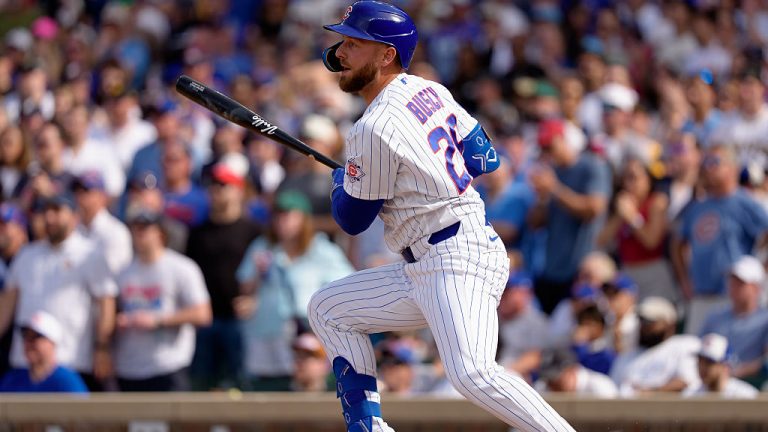
Watching the Los Angeles Dodgers’ farm system develop high-tier talent is a point of pride for the fans, but it always comes with a caveat: Sometimes, there just isn’t any room at the inn.
I vividly remember when the Dodgers selected Michael Busch out of the University of North Carolina with the 31st overall pick in the 2019 MLB Draft. He was widely evaluated as one of the best pure left-handed bats in his class.
By 2021 and 2022, he was cemented as the No. 3 prospect in the organization, drawing internal comparisons to Max Muncy due to his rare combination of bat speed, patient approach, and raw strength. He went on to secure the Pacific Coast League MVP Award in 2023 by posting a monstrous 1.049 OPS.
Yet, when you are trying to break through on a perennial championship contender, the luxury of patience doesn’t exist. Busch got sparse, sporadic looks at the big league level in Los Angeles, usually only when injuries struck. It created immense pressure to perform immediately, leading to a visible struggle in a limited sample.
With Busch blocked by superstars, the Dodgers executed a blockbuster trade on January 11, 2024, sending the young slugger and reliever Yency Almonte to the Chicago Cubs for teenage prospects Jackson Ferris and Zyhir Hope. While time will tell who won that trade in the long haul, the Cubs immediately handed Busch the everyday first base job, and he hasn’t looked back.
The 2025 Breakout and Puzzling 2026 Regression
After a solid foundational year in 2024 (.775 OPS, 21 HR), Busch transformed into a certified star for Chicago in 2025. He played in 155 games, crushing 34 home runs, driving in 90 runs, and turning in an excellent .866 OPS accompanied by a 4.5 bWAR.
He was punishing baseballs to the tune of a 92.2 mph average exit velocity (90th percentile) and finding the launch angle sweet spot a spectacular 41.1% of the time (96th percentile).
That is why his ice-cold start to the 2026 campaign was so incredibly puzzling. By the end of April, despite the Cubs getting off to a sharp 19-12 start, Busch was lost, languishing with a painful .193 batting average and a .576 OPS.
A deep dive into his metrics reveals that his uncharacteristic slump wasn’t a matter of diminishing bat speed or worsening plate discipline, but purely a mechanical issue with his launch angle.
To start 2026, his sweet-spot rate plummeted to 31.8% (32nd percentile), dragging his average exit velocity down to 88.6 mph. He went from crushing breaking pitches in 2025 (.325 average, .610 slugging) to hitting a meager .192 against them this year.
His line drive rate dropped from 23.5% to 18.2%, and he began topping the baseball on 27% of his batted balls compared to 23% last year.
Furthermore, stark home-and-away splits emerged. All year, Busch has been a titan at Wrigley Field (.291 AVG, .894 OPS) but a ghost on the road (.198 AVG, .634 OPS).
The May Awakening
Despite those early statistical craters, the tide has turned dramatically over the last few weeks. The underlying data on Baseball Savant proves that Busch’s elite core traits are intact. He boasts an 82nd percentile Batting Run Value and an 88th percentile Fielding Run Value, operating as a solid defender at first base with a 93rd percentile Outs Above Replacement (OAA).
Most impressively, his eye at the plate has reached an elite tier. Busch is walking at a career-high 16.1% clip, which ranks in the 96th percentile of all major league hitters, all while keeping his chase rate in the 79th percentile.
That persistent discipline laid the groundwork for a quiet awakening throughout May. In 130 plate appearances this past month, Busch hit .300 with a .956 OPS. He blasted four home runs, racked up 24 RBI, and walked 25 times against 27 strikeouts. He has been systematically squaring up baseballs again (73rd percentile), signaling that he is rapidly unlocking the optimal launch angle that made him so deadly a year ago.

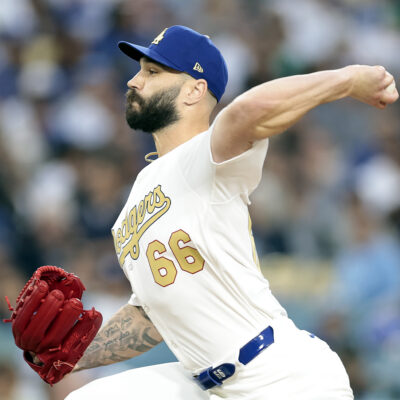
Sparking the Streaky Cubs
The Cubs have defined volatility to start 2026. In an unprecedented feat of inconsistency, Chicago joined the 2017 Dodgers as the only teams in MLB history to log two separate 10-game winning streaks and a 10-game losing streak in a single season, and the Cubs managed to do all of that within their first 55 games.
While the pitching staff has braved a relentless barrage of injuries, the offense has functioned like a light switch. The scariest part for the rest of the National League is that Chicago managed to string together two separate double-digit win streaks while their star first baseman was in a catastrophic funk.
Now that Busch is getting back to his old self, he provides the middle-of-the-order anchor this streaky lineup desperately needs. To maximize this hot streak, Busch could benefit from being even more aggressive early in counts, where he has been absolutely lethal this year.
On 0-0 counts, he is hitting a blistering .412 with a 1.152 OPS. When he gets ahead 1-0 or 2-1, he is a combined 10-for-26 (.385) and consistently driving the ball for extra bases.
As Michael Busch continues to trust his swing decisions and lift the ball with authority, he will serve as the indispensable spark that stabilizes the Cubs and propels them back into true postseason contention.
Become a Member of Just Baseball
Subscribe and upgrade to go ad-free!
* Save 25% by subscribing annually.

Written by