
Chase Meidroth Has a Target on His Back in 2026
Chase Meidroth faces a complicated situation in Chicago heading into his second season in MLB. How should the White Sox approach his future?
 | |
| | 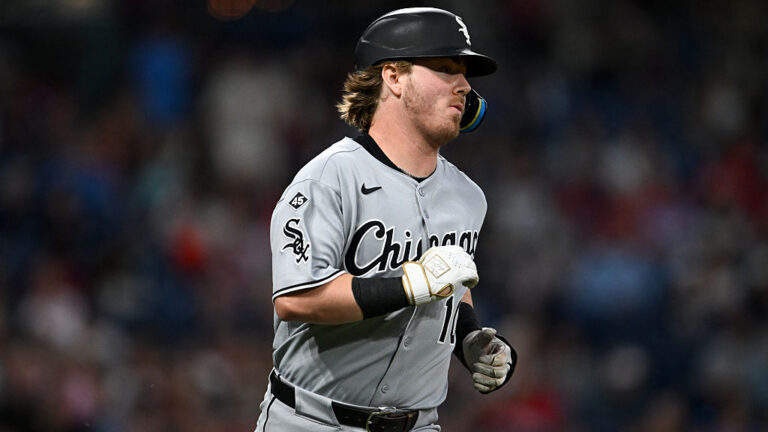
Acquired as the de facto third player in the Garrett Crochet-to-Boston blockbuster trade last winter, infielder Chase Meidroth had a solid rookie campaign.
In 122 games, the middle infielder slashed .253/.329/.320 with an 87 wRC+ and 1.3 fWAR. He was something of a singles guru, mustering just 20 extra-base hits. He also provided plus defense up the middle, netting +3 outs above average at shortstop.
This was the book on Meidroth as a prospect in Boston’s system. He’s a hit-over-power bat with plus command of the strike zone and defensive versatility. In a lot of systems, he’s the perfect complementary piece.
However, the Chicago White Sox are quickly becoming a less-than-perfect fit; not because of dysfunction — quite the contrary, actually.
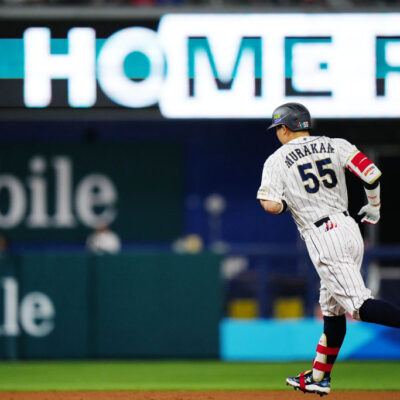
The White Sox are starting to build a strong contingent of position players, some already impacting the major-league level. The latest addition is Japanese phenom Munetaka Murakami, who joins Colson Montgomery and Miguel Vargas on the infield.
As a result, the 24-year-old Meidroth enters 2026 with a target on his back. What must he do to evade the arrows behind him?
Swing More
Among 145 qualified hitters, Meidroth ranked 143rd in swing rate last season. The only two beneath him were Juan Soto and Taylor Ward — both of which hit over 30 home runs. He also ranked 145th in swing rate on strikes.
Pitchers aren’t spamming first-pitch strikes against him, as he ranked 90th in first-pitch strike rate. But he’s giving away a lot of strikes, ranking first in called-strike rate. Even with a 4.3% whiff rate, that still positions him in the top 12 for called strike plus whiff rate.
He uses his bat-to-ball skills as a weakness in a lot of respects. While there’s no guarantee that more swings will improve his batted-ball luck, but the data suggests he gets worse the more strikes he sees.
When the count goes to 0-1, Meidroth finished plate appearances with a .234/.271/.282 slash line, a 55 wRC+, and .247 wOBA. When counts go to 1-1, 2-1, or 3-1, he still regresses to an 80 wRC+ from his baseline of 87.
He doesn’t whiff at all, but sometimes hitters can conflate having command of the zone for a serious swing issue. As someone with limited power, he should be increasing opportunities for batted-ball success. He doesn’t have to swing as frequently as his former fellow Red Sox farmhand Ceddanne Rafaela, or crosstown rival Pete Crow-Armstrong, but perhaps he can he get to Luis Arraez’s level.
In 2025, Arraez had a swing rate of 48.8%, 10.6% higher than Meidroth. Arraez is the extreme example of relying on batted-ball luck, but Meidroth is in that tier of avoiding whiffs and squaring the ball up.

Become an Elite On-Base Guy
If Meidroth doesn’t want to swing more, the framework is there for him to be an elite on-base machine. Even with a .253 average last year, he still posted a .329 on-base percentage. His 8.9% walk rate ranked in the 58th percentile, but he ranked in the 96th percentile for whiff rate and 84th percentile chase rate.
He even had the third most called strikes on pitches out of the zone last year, trailing only Gleyber Torres and Ward. As a result, he should benefit greatly from the Automated Balls and Strikes system coming to MLB.
Umpire error isn’t to blame for Meidroth’s numbers, but eliminating some of it should help him. But otherwise staying the course in his gameplan could create more success. After all, some hitters he compares to from the standpoint of a lack of power and batted-ball profile are Arraez and Nico Hoerner, who have track records as above-average bats.
Add Some Thump to His Game
Adding power is easier said than done, as this basically asks Meidroth to be something he’s never been as a professional. However, the name of the game is home run ability.
He doesn’t need to hit 20 homers to be viable, but can he establish a benchmark of his professional career high of nine? Ultimately, it’s hard to hit singles and be considered even an average big-league hitter. In 2025, only six qualified hitters had an ISO under .100; five of those six had a sub-100 wRC+.
Only Hoerner was considered above average, and even he narrowly eclipsed that plateau at a 109 wRC+. However, Hoerner is an elite baserunner and defender, so he maintains viability so long as he doesn’t bottom out as a hitter.
Meidroth was a plus defender but also was a 28th-percentile baserunner. Can he be pre-injury Luis Rengifo with better defense? At his peak, Rengifo posted ISOs of .166 and .180, averaging 39 extra-base hits and 1.7 fWAR those two seasons.
Other Obstacles Meidroth Faces
On the White Sox’s MLB roster is Lenyn Sosa, who is out of options. In a similar volume, he posted 1.4 fWAR and just a .293 on-base percentage. However, thanks to his 22 home runs, he bested Meidroth with a 100 wRC+.
Sosa offers similar infield versatility as well, with games spent at second, first, and third base last season. He was not a plus defensively, but -3 OAA at second base isn’t so bad if he’s a significantly better hitter. Especially considering Meidroth posted zero OAA at the position and Montgomery looks the part of a long-term organizational fixture at shortstop.
There’s always third base. Meidroth didn’t factor in at that position in 2025, but he played there for 35 games with the Worcester Red Sox in 2024. Unfortunately, Vargas finally flashed the potential that made him a top prospect with the Los Angeles Dodgers. In the second half, he slashed .267/.354/.436 with 16 extra-base hits in 189 second-half plate appearances.
Defensively, he took more to first base than third, but Murakami complicates playing time at the position. They could try and sell high on Vargas’ second half, but that seems like an unnecessary step to create playing time for a low-impact bat.
Not to mention, the White Sox have the No. 1 pick in the draft, with top prospect being UCLA shortstop Roch Cholowsky. While no guarantee he translates to pro ball right away, early belief is he could fly through the ranks rather quickly. A long-term middle infield of Montgomery and Cholowsky oozes potential.
The second-year Meidroth can be a good ballplayer but is very situation dependent. Unfortunately, it doesn’t appear the White Sox are a situation in need of him long term.
Written by