
Bryce Eldridge Has More Than Found His Footing for the Giants
San Francisco Giants' rookie Bryce Eldridge shares his early big league experience and what has gotten him comfortable at the highest level.
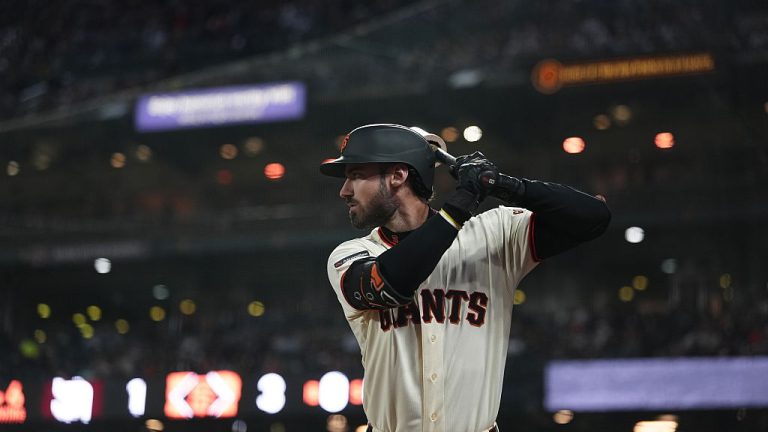
When the Giants drafted Bryce Eldridge 16th overall in the 2023 MLB Draft, they knew they selected a high-risk, high-reward prospect with an offensive ceiling as high as any player in the class.
The Giants threw him straight into game action after the ink dried, where he launched five homers in 16 Arizona Complex League games before holding his own in 15 Low-A games as well.
Eldridge carried that momentum into his first full pro season, where he launched 22 homers in 99 games with a 147 wRC+ between Low-A and High-A before seeing action at Double-A for nine games and Triple-A for the final eight games of the year, with that being the only Minor League level still going.
He was assigned to Double-A to start the 2025 season, where he mashed to a 147 wRC+ through 34 games, earning a promotion to Triple-A, where he remained decently productive but saw his strikeout rate creep up north of 30% over his final 66 games.
Even with the uptick in swing and miss, the Giants called the then 20-year-old up to the big leagues in September in an effort to spark their offense in a final Wild Card push.
Eldridge struggled in the small sample, going just 3-for-28 with a 35% strikeout rate, which hardly was cause for concern given how difficult a spot he was thrust into. That said, there was still some reasonable hit tool question from the upper minors sample as well, where he struck out 29% of the time that season.
The 21-year-old began this season at the Triple-A level, where he continued to mash–even for Pacific Coast League standards–posting a 155 wRC+ through 30 games, albeit with a 30% strikeout rate.
With the big league club sputtering out of the gate, they promoted Eldridge back up to San Francisco with an undefined role.
Eldridge Finding His Footing the More He Plays
Through his first two weeks with the Giants, Eldridge saw just 31 plate appearances. He finally saw action in three consecutive games starting on May 29th, and since then, he has been one of the best hitters in baseball, hitting .291/.385/.504.
“It’s easier to get comfortable when you’re in there every day,” Eldridge said. “You get at-bats, you get into a rhythm. Being able to breathe in the box, slow things down — now that I’ve had a little more experience under my belt, things have definitely calmed down and slowed down a little bit.”
The consistent playing time surely helps, especially for a young player trying to find his footing at the highest level, but it still does not fully explain the drastic shift in contact rate against the best pitching Eldridge has ever seen.
In his roughly 1,200 minor league at-bats, Eldridge ran a contact rate right around 68% and a strikeout rate of 27%. Though it’s a small sample, in 139 MLB plate appearances this year, Eldridge has run a contact rate of 81% (88% in zone), with a 20% strikeout rate.
In a nearly identical sample size (137 PA) at Triple-A before his MLB promotion this season, Eldridge was right in line with his career averages in the Minor Leagues, sporting a 68% contact rate and 30% strikeout rate.
Such a dramatic and immediate shift is rare to see, even when working with a smaller sample, something the Giants’ 21-year-old credits to an improved plan at the plate.
“The approach has been the biggest thing — just learning how to hit before I get to two strikes, and coming up with a plan with our hitting coach Hunter Mense, pitcher by pitcher,” Eldridge said.
We are going to shrink a small sample even smaller now by sorting by two strikes, but the early returns have been positive, going 17-for-68 (.250) with an OPS of .803. His chase rate when down to his last strike is down five percent from his career averages in the Minor Leagues, and he has already launched three homers.
It’s too early to discern anything of major note there, though the early numbers at least corroborate his intent in the box.
“The thing that’s helped me get comfortable is being comfortable taking a strike three — and that’s allowed me to not chase as much with two strikes,” Eldridge said. “Before, I was just trying to cover everything. I didn’t want to give him a strike. And now, if it’s not what I’m looking for and he’s trying to pick corners, I’m gonna make him do that three times before I hit something weak.”
While the improvements were more mental than mechanical, Eldridge did cite some improved feels in his cage work, translating as well, particularly with keeping his weight back.
As young hitters see better stuff, it becomes increasingly difficult to hold the back side, as stuff will get on guys quicker, and secondaries can become more challenging to identify and get an A swing off against.
“I’m trying to think of pulling my back hip and kinda creating that tension,” he said. “I think that gives me [more] time to see the pitch and react to different pitches because you’re holding onto it, not jumping out of it so quick where you can’t react and adjust to anything.”
Even through his productive Minor League seasons, Eldridge struggled to make consistent contact against secondaries, owning a contact rate just right around 58% and a chase rate of 30% across all levels.
Through his first 144 plate appearances at the Major League level this year, Eldridge’s contact rate is up to 70% against secondaries, with a chase rate at 19%.
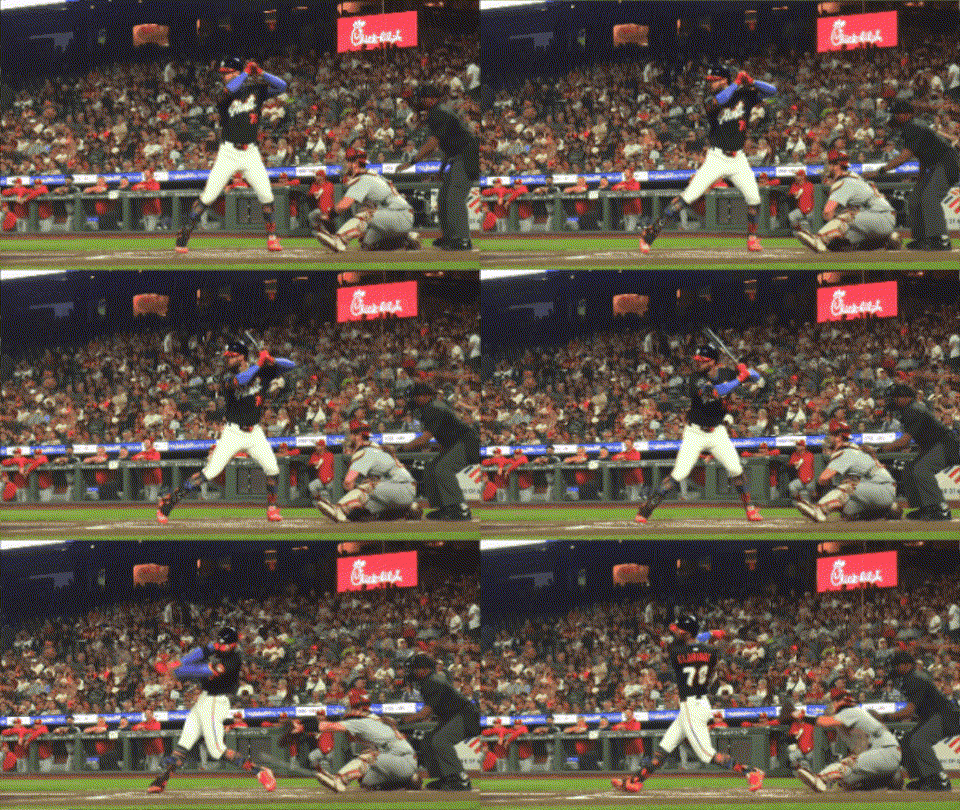
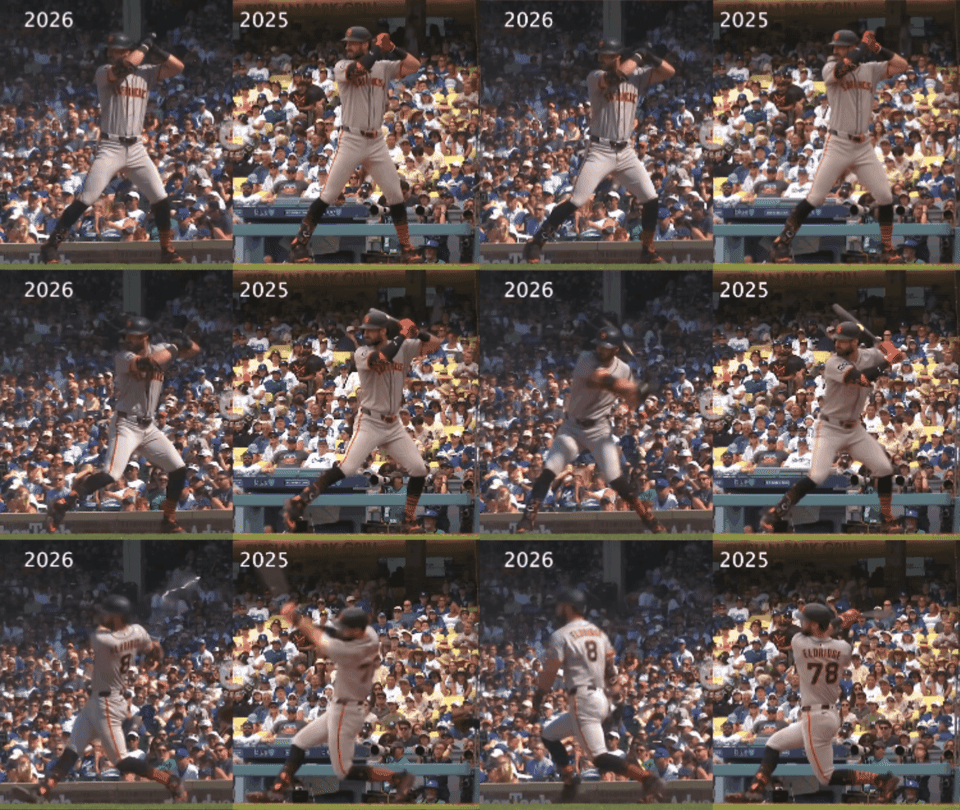
Seeing those numbers hold over a larger sample will, of course, help validate them further, but the video backs up what Eldridge is feeling in the box. In watching through his open side video, he is getting pulled onto his front side far less prematurely and less frequently on breaking balls.
Breaking balls with more depth really exposed it, like the swing on the video below, which was a 78 MPH curve from Andre Pallante. You can see his hips slide forward before he fires the barrel, which of course is going to result in a heavy front side.
In an effort to compare apples to apples, the video below featured a pair of upper-80s sliders in the same inner third location. While not as dramatically evident as the swing above, the finish from the 2025 swing is revealing of his challenges to hold tension in his backside.
“I do a one-leg hinge drill where I just hold here, stand on one leg, and just kinda rest into this hip and ride it out and try to stay 50/50 when I land,” Eldridge said. “It’s easy to tell when I’m off it — I’ll just be jumping at the ball, or I’ll be cutting off. That’s been a huge part of my routine.”
As good as Eldridge has been, he understands that things likely won’t always go this smoothly in the show. Given the ebbs and flows that come with the territory, his goal the rest of the way is clear.
“There’s gonna be struggles, there’s gonna be very high moments, there’s gonna be very low moments — the biggest thing for me is just staying level this year. And I think that’ll help me be the most consistent on the field.”
There are few hitters in the game with more upside than Eldridge, and in a disappointing Giants season, he has provided a bright spot for the franchise. In his mind, that’s just the beginning.
“I’m just going to keep working hard to be the face of this franchise,” Eldridge said after his walk-off homer on June 10th. “That’s something that motivates me every day.”
Become a Member of Just Baseball
Subscribe and upgrade to go ad-free!
* Save 25% by subscribing annually.

Written by
Aram Leighton is the Co-Founder and Executive Editor for Just Baseball. A Syracuse University grad, Aram is one of the hosts of the Just Baseball Show…