
Brett Bateman Is Proving His Worth on the Blue Jays
Initially considered an afterthought, Brett Bateman is quickly turning heads, and spearheading a postseason push for the Blue Jays.
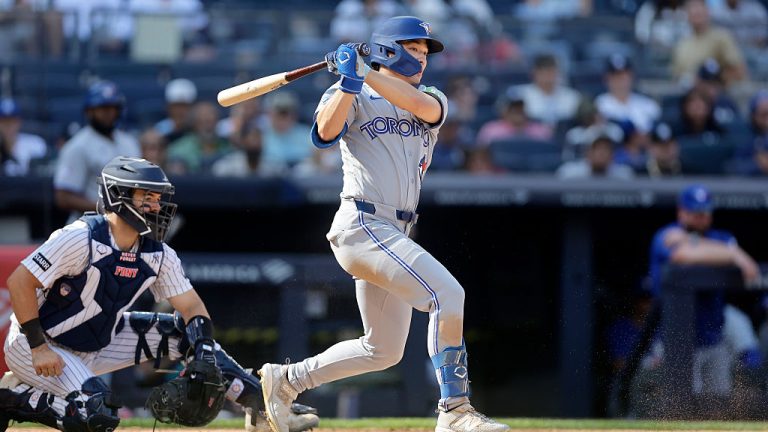
Consider where the Toronto Blue Jays were on the day of the trade deadline. After dropping a game to the Houston Astros that night they found themselves 53-60, 4.5 GB of the third wild-card spot with five teams to leapfrog. They had also just completed the sell-off of multiple assets from the MLB roster, including the likes of Kevin Gausman, Daulton Varsho, and Jeff Hoffman.
Having spent the entirety of the 2026 season as basement dwellers in nearly every offensive metric that matters, the Blue Jays looked like a dead team walking. Even in an unusually weak year for the American League, the pathway to October seemed to be blocked off.
The final couple months of the year seemed to be destined for the Blue Jays to get some of their Triple-A prospects some runway just to see what they had in an abbreviated sample. To that end, they called up one half of the Gausman return, outfielder Brett Bateman on August 7 to make his MLB debut in Philly against none other than Zack Wheeler.
The very first pitch Bateman saw in his big league career was laced off the left field wall on the fly for an opposite field 97.4 MPH double against one of the best starters of this decade. Since then, all he has done is hit and provide a spark. Spearheading a hot stretch that now has the Blue Jays right in the thick of the Wild Card race.
There are legitimate questions as to how this profile will hold up moving forward as pitchers adjust to Bateman. It’s a profile that hasn’t historically held up, but there’s some intangibles that could allow for him to continue to be useful, even if he surely would sustain his current pace.
Let’s dive in.
All stats updated prior to games on Saturday, September 5
Brett Bateman Offensive Profile
Let’s start here. Brett Bateman has been the third most valuable centerfielder in baseball in terms of FanGraphs WAR since he made his MLB debut on August 7.
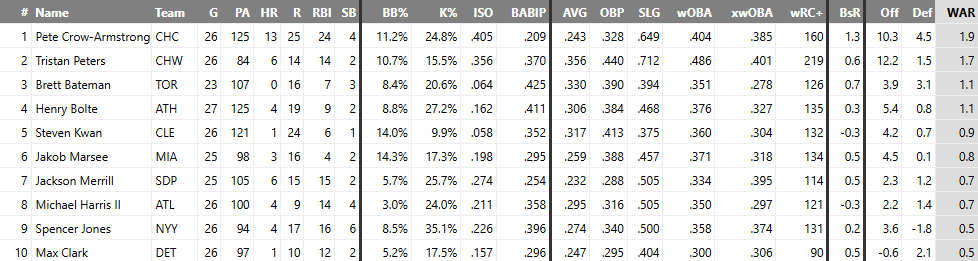
What stands out here immediately is the process behind his hot start. He is the only player inside the top 10 that hasn’t homered during this stretch, while also running the highest BABIP. His .278 xwOBA is also the worst of the group.
These are all indicators that his current production isn’t sustainable, but we already knew this. Nobody expects Bateman to continue slashing .330/.390/.394 for a prolonged period of time. The real question is, what’s a realistic expectation moving forward?
The profile for Bateman is pretty straightforward. This is a slash-and-dash hitter. He has yet to barrel a single baseball in his MLB career. His 83.6 MPH average EV, 102.3 MPH max, and .287 xSLG are all in the 1st percentile. As is his 0.1° launch angle. There is absolutely zero power to speak of in this profile.
Consider this: Bateman has always been someone who pounds the ball into the ground. His 64.7% groundball rate in the big leagues would be the highest in all of baseball if he was a qualified hitter. This isn’t anything new for Bateman, who has historically ran <50% groundball rates throughout his time in the minor leagues.
What’s working to his advantage though is the fact most of his groundballs are going to the left side of the infield, which paired with his 28.8 MPH sprint speed (87th percentile) sets him up to be able to beat out infield hits at a higher rate than average. He’s always going to run high end BABIP numbers because of the simple fact he’s pairing elite speed with grounders to the opposite end of the infield.
From a plate skills standpoint, Bateman’s career OBP during his four seasons in the minors averages out to a pristine .401. His career walk across five levels is 16.7%. Clearly, he has the ability to discern balls from strikes at a high clip. Thus far in a small sample at the MLB level the walk rate sits at 8.4% while his strikeout rate has ballooned to 20.6%.
The true test for Bateman will come when pitchers start pounding the strikezone against him. His career high for home runs in a single season is three. This is not someone who’s any sort of threat to hit the ball over the fence. Once pitchers make the adjustment and start pounding the zone, we’ll find out if Bateman’s elite plate skills in the minors were due to an elite eye, or passiveness due to the fact minor league pitchers simply don’t have the same control or command.
The thing about Bateman is, he’s unique. He does things most guys don’t do. He’s an old school hitter in a new school era. He’s not chasing bat speed or launch angle. He’s simply putting bat to ball and seeing what happens. He may be one of those rare breeds who outperform their under the hood expected results simply because they can adapt to any situation. Case in point right here.
Defensive profile
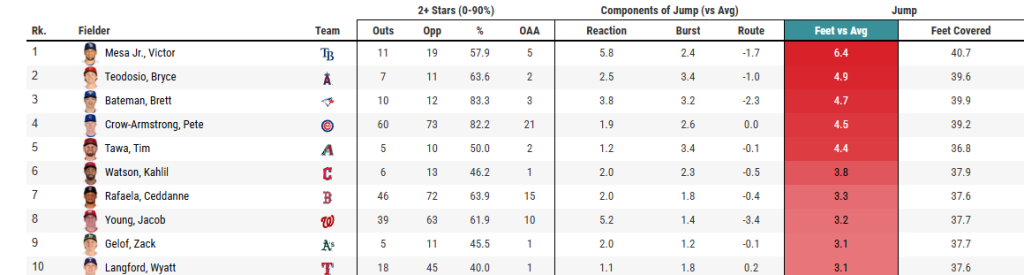
This is the part of Bateman’s game that truly shines. Small sample size caveats apply but Bateman’s been one of the top three best centerfielders in the game from a defensive standpoint.
Since debuting, Bateman has been elite at reading balls off the bat. He’s covering +4.7 feet better than average. Both his jumps and the amount of ground he covers are top three in the sport. What this does is it makes makes really difficult plays looks routine for Bateman as he’s making five-star catchers on the run rather having to make an all out dive simply because he has an elite first step and closing speed.
A prime example would be this play he made on Yandy Diaz, as the great Chris Black breaks down. Bateman is reading the fact this ball is going to have a crazy amount of slice and gets an absolutely ridiculous jump off the ball, essentially 10 feet better than MLB average. This may not look like a 5 star catch to the naked eye, but that’s a simply a testament to the jump he gets off the bat. Truly special.
This is a ball that maybe two or three other center fielders make, and that’s not hyperbole. We’re talking the PCAs, Ceddanne Rafaelas and Jacob Youngs of the world. Bateman is covering so much real estate in center, that he’s allowing the corner outfielders to simply worry about a very small pocket of real estate.
It doesn’t end there though. Not only is Bateman elite from a range standpoint in center, he’s also got an extremely strong arm that ranks in the top 20 amongst outfielders from an average standpoint.
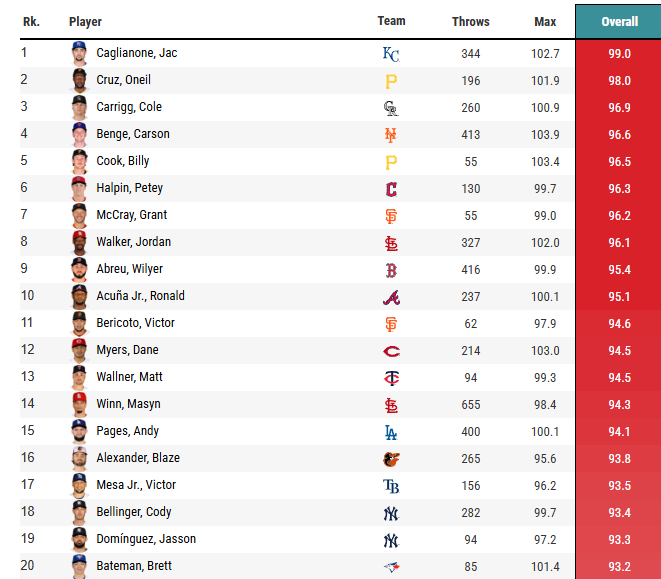
When you sort by each players max, Bateman jumps to seventh on this list. Illustrating the amount of juice he has in that left arm when he needs it. For as good as Varsho was roaming center field for the Blue Jays (and he was elite), he never possessed an arm close to what Bateman features.
Since debuting, Bateman’s 4 FRV puts him fourth amongst all outfielders with a minimum of 200 innings of action under their belt since August 7. Simply put, every possible defensive metric you care about places Bateman as a top-five defensive outfielder at worst.
Future outlook
Bateman’s truly elite defensive profile gives him a safe floor as a fourth outfielder at worst. His ability to play an elite centerfield will keep him in the big leagues for a long time. The offensive profile will be the ultimate decider in what his ceiling ends up being.
Can you effectively have a starting outfielder who may go an entire season without hitting a single ball over the fence? Chandler Simpson says yes, and while Bateman doesn’t possess the speed Simpson does, his overall skillset in the outfield supersedes Simpson, as do his plate skills.
It’ll be fascinating how the Blue Jays attack their outfield this winter. Will they go for a center fielder? Will they hand the keys to Bateman? The answer may be somewhere in the middle. Where they acquire a lefty mashing platoon partner and leave Bateman on the strong-side of said platoon.
Either way, he’s a big leaguer. And a valuable one at that.
Become a Member of Just Baseball
Subscribe and upgrade to go ad-free!
* Save 25% by subscribing annually.

Written by
Damon's ultimate passion lies in Baseball. An aspiring sports journalist, Damon has been a die hard Blue Jays fan since essentially birth but prides himself from…