
MLB Draft Notebook: Arkansas vs South Carolina
Arms were the story of this series, as both clubs enjoyed some standout performances from their starters.
 | |
| | 
Boy, what a whirlwind weekend it was down in Columbia, SC.
When I arrived at Founders Park on Friday, I entered an emotional void. A place that was usually rowdy and electric was dull, lifeless, and depressed. It did not get better as Arkansas laid the hammer down on South Carolina, scoring 22 runs in seven innings. That would be the final straw for the Paul Mainieri era in Columbia.
As much as Mainieri is a legend, it was time for a change. Monte Lee was promoted Saturday morning to lead his third South Carolina ball club, and the vibes at Founders made a complete 180 the rest of the weekend.
After suffering that brutal defeat on Friday, the Gamecocks would outscore Arkansas 11-7 and won their first SEC game of the season on Sunday, taking it 9-4. It was a truly welcome sight, especially since I love scouting in that environment.
Arms were the primary story of the weekend, as both clubs had starters that did very well for themselves on the draft radar. Hunter Dietz, Amp Phillips, and Brandon Stone all looked fantastic for their respective clubs, and there were a few bats that looked the part overall. Below are my thoughts on seven performers from this weekend’s action.
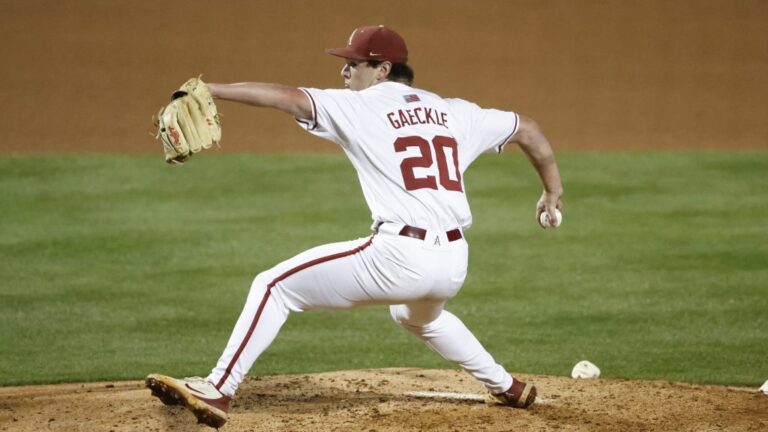
RHP Gabe Gaeckle, Arkansas
Final Line: 5 IP, 5 H, 4 R (2 ER), 2 BB, 7 K (62 Strikes/89 Pitches)
I’ve seen Gaeckle a few times over the years. When I first saw him at PG National in 2022, he impressed me a lot, but I was admittedly concerned about the size. It made for a tough evaluation then, and the same can be said for today.
Listed at six-foot-flat, 190 pounds, Gaeckle’s body is relatively maxed out, and there are questions about how much better he can get from here. That said, it’s loud stuff, and it has been for multiple seasons. He struggled a year ago as a starter, though things look much improved this spring, as his strike-throwing has improved, and he’s made more changes to his arsenal usage.
We’ll start with the fastball, which is down a tick in velocity from a year ago. It sat in the 92-95 MPH range consistently, brushing 96 MPH at his peak. He’s not afraid to bully hitters off the plate with running action inside, and he can create obscene angles when he elevates the baseball.
However, it’s not a bat-misser at this moment despite underlying metrics that would point to it being one. He is capable of getting solid carry on the pitch at times, though it can flatten out in the middle of the zone.
The breaking balls are the best offerings in Gaeckle’s repertoire, and for good reason. His mid-80s slider was his signature out pitch, a two-plane breaker with serious teeth that he can land for strikes. He can manipulate the shape of the pitch, turning it into a nasty sweeper that righties can struggle to catch up with.
The low-80s curveball has seen more action in 2026, and it’s just as nasty as the slider. There’s big depth to it, and, much like the slider, he can land it for strikes consistently.
The biggest surprise to me was the deployment of his upper-80s change-up, which he’s gained more confidence in throwing. He does lower his arm slot slightly to throw the offering, but he gets significant fade and tumble to the offering, plus he displayed an ability to throw it right-on-right with little issue.
Gaeckle’s stuff did wane later in the outing, but to be fair, he did sit for extremely lengthy periods due to Arkansas’ offense going nuclear on Gamecock pitching.
While his size will be a deterrent to some scouts, his dynamic stuff does give him a pathway to being a starter. He should be given every opportunity to do so at the next level, though if it doesn’t pan out, he can be a fun leverage reliever at the back end of games.
LHP Hunter Dietz, Arkansas
Final Line: 6.2 IP, 5 H, 2 ER, 2 BB, 12 K (67 Strikes/103 Pitches)
The younger brother of current Padres farmhand Tyler Dietz, Hunter was highly regarded as a prep at Calvary Christian, where he shared a rotation with Liam Peterson and Landen Maroudis.
Despite injuries taking their toll on his career, Dietz has broken out in a big way this spring, and Saturday’s outing may have been his strongest to date, matching a career-high in strikeouts with twelve across 6.2 stellar innings.
He’s noticeably stronger than he was while at Calvary Christian, adding roughly 40 pounds of muscle to his frame since enrolling in Fayetteville. Dietz is an outlier arm in regard to his release, which sits just below seven feet off the ground. As a result, he creates an incredibly steep angle to the plate, and his arsenal plays off of it very well.
We’ll start with the breaking balls in his arsenal, specifically the slider. Dietz threw three variations of his slider in this outing, accruing 22 (!) whiffs alone with the trio. The shape varied between a cutter, a bullet slider, and a death ball slider, sitting in the mid-80s consistently with all three variants. While none of the shapes stand out on paper, the angle and sharp bite can be devastating on hitters.
He kept the fastball in the back pocket for most of the outing, which is a change from previous starts. His command of the offering can waver at times, especially when trying to command it on the top rail, but the pitch sat in the mid-90s throughout with good shape. He used it more to set up his secondaries, utilizing his misses to his advantage.
Dietz’s low-80s curveball has hammer qualities, though he struggled to land it consistently against South Carolina. A few pitches popped out of his hand, while others were spiked in the dirt.
At its best, it’s a true 12-6 curveball with up to fifteen inches of depth, which gives him considerable vertical separation off the fastball. Dietz did throw one change-up in the outing, getting a whiff in the second at-bat of the game.
Like Gaeckle, Dietz might wind up being a tough evaluation, especially considering the lack of a track record. However, the breaking balls are legitimate weapons, and some mechanical cleanup can help him find more fastball command. He might end up in a leverage spot in the bullpen, but he should be given every chance to start, and he’s in contention for LHP1 in this college class.
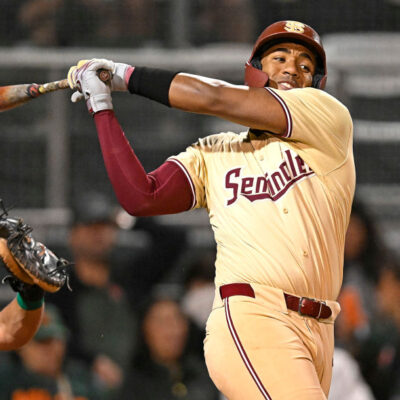
2B/SS Cam Kozeal, Arkansas
Final Line: 4-12, 1 HR, 4 RBI, 1 HBP, 2 BB, 1 K
Kozeal has been on my radar for quite some time, having first seen him as a prep on the USA backfields. He took current Pirates farmhand Zander Mueth deep back there, and that impact has continued to grow as he’s gained experience in the SEC.
Kozeal is on the smaller side of the spectrum and lacks the kind of projection that some of his peers do, but he does make up for it in the power department. He showed off pop to both sides of the park, including a home run to right field off a curveball during Friday’s three-hit performance. He’ll lace line drives, too, including one he scorched at 107 MPH.
His swing path has loft and a flatter entry into the zone, which does help with high velocity. It’s tough to say he’ll add much more power, but he’s capable of average power when all is said and done.
The hit tool does lag behind the power, as Kozeal’s swing tends to get long and his hands get outside of his body at times. He took aggressive hacks all weekend, though he was foiled by velocity at the letters.
One change I noticed was that he’s toned down the aggression that he was known for a year ago, building up a bigger affinity for walks. It’s a welcome sight, as he now boasts an even strikeout-to-walk ratio on the season.
Defensively, Kozeal has manned shortstop all season for the Razorbacks, though I think he’s better suited for second base as a professional. While calm and collected, he doesn’t attack the baseball, and his movements aren’t as twitchy as some of his teammates.
He does have the arm for the left side of the infield, but to alleviate concerns about how his tools work on that side of the bag, second base would be a much better spot for him.
I’m not sure if I would place Kozeal in Day 1 territory just yet, but he’d be a nice get for someone in Rounds 4-6.
C Ryder Helfrick, Arkansas
Final Line: 2-10, 1 HR, 3 RBI, 5 BB, 2 K
Helfrick is another Arkansas bat that I can trace live looks back to high school for. Since then, the transformation he has made is astounding.
It starts with the swing change. When he was a prep in California, Helfrick had more of a squatted stance, sinking into his back leg in particular. Now, Helfrick has an upright stance with a closed front leg, which helps him generate considerable leverage in his swing.
The power is the big selling point here. Utilizing a pull-heavy approach, Helfrick tattooed a couple of balls over the weekend, including a 111 MPH lineout to left field. It’s huge bat speed with a heavy barrel and loud hip/shoulder separation that helps him generate leverage once his foot hits the dirt.
His flatter angle into the zone and lofted path allow him to smother high fastballs, and he did just that on Sunday, back-spinning a baseball 444 feet away to left center. It’s every bit of plus power at the next level.
While we’ve had qualms about the hit tool previously, his contact skills have improved this season. He has cut his fastball whiff rate nearly in half (19% to 11%), and his whiff rate against sliders has become more manageable, sitting at 30%.
The walk rate has increased significantly, as well. Helfrick walked five times on the weekend and whiffed on just two offerings, putting together a solid weekend despite just two hits on the docket.
As a defender, I was surprised by how mobile and athletic Helfrick looked. He’s explosive out of the crouch with a very good arm, flashing a 1.90 pop time in-game. He made impressive blocks, as well. To add another wrinkle, Helfrick is an advanced runner for a backstop, posting a 3.8 home-to-first time on a bunt single on Sunday. He should stick behind the plate long-term.
If it weren’t for Vahn Lackey’s performance at Georgia Tech, we would be talking about Helfrick as being the best catcher in the collegiate ranks. There’s first-round upside here if he holds the improvements throughout the rest of the season.
OF Maika Niu, Arkansas
Final Line: 5-12, 2 HR, 2 2B, 6 RBI, 2 BB, 2 K
A well-traveled bat with stops at New Orleans and Marshall on his ticket, Niu won the MVP award on the Cape, and while he’s had a slow start to his career at Arkansas, he’s beginning to show why he was heralded out of the portal last summer.
While Niu is a finished product in terms of his stature, he makes up for that with significant athleticism and twitch. There are a lot of moving parts to his swing, however. He operates with an elevated inward front foot and low hands, though they get quite noisy throughout his load. This does lead to some whiff concerns, especially against velocity. He is an aggressive swinger, as well.
However, despite those whiff concerns, Niu can pack a punch. On Friday, Niu had multiple batted balls above 105 MPH, including a double that was over 110 MPH. He added two home runs to the equation, too.
All of his impact came to his pull side, though he has shown some pop to the opposite field this season. It’s a definite power-over-hit profile that does require a swing adjustment to boost his overall production, but it’s tough to hate the offensive tools now.
As a defender, he’s moved around the field quite a bit in his career. Last year, he was the shortstop at Marshall, but the results weren’t great.
However, a move to center has helped revitalize his glove, and it’s a darn good one out there. He has exceptional range thanks to his speed, and he can gobble up baseballs in the gaps on the regular. He made an incredible diving play in the gap on Friday, stealing a surefire double in the process. It’s an outstanding arm, too.
His defense will give him a viable floor as a prospect, whether the bat works out or not.
While Niu is a senior bat, his toolset should see him get taken earlier, especially in the new age of draft strategy. He’ll be a “priority senior” and should hear his name called rather early if he keeps this up.
RHP Amp Phillips, South Carolina
Final Line: 7 IP, 3 H, 1 ER, 2 BB, 6 K (58 Strikes/87 Pitches)
After generating solid draft interest at USC Upstate last spring, Phillips traveled down I-26 to his new home in Columbia. After a couple of key injuries in the rotation, Phillips is now in the Saturday role for the Gamecocks, and it’s safe to say he was quite amped that day, delivering seven excellent innings of one-run ball.
Phillips throws with an up-tempo delivery that features an over-the-top arm slot and quality arm speed. His size, command, and effort do point towards a future in the bullpen, but it’s an arsenal that should play well in the bullpen.
His fastball features heavy cutting action with significant ride through the zone, and it was his most successful weapon on Saturday. He was able to pummel the zone with the heater consistently, and he got seven whiffs on the outing.
His best secondary was a kick-change that he’s gotten much more comfortable with, especially after not throwing it much a year ago. The pitch tended to dance through the zone during the outing, fading hard away from left-handed bats. He kills a ton of spin with the offering, sitting between 1,100 to 1,300 RPMs of spin on average.
He utilized two different breaking balls in the outing, which included a firm mid-80s slider with two-plane break and a low-80s curveball with significant depth out of the hand. He went to the slider often in two-strike counts early before leaning upon the curveball more heavily later in the outing.
He’s done well for himself over the past couple of outings, but his performance Saturday was his best yet. He’s an arm that should hear his name called in the middle of Day 2.
RHP Brandon Stone, South Carolina
Final Line: 5.1 IP, 5 H, 2 ER, 2 BB, 5 K (58 Strikes/85 Pitches)
A former JUCO bandit from Johnson County CC, Stone initially started the season in the rotation but got bumped to the bullpen after two starts. Monte Lee elected to turn to the physical right-hander on Sunday to salvage their series, and he delivered with 5.1 innings of two-run ball.
Despite his size, Stone is a funky operator on the mound. Throwing from a sidearm release, Stone has a release height that hovers around the five-foot mark with some width to it. As a result, Stone works the horizontal axis of the zone consistently with his arsenal.
Stone relied heavily upon his breaking balls on Sunday, which consist of a two-plane low-80s slider and a firm mid-80s cutter.
The slider gets plenty of sweeping action with roughly four inches of lift, an interesting breaking ball metrically. The cutter averaged two inches more lift than the slider, and he was able to tunnel both pitches well. He got eleven whiffs combined on both offerings, and they played at their best when thrown inside to lefties.
The fastball is a true sinker with negative IVB at times, while boasting over fifteen inches of tail. It does its job as a groundball machine, though he did get some whiffs in the zone with the pitch. He gets solid extension from his release height, which does aid his VAA traits. He will tunnel his mid-80s change-up from the same slot, which mimics the sinker shape with slightly less spin.
Stone’s uniqueness and traits should get him selected later in the draft, especially if a team can clean up his mechanics to unlock another gear in terms of velocity.
Become a Member of Just Baseball
Subscribe and upgrade to go ad-free!
* Save 25% by subscribing annually.
Written by